Skip to content
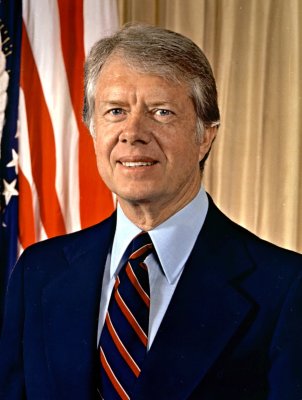
Jimmy Carter

39th President of the United States, 1977–1981; Governor of Georgia 1971–1975

Recorded said elsewhere, not written here
When I was a young boy, [my schoolteacher Julia Coleman] introduced me to Leo Tolstoy's novel, "War and Peace." She interpreted that powerful narrative as a reminder that the simple human attributes of goodness and truth can overcome great power. She also taught us that an individual is not swept along on a tide of inevitability but can influence even the greatest human events.

Oslo City Hall, The Nobel Foundation, 10 December 2002 source ↗

Others on this question

View all 24 →
Winston Churchill Prime Minister of the United Kingdom, 1940–1945 and 1951–1955; Member of Parliament 1900–1964
In history I decided to begin with Gibbon. Someone had told me that my father had read Gibbon with delight; that he knew whole pages of it by heart, and that it had greatly affected his style of speech and writing. So without more ado I set out upon the eight volumes of Dean Milman's edition of Gibbon's Decline and Fall of the Roman Empire . I was immediately dominated both by the story and the style. All through the long glistening middle hours of the Indian day, from when we quitted stables till the evening shadows proclaimed the hour of Polo, I devoured Gibbon. I rode triumphantly through it from end to end and enjoyed it all.
Recorded Chapter of his autobiography, written at Chartwell in 1930, Winston S. Churchill, My Early Life (Thornton Butterworth, 1930), Project Gutenberg Canada, October 1930 source ↗
Keith Black Neurosurgeon; chair of neurosurgery at Cedars-Sinai Medical Center
I remember reading The Making of a Surgeon when I was in probably about the sixth or seventh grade. And that was a book that kind of got me focused, I think, on the career path. And I remember, one thing in there I still remember is that you can always tell you’ve really arrived as a surgeon when the nurses in the hospital ask you to be their physician.
Recorded Academy of Achievement recorded interview, American Academy of Achievement, 4 May 2001 source ↗
Very much so. I went to synagogue regularly. My first education was interpreting the Bible. But I also grew up with German folk songs and stories, which became as much a part of my imagination as the Bible stories. My sense of history came from these stories—I was fascinated with what you might call fairy-tale-shaped history. But from the beginning I felt I belonged to a different people, which wasn’t any problem for me. I made the German landscape, which was very beautiful to me—flowing rivers, mountains, forests, lakes—into a biblical landscape. The valley of sunshine into which we went on school excursions in my imagination became the valley in which David and Goliath fought.
Recorded Lawrence Joseph, Cafés in Greenwich Village, New York, The Paris Review, Issue 122, Spring 1992, 1992 source ↗
John Vervaeke Professor of psychology and cognitive science at the University of Toronto
I picked What Is Ancient Philosophy? by Pierre Hadot. That book, and philosophy as a way of life. And this is where Hadot brings out that philosophy is not primarily about the propositional. It’s not primarily about declarative discourse. Philosophy is a way of life in which you’re training skills, states of mind, perspectives, traits of characters, and those are all the components of virtue.
Recorded Tim Ferriss, The Tim Ferriss Show podcast, 25 February 2023 source ↗

More from Jimmy Carter

View profile →
Question What are you still hoping to finish? Death & what remains
As far as the Carter Center's concerned, I would like to see guinea worm completely eradicated before -- before I die. I'd like for the last guinea worm to die before I do. ... I think right now, we have 11 cases. We started out with 3.6 million cases. And I think we have two cases in South Sudan and one case in Ethiopia and one case in Mali and seven cases in Chad. That's all the guinea worms in the world, and we know where all of them are. So obviously, that would be my top priority.
Recorded Maria Saporta, News conference at the Carter Center, Atlanta, as transcribed by CNN, 20 August 2015 source ↗
Question What became visible only after your working life slowed down or ended? Time & hindsight
I'm the only president that's ever visited Africa south of the Sahara Desert. I went to two (African) countries while I was president, and I didn't know the potential of that continent, nor the challenges that faced those people. Now I do. To a much greater extent I didn't understand the [widespread] problems in our own country, from a personal point of view. I was dealing with billions of dollars that would be allocated for education or health or welfare or housing, or whatever. But I didn't know from a personal point of view the people that actually were in need or that were the recipients of those quite often inadequate and ill-designed programs.
Recorded Academy of Achievement interview, Atlanta, Georgia, 25 October 1991 source ↗
Question Which teacher, parent, coach, or friend most made you who you are, and what did you learn from them? Relationships
My mother in that way I've described. My daddy taught me how much a man could do in dealing directly with a multiplicity of responsibilities. Outside my family, the main person, outside of my father, the main man who has had an influence on my life is Admiral Hyman Rickover. I was one of the two young officers in the program to build atomic submarines. There were two built: the Nautilus and the Sea Wolf. I was in charge of the crew that was helping to build the Sea Wolf and building the nuclear power plant that later became a prototype. Rickover was a man who demanded absolute excellence and total dedication from all those who worked under him. He demanded as much from himself. And so he set a standard of commitment and perfection in life that I had never experienced before. He really had a great impact on my life.
Recorded Academy of Achievement interview source ↗
Question Does the thought of dying frighten you? Death & what remains
At first I - I felt that it was confined to my liver and that they had - the operation had completely removed it. And so I felt quite relieved. And then that same afternoon we had an MRI of my head and neck and it showed up that it was already in four places in my brain. So I would say that night and the next day, until I came back up to Emory, I just thought I had a few weeks left. But I was surprisingly at ease. You know, I've had a wonderful life. I've had thousands of friends and I've had an exciting and adventurous and gratifying existence. So I was surprisingly at ease, much more so than my wife was.
Recorded News conference at the Carter Center, Atlanta, as transcribed by CNN, 20 August 2015 source ↗
Question If you could revise one chapter of your past, what would you change? Failure & regret
I wish I sent one more helicopter to get the hostages and we would have rescued then and I - I would have been re-elected, but that may have - and that may have interfered with the foundation of the Carter Center. And if I had to choose between four more years and the Carter Center, I think I would choose the Carter Center.
Recorded News conference at the Carter Center, Atlanta, as transcribed by CNN, 20 August 2015 source ↗

More on taste & recommendation

Also answered this

George H. W. Bush, Bill Clinton, Alexis Ohanian, Desmond Tutu, Albie Sachs, Rana el Kaliouby

Search the directory for somebody in particular.

Explore further

Report this answer