Skip to content

The question

What do you fear most?

Originally asked

Vanity Fair, to its interview subject, The Proust Questionnaire

The exact prompt is fixed in Vanity Fair's Proust Questionnaire and independently sustained in The Guardian's The Q&A over multiple decades.

You answer as yourself. Nobody on FLAPSS answers as anybody else.

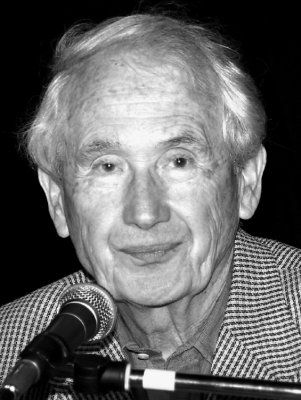
Frank McCourt

Teacher and memoirist; winner of the Pulitzer Prize for Biography or Autobiography

Recorded said elsewhere, not written here
It was desperate because of certain things, ingredients like my father being an alcoholic, my mother having too many babies in too short a time, no work available in Ireland, and even when my father did get a job he drank the wages. Then there was the harsh kind of schooling we had with school masters who ruled with a stick and then because of the overwhelming presence of the church, which imbued us with fear all the time. So it was fear, dampness, poverty, alcoholism, fear of the church, fear of the school masters, fear in general.

Academy of Achievement, Academy of Achievement interview, Washington, D.C., 19 June 1999 source ↗

Others on this question

View all 256 →
Tom Lubbock Art critic
I think that loss of speech, and of understanding of speech, and of understanding of writing, and of coherent writing – these losses will amount to the loss of my mind. I know what this feels like and it has no insides, no internal echo. Mind means talking to oneself. There wouldn't be any secret mind surviving in me.
Recorded The Observer, from the journals he kept between 2008 and 2010, 7 November 2010 source ↗

More from Frank McCourt

View profile →
Question Which writers or artists have most influenced your work? Taste & recommendation
The last teacher I had was a man named O’Halloran. But he was the only one who offered words of encouragement, who told us we were distinct, unique individuals with a right to think for ourselves. And that was just before we left Leamy’s National School. And he told me, “My boy, you are a literary genius.” And you can imagine what I had to put up with at the schoolyard with all the others. “Hey, McCourt, you’re a literary genius. Look at him. Look at the literary genius.
Recorded Academy of Achievement interview, Washington, D.C., 19 June 1999 source ↗
Question What became visible only after your working life slowed down or ended? Time & hindsight
The day I retired from teaching, again, was one of the most satisfying days of my life and it was sad, but when I — the day I retired, I went home and I was by myself and I was having a glass of wine. I was thinking about the lunch the teachers gave me that day. The retirement lunch. And I was able to look back on that life, that 30 years in the classroom, and say — I was able to congratulate myself. I'm glad I did that. That was good. I felt useful, that I don't think I would have felt if I had gone into business or something like that.
Recorded Academy of Achievement interview, Washington, D.C., 19 June 1999 source ↗

More on identity & self

Also answered this

Helen George, Aung San Suu Kyi, Keith McNally, Gayle King, Kevin Rowland, Robert Glenister

Search the directory for somebody in particular.

Explore further

Report this answer