Skip to content

The question

What fills you with the most pride?

Originally asked

Vogue, to one guest at a time, on camera, 73 Questions

Vogue's 73 Questions repeatedly asks respondents to select the work, relationship, or achievement that makes them proudest.

You answer as yourself. Nobody on FLAPSS answers as anybody else.

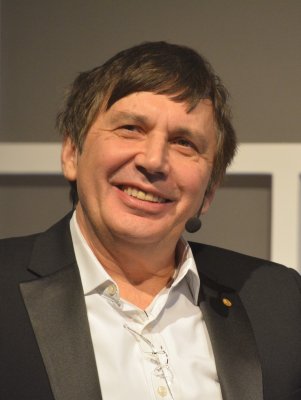
Andre Geim

Condensed matter physicist; Nobel laureate in Physics, 2010

Recorded said elsewhere, not written here
OK, but speaking seriously, I’m actually quite proud of my IgNobel Prize – not because of IgNobel Prize – it’s a more subtle association. Essentially, yeah, IgNobel Prize is given for something which forces people to smile. ... with IgNobel Prize they ask you a few weeks in advance whether you are ready to accept this prize or not. So we considered hard and, at the end, we had courage to accept this IgNobel Prize, yeah. So, I’m proud that I had enough courage to do that and I do not regret accepting it.

Adam Smith, Telephone interview following the announcement of the 2010 Nobel Prize in Physics, The Nobel Prize, 5 October 2010 source ↗

Others on this question

View all 103 →
Javier Zanetti Argentine former footballer; long-serving Inter Milan captain and now the club's vice-president
Yes, I do, and I like to be seen by fans like this. Being a legend for my fans and my family is something I can be proud of, as I had the opportunity to play in World Cups myself, so I knew what the squad were feeling. I have the third highest appearances for Argentina, for whom many very talented footballers have played, so it’s an honour. To me, representing my home country anywhere in the world has been the best feeling.
Recorded SoccerBible interview, 9 June 2023 source ↗
Stellan Skarsgård Swedish actor
I am not a nationalist in any way, and I hate flag waving, and I don’t think much good has come out of nationalism. I am proud of Scandinavia in the sense that we have actually managed to create a very tolerant and human society, which is very livable. They are of course deconstructing it and privatizing everything now, but there has been some achievement up there, in that cold north.
Recorded The Talks interview, 19 September 2012 source ↗
Aaron Ciechanover Biologist and physician; Nobel laureate in chemistry for the discovery of ubiquitin-mediated protein degradation
I cannot tell you even. I have to ask my son and my wife that were with me in the room because I came to say ”hello,” that I’m leaving. And, I was caught in total surprise. It’s wonderful. What can I tell you? Obviously, it’s wonderful. That’s the climax that every scientist can ever dream of. I will not deny that I am proud for me, for this science, for the state of Israel, for my family, for everybody.
Recorded Joanna Rose, Telephone interview following the announcement of the 2004 Nobel Prize in Chemistry, The Nobel Prize, 6 October 2004 source ↗
Bert Sakmann Cell physiologist; Nobel laureate in physiology or medicine for the patch clamp technique
This was an unexpected benefit let’s say. There is a new class of diseases that came up in the last, yes I would say 10 years, they are called channelopathies. This means diseases related to defects in the function of ion channels and all of a sudden ion channels and electrical signals, which we’re not very popular for the general public because it’s somewhat difficult to understand how electrical signal comes about and that we all run on electrical signals but this development of finding channelopathies is quite, you know, rewarding I would say
Recorded Marika Griehsel, 53rd meeting of Nobel Laureates, Lindau, Germany, The Nobel Prize, July 2003 source ↗

More from Andre Geim

View profile →
Question What does everyone in your world seem to agree on that you think is wrong? Values & belief
Instant information about everything and everyone often allows an individual opinion to compete with consensus and paranoia with evidence. It is a time when one blunt honest statement can finish a life-long political career, and one opinionated journalist can bully a government or a royal family. Science is not immune from such pressures. For example, how many Nobel prize-winning experiments – you think – would have been stopped, if ethics or health-and-safety regulations at that time were as zealous as they are today? I can think of more than a few.
Recorded Nobel Banquet, Stockholm City Hall, Nobel Prize Outreach, 10 December 2010 source ↗

More on identity & self

Also answered this

Robert J. Lefkowitz, Mario Molina, Willem Kolff, Robert Ballard, Bert Sakmann, Harold Kroto

Search the directory for somebody in particular.

Explore further

Report this answer