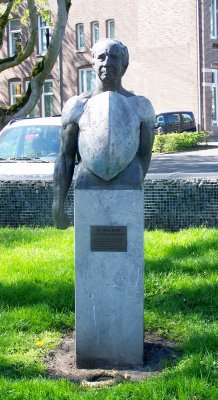
In my early years it was undoubtedly my father. My father was director of a sanatorium for pulmonary tuberculosis, and at that time there were no antibiotics, tuberculosis was a terrible disease. And, he and I would walk in the woods around that sanatorium and he would discuss his worries about his patients. And from him, I certainly inherited this extreme concern about the well-being of patients. I’ve seen him very happy when he succeeded after months and months of rest and other things to have these people go home cured. I’ve also seen him crying and desperate after trying for a long time and a patient did not get well, and went home to die.
Managed profile
Not claimed by Willem Kolff
Willem Kolff has not joined FLAPSS and has not endorsed it. This page is a reference record assembled from published interviews and public remarks. Every answer below is a direct quotation with the source and date shown next to it.
Willem Kolff
Physician and inventor; builder of the first practical artificial kidney
Netherlands · 1911–2009
Science and medicine
About
Dutch physician who built the first practical dialysis machine in occupied Kampen during the Second World War, then moved to the United States, where he worked on the heart-lung machine and the artificial heart at the Cleveland Clinic and the University of Utah.
5 answers
I’ve been mortally opposed to the so-called life-and-death committees that were instituted. When there were many more patients that needed to be dialyzed, and not enough artificial kidneys available, you had the institution of the life-and-death committees. ... Depending on the answer to these questions, he could be dialyzed. Otherwise, he could go to hell. I’ve been mortally opposed to that. When I set up a dialysis center here with a grant from some government agency, I was forced to put in a life-and-death committee, but it never met.
By the way, the guys with very high grades are not necessarily the people that are the most successful in later life. They may be the ones that can regurgitate gracefully, and they get very high grades. But if the guys that have to work for it and do not have such good grades can do something extra, and prove that they can perform, they may have a chance.
When I was this young assistant at the University of Groningen my responsibility was for four beds, or rather the patients in four beds. That was all I had to do. And, one of these patients was a young man, 22 years old, who slowly and miserably died from renal failure. He became blind, he vomited, and it was a miserable death. And I, as a very, very young physician, had to tell his mother, in a black dress and a little white cap like the farmers have, that her only son was going to die. I couldn’t do a damn thing about it. So, I began to think, “If I could just every day remove as much urea as this boy creates, which is about 20 grams, then the boy could live.” Well, he died, but I began to work on that.
No. You see immediately what your next task will be. I’ve been asked all kinds of silly questions, like “Aren’t you proud? Aren’t you this? Aren’t you that?” I have no time for that, because the next project is upon me.
Every quotation above is reproduced from the source shown beside it and has not been edited. Willem Kolff did not write these answers for FLAPSS. Request a correction or removal.