Skip to content
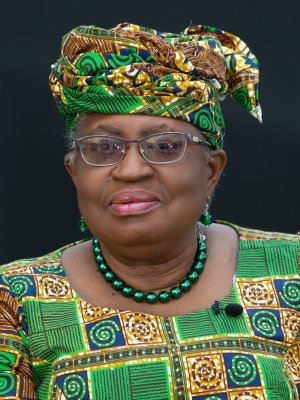
Ngozi Okonjo-Iweala

Director-General of the World Trade Organization from 2021; Finance Minister of Nigeria, 2003–2006 and 2011–2015

Recorded said elsewhere, not written here
What I want to do this morning is share with you a couple of stories and talk about a different Africa. Already this morning there were some allusions to the Africa that you hear about all the time: the Africa of HIV/AIDS, the Africa of malaria, the Africa of poverty, the Africa of conflict, and the Africa of disasters. While it is true that those things are going on, there's an Africa that you don't hear about very much. And sometimes I'm puzzled, and I ask myself why. This is the Africa that is changing, that Chris alluded to. This is the Africa of opportunity. This is the Africa where people want to take charge of their own futures and their own destinies.

TED2007, 3 March 2007 source ↗

Others on this question

View all 80 →
Yves Bonnefoy Poet, essayist and translator
I started reading poetry in primary school—Victor Hugo, the romantics, and the Parnassians—they were part of the curriculum. In my grandfather’s library there were some anthologies of nineteenth-century poetry. Alfred de Vigny impressed me most; indeed I won a competition by reciting Vigny’s “Moses” with an enthusiasm that touched the examiner. In fact this poem and “La Maison du Berger” are among the most beautiful poems in the French language, unfairly neglected today.
Recorded Shusha Guppy, The Paris Review, Issue 131, Summer 1994, 1994 source ↗
Muhammad Yunus Founder of Grameen Bank; Nobel Peace Prize laureate, 2006
To me poor people are like bonsai trees. When you plant the best seed of the tallest tree in a flower-pot, you get a replica of the tallest tree, only inches tall. There is nothing wrong with the seed you planted, only the soil-base that is too inadequate. Poor people are bonsai people. There is nothing wrong in their seeds. Simply, society never gave them the base to grow on.
Recorded Nobel Peace Prize lecture, Oslo City Hall, The Nobel Foundation, 10 December 2006 source ↗
Maryam Mirzakhani Mathematician; Fields Medallist, 2014
However, I should say that the education system in Iran is not the way people might imagine here. As a graduate student at Harvard, I had to explain quite a few times that I was allowed to attend a university as a woman in Iran. While it is true that boys and girls go to separate schools up to high school, this does not prevent them from participating say in the Olympiads or the summer camps.
Recorded Clay Mathematics Institute annual report interview, Clay Mathematics Institute Annual Report 2008, 1 January 2008 source ↗
Amartya Sen Economist and philosopher; laureate of the Sveriges Riksbank Prize in Economic Sciences, 1998
And yet, despite the high moral and ethical quality of social commiseration, political dedication and a deep commitment to equity, there was something rather disturbing about standard leftwing politics of that time: in particular, its scepticism of process-oriented political thinking, including democratic procedures that permit pluralism. The major institutions of democracy got no more credit than what could be portioned out to what was seen as "bourgeois democracy," on the deficiencies of which the critics were most vocal. The power of money in many democratic practices was rightly identified, but the alternatives – including the terrible abuses of non-oppositional politics – did not receive serious critical scrutiny.
Recorded Laureate-written autobiography for Les Prix Nobel, Nobel Prize Outreach, 1 December 1998 source ↗

More from Ngozi Okonjo-Iweala

View profile →
Question What bad recommendations do people in your field repeat too often? Craft & work
And it brings us to the debate that has been going on here: aid versus private sector, aid versus trade, etc. And someone stood up to say that one of the frustrating things is that it's been a simplistic debate. And that's not what the debate should be about. That's engaging in the wrong debate. The issue here is how do we get a partnership that involves government donors, the private sector and ordinary African people taking charge of their own lives? How do we combine all this?
Recorded TEDGlobal 2007, Arusha, 7 June 2007 source ↗

More on values & belief

Also answered this

Daron Acemoglu, Muhammad Yunus, Halla Tómasdóttir, Dan Pallotta, Howard Marks, Warren Buffett

Search the directory for somebody in particular.

Explore further

Report this answer