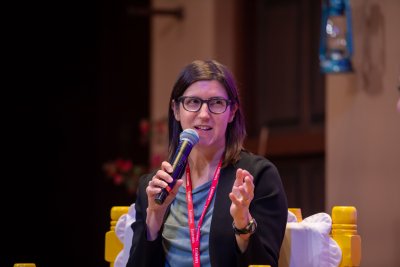
In my own life I think there are times when I’m not in the mood to write, but I don’t consider that to be writer’s block. If I really don’t want to enter my own book in progress, I’ll try to think about why and find a way around that. So I start from the beginning cleaning it up. Almost treat it like it’s a messy room and clean it up. Or if there’s a scene that I don’t want to write because it bums me out, maybe I’ll just work on a different scene and come back to it. Or I’m having trouble writing because I haven’t done enough research. So I go do the research. I try to troubleshoot, or figure out what the underlying reason is.
Managed profile
Not claimed by Curtis Sittenfeld
Curtis Sittenfeld has not joined FLAPSS and has not endorsed it. This page is a reference record assembled from published interviews and public remarks. Every answer below is a direct quotation with the source and date shown next to it.
Curtis Sittenfeld
writer
United States · b. 1975
Arts and letters
About
Elizabeth Curtis Sittenfeld (born August 23, 1975) is an American writer. She is the author of two collections of short stories, You Think it, I’ll Say It (2018) and Show Don't Tell (2025), as well as seven novels: Prep (2005), the story of students at a Massachusetts prep school; The Man of My Dreams (2006), a coming-of-age novel and an examination of romantic love; American Wife (2008), a fictional story loosely based on the life of First Lady Laura Bush; Sisterland (2013), which tells the story of identical twins with psychic powers; Eligible (2016), a modern-day retelling of Pride and Prejudice; Rodham (2020), an alternate history political novel about the life of Hillary Clinton; and Romantic Comedy (2023), a romance between a comedy writer and a pop star.
3 answers
I think that’s an instinct.
At first I’ll think of stuff in my head for a while. The more I think of an idea, the more promising it is— it just naturally occupies space in my brain. Then I start making notes with pen and paper. If it’s a story, it’s more like a moment, or just it’s kind of a more fleeting idea. And if it’s a novel, it’s something that I can see approaching in a lot of different ways, and sticking with for two or three years. I might write a scene or two and just kind of see how it feels. Then I will type an outline. That’s when I really feel like I have a path forward, even though I don’t feel like I have to stick to the outline, but it is very reassuring to me to have it.
Every quotation above is reproduced from the source shown beside it and has not been edited. Curtis Sittenfeld did not write these answers for FLAPSS. Request a correction or removal.