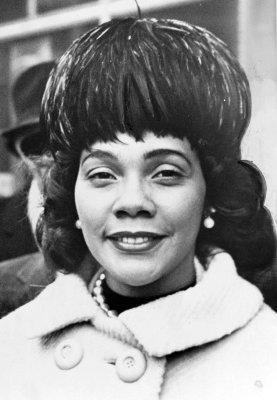
Coretta Scott King

Civil rights leader; founder of the King Center

Recorded said elsewhere, not written here
In high school, I had a teacher who influenced me greatly, Miss Olive J. Williams, and she was versatile in music, and I wanted to be like her. She exposed me to the world of classical music. Before then, I had never heard classical music. She exposed me also to the great composers of the world, as well as black performers, which I didn’t know about at the time: Marian Anderson, Paul Robeson, Roland Hayes and Dorothy Maynor and others.

Academy of Achievement interview source ↗

Others on this question

View all 77 →
Benazir Bhutto Prime Minister of Pakistan, 1988–1990 and 1993–1996
A very important influence. Now when I look back on it, it was my father who was against the gender constraints of my time. And my mother, she used to be a working woman herself, she joined the National Guards. She was a captain in the National Guards. She was the first woman in Karachi to own a car and to drive, and people used to talk about her because they said, you know, “We’re not supposed to drive cars.” But when I look back on it, it was my mother who taught that a woman grew up to be married and to have children, and she would tell my father in front of me, “Why do you want to educate her? No man will want to marry her.” So all the time, for her, success depended on having a good catch as a husband, and having children. Whereas for my father, he broke free of those constraints, and he insisted that I have an education. He said, “Boys and girls are equal. I want my daughter to have the same opportunities.”
Recorded Academy of Achievement interview source ↗
Pete Rozelle Commissioner of the National Football League, 1960–1989
My dad certainly, and coaches I had that I was very close to. They took a big part in my developing an interest in sports, actually. One has passed away I was very close to. His name was Bill Slybaum. He was my coach in junior high school for tennis and then he moved up the ladder academically and went to the high school about the time I got there. He was my high school coach in basketball. I became very close to him. Later on, when I came back after the service, I went to Compton Junior College near Los Angeles, and he was the junior college basketball coach. I was very close to him.
Recorded Academy of Achievement interview source ↗
Mario Molina Atmospheric chemist; Nobel laureate in Chemistry, 1995
I had a number of very good teachers in high school, in fact. Some mathematics teachers that perhaps allowed me the freedom to go beyond the normal routine of the class and to explore some more advanced areas. The same thing happened in college. I was able to communicate with a few of my teachers and professors, and go beyond the normal expectations. And then, as I mentioned before, Professor Pimentel, my mentor for graduate studies, was really influential in terms of the influence that he had for me.
Recorded Academy of Achievement interview, Sun Valley, Idaho, 29 June 1996 source ↗
Akio Toyoda President of Toyota Motor Corporation, 2009–2023; chairman from 2023
Driving 24 hours with rivals at Nürburgring, the world's toughest circuit, presented many more challenges than driving a test course for three years. Naruse always said that ‘Roads make cars.’ The race is punishing, but it forges better machines. Nürburgring is where I learned that ‘the road makes the car.’
Recorded Toyota Times, 31 March 2020 source ↗

More from Coretta Scott King

View profile →
Question What is something you were told by a parent, teacher, or mentor that you still repeat to yourself? Time & hindsight
But I was blessed with parents who taught me not to let anyone make me feel like I wasn’t good enough, and as my mother told me, “You are just as good as anyone else. You get an education and try to be somebody. Then you won’t have to be kicked around by anybody, and you won’t have to depend on anyone for your livelihood, not even a man.”
Recorded Academy of Achievement interview, 12 June 2004 source ↗
Question What is something everyone in your world agrees about that you think is wrong? Values & belief
I never got to the point where I felt that nonviolence was not viable. ... I realized that it wasn’t that it wouldn’t work, it’s that people didn’t follow the proper steps in trying to achieve it because there are a set of principles and there are a set of steps in the methodology that we were taught about nonviolence. And when we follow those they work.
Recorded Academy of Achievement interview, 12 June 2004 source ↗

More on relationships

Also answered this

Jimmy Carter, Wendy Kopp, Bill Clinton, Antonio Villaraigosa, Desmond Tutu, Leon Panetta

Search the directory for somebody in particular.

Explore further

Report this answer