Skip to content
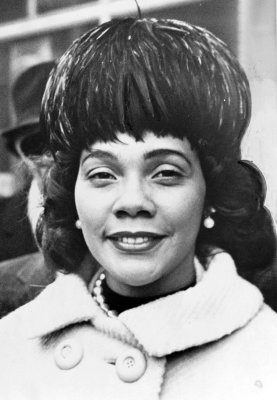
Coretta Scott King

Civil rights leader; founder of the King Center

Recorded said elsewhere, not written here
I never got to the point where I felt that nonviolence was not viable. ... I realized that it wasn’t that it wouldn’t work, it’s that people didn’t follow the proper steps in trying to achieve it because there are a set of principles and there are a set of steps in the methodology that we were taught about nonviolence. And when we follow those they work.

Academy of Achievement interview, 12 June 2004 source ↗

Others on this question

View all 80 →
Frederick Douglass Abolitionist, orator, newspaper editor and U.S. diplomat; U.S. Marshal for the District of Columbia 1877–1881; U.S. Minister Resident to Haiti 1889–1891
I do not think much of the accident or good luck theory of self-made men. It is worth but little attention and has no practical value. An apple carelessly flung into a crowd may hit one person, or it may hit another, or it may hit nobody. The probabilities are precisely the same in this accident theory of self-made men. It divorces a man from his own achievements, contemplates him as a being of chance and leaves him without will, motive, ambition and aspiration. Yet the accident theory is among the most popular theories of individual success.
Recorded Lecture, delivered repeatedly 1859–1893, Teaching American History, reproducing Frederick Douglass Papers, Library of Congress Manuscript Division source ↗
Willem Kolff Physician and inventor; builder of the first practical artificial kidney
I’ve been mortally opposed to the so-called life-and-death committees that were instituted. When there were many more patients that needed to be dialyzed, and not enough artificial kidneys available, you had the institution of the life-and-death committees. ... Depending on the answer to these questions, he could be dialyzed. Otherwise, he could go to hell. I’ve been mortally opposed to that. When I set up a dialysis center here with a grant from some government agency, I was forced to put in a life-and-death committee, but it never met.
Recorded Academy of Achievement recorded interview, American Academy of Achievement source ↗
Ursula K. Le Guin Novelist, poet and essayist
Books aren’t just commodities; the profit motive is often in conflict with the aims of art. We live in capitalism, its power seems inescapable — but then, so did the divine right of kings. Any human power can be resisted and changed by human beings. Resistance and change often begin in art. Very often in our art, the art of words.
Recorded National Book Awards ceremony, New York, 19 November 2014, ursulakleguin.com (the author's own site), 19 November 2014 source ↗
Will Self Novelist, essayist and journalist
You know that sickening feeling of inadequacy and over-exposure you feel when you look upon your own empurpled prose? Relax into the awareness that this ghastly sensation will never, ever leave you, no matter how successful and publicly lauded you become. It is intrinsic to the real business of writing and should be cherished.
Recorded The Guardian Review, 20 February 2010 source ↗

More from Coretta Scott King

View profile →
Question Which teacher, parent, coach, or friend most made you who you are, and what did you learn from them? Relationships
In high school, I had a teacher who influenced me greatly, Miss Olive J. Williams, and she was versatile in music, and I wanted to be like her. She exposed me to the world of classical music. Before then, I had never heard classical music. She exposed me also to the great composers of the world, as well as black performers, which I didn’t know about at the time: Marian Anderson, Paul Robeson, Roland Hayes and Dorothy Maynor and others.
Recorded Academy of Achievement interview source ↗
Question What line from a parent, teacher, or mentor do you still repeat to yourself? Time & hindsight
But I was blessed with parents who taught me not to let anyone make me feel like I wasn’t good enough, and as my mother told me, “You are just as good as anyone else. You get an education and try to be somebody. Then you won’t have to be kicked around by anybody, and you won’t have to depend on anyone for your livelihood, not even a man.”
Recorded Academy of Achievement interview, 12 June 2004 source ↗

More on values & belief

Also answered this

Desmond Tutu, Wangari Maathai, Mohamed ElBaradei, Frederick Douglass, Bill Clinton, Corazon Aquino

Search the directory for somebody in particular.

Explore further

Report this answer