Skip to content
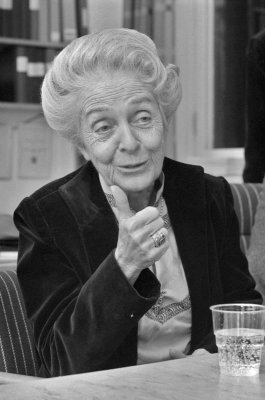
Rita Levi-Montalcini

Neurobiologist; Nobel laureate in Physiology or Medicine, 1986

Recorded said elsewhere, not written here
Ever since adolescence, [my elder sister Anna] has been an enthusiastic admirer of the great Swedish writer, the Nobel Laureate Selma Lagerlöf, and she infected me so much with her enthusiasm that I decided to become a writer and describe Italian saga "à la Lagerlöf". But things were to take a different turn.

Laureate-written autobiography for Les Prix Nobel, Nobel Prize Outreach, 1 December 1986 source ↗

Mentioned in this answer

Others on this question

View all 82 →
Michael Lewis American writer and journalist
Oh, yes. In fact, it’s funny, because I’ve just sent a couple of friends a pair of novels, and one of the novels I’ve sent to a dozen people, and it will seem like a random choice to you, but it’s one of these books that, it’s just a miracle of a book. It’s called The Long Ships , and it’s by a Scandinavian historian. It’s a novel by a Scandinavian historian who only wrote one novel. I think his name is Frans Bengtsson, and he was a Viking historian, and he packed everything he knew about the Vikings into this wonderful comic novel. At the end of it, you feel like you were a Viking for 400 pages. It’s a piece of history that he just brings to life in this story. I hand that out all the time, partly because it is just an incredible pleasurable reading experience, and partly just to illustrate a point that you never know where great books are going to come from. There are lots of examples of people, even very late in life, a book just pops out of them, and it was their one book. The other book, my pandemic reading gift I’ve been giving to people, because it’s a perfect pandemic novel, is Amor Towles’ A Gentleman in Moscow , and it’s about a Russian aristocrat who, during the Revolution, he’s the kind of guy who was supposed to be shot, but because of certain qualities, he isn’t shot. Instead, they lock him up in the Metropol Hotel in Moscow, and he doesn’t leave for the next 50 years. So you were stuck inside this place, and it’s Eloise for Grownups , and just beautifully done, but it makes you, in this moment, it makes you see the possibilities of resourcefulness in a confined space. There are a bunch of books that I give to people, but those are the two that I’ve just recently, in the last week, sent to people.
Recorded Tim Ferriss, The Tim Ferriss Show podcast, 14 May 2020 source ↗
Dax Shepard Actor and film-maker; host of the Armchair Expert podcast
Yeah, there’s a number one. I can’t stop talking about it. I’ve read it three times now. I will read it again soon, is Titan , the Ron Chernow book about
Recorded Tim Ferriss, The Tim Ferriss Show podcast, 19 November 2020 source ↗
Marco Canora American chef
Yeah. At work every year, I kind of give my line cooks and my management team books as gifts around the holidays. So This is Water by David Foster Wallace is one I commonly give because it’s so short and the message is so perfect in my opinion. So I’ve given that a lot. And then for cookbooks, I got to say, the Marcella Hazan Essentials is just, I adore that woman. I adore her simple approach. It is like, she’s the OG of Italian grandma cooking. And so those are the two books.
Recorded Tim Ferriss, The Tim Ferriss Show podcast, 10 November 2021 source ↗
Chris Young Cook and inventor; co-author of Modernist Cuisine, co-founder of ChefSteps
I think a lot of them will probably be in the cooking space. Definitely On Food and Cooking . I’ve gifted that a lot. My career starts with that book in many ways. There wouldn’t be any of this modern cooking movement without Harold’s book, I don’t think. There certainly wouldn’t be modernist cuisine that played a big role in my career without that book. So I’ve gifted that a lot because I think it’s relevant and I think for a certain type of individual, it’s the kind of book that every time you open it up, you see something. You’re like, “I didn’t even know that was there; that’s super cool.” And you read something and go, “The world is way more interesting than I thought.” I think I’ve gifted Michel Bras’s Essential Cuisine quite a bit, although it’s hard to do now because I think it’s out of print in English and quite expensive. The other book I found myself gifting a lot lately is an out-of-print book on thermodynamics called The Second Law . It was written by an Oxford physical chemistry professor named P.W. Atkins. That book is just a phenomenal, casual, infographic-laden read on how the world works from an energy perspective. I found that so incredibly useful in trying to understand how to do something, how to make something work, whether something’s even possible. It’s frequently my bullshit detector. When somebody’s trying to convince me some technology or some idea has merit, I very quickly come back to just sketching out the kind of thing I did for that email, where it’s like, let me just see – with knowing nothing about the subject, if I can just sketch out the basic ideas of how much energy is going to be involved or consumed or if I assume limitless capacities, does this make any sense ever? So many things sound good, but just don’t pass muster as soon as you start looking at the world that way. You’re like, “Well, that’s clearly just a waste of everybody’s time and we should just stop and go do this thing over here,” which at least you’re not having to invent new physics or violate the laws of physics to go do it.
Recorded Tim Ferriss, The Tim Ferriss Show podcast, 4 June 2018 source ↗

More from Rita Levi-Montalcini

View profile →
Question What is the hardest thing that has happened to you, and what did you carry out of it? Failure & regret
The two alternatives left then to us were either to emigrate to the United States, or to pursue some activity that needed neither support nor connection with the outside Aryan world where we lived. My family chose this second alternative. I then decided to build a small research unit at home and installed it in my bedroom. My inspiration was a 1934 article by Viktor Hamburger reporting on the effects of limb extirpation in chick embryos. My project had barely started when Giuseppe Levi, who had escaped from Belgium invaded by Nazis, returned to Turin and joined me, thus becoming, to my great pride, my first and only assistant.
Recorded Laureate-written autobiography for Les Prix Nobel, Nobel Prize Outreach, 1 December 1986 source ↗

More on taste & recommendation

Also answered this

Katalin Karikó, Chris Young, M. Sanjayan, Andrew Weil, Tu Youyou, Amartya Sen

Search the directory for somebody in particular.

Explore further

Report this answer