Skip to content
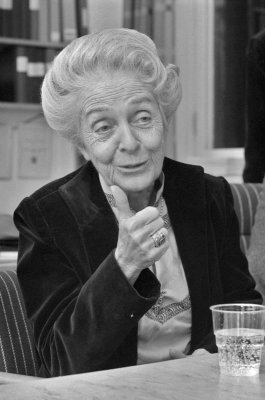
Rita Levi-Montalcini

Neurobiologist; Nobel laureate in Physiology or Medicine, 1986

Recorded said elsewhere, not written here
The two alternatives left then to us were either to emigrate to the United States, or to pursue some activity that needed neither support nor connection with the outside Aryan world where we lived. My family chose this second alternative. I then decided to build a small research unit at home and installed it in my bedroom. My inspiration was a 1934 article by Viktor Hamburger reporting on the effects of limb extirpation in chick embryos. My project had barely started when Giuseppe Levi, who had escaped from Belgium invaded by Nazis, returned to Turin and joined me, thus becoming, to my great pride, my first and only assistant.

Laureate-written autobiography for Les Prix Nobel, Nobel Prize Outreach, 1 December 1986 source ↗

Others on this question

View all 35 →
Oliver Sacks Neurologist and writer
And I spent four years at a boarding school in the country, probably a rather abusive boarding school, and seeing very little of my parents, and that was a very bad time for me. A bad and almost a mad time. ... I think that some sort of trust, and ability for closeness, may have been compromised. And I think I’ve perhaps, to some extent, sort of kept a distance since that time, although this is not a distance I feel with my patients or my students.
Recorded Academy of Achievement recorded interview, American Academy of Achievement, 17 June 2000 source ↗
Christopher Hitchens Essayist, critic and journalist
Deprivation of the ability to speak is more like an attack of impotence, or the amputation of part of the personality. To a great degree, in public and private, I “was” my voice. All the rituals and etiquette of conversation, from clearing the throat in preparation for the telling of an extremely long and taxing joke to (in younger days) trying to make my proposals more persuasive as I sank the tone by a strategic octave of shame, were innate and essential to me. I have never been able to sing, but I could once recite poetry and quote prose and was sometimes even asked to do so.
Recorded Vanity Fair, 9 May 2011 source ↗
Rosa Parks Civil-rights activist
Back in Montgomery during my growing up there, it was completely legally enforced racial segregation, and of course, I struggled against it for a long time. I felt that it was not right to be deprived of freedom when we were living in the Home of the Brave and Land of the Free. Of course, when I refused to stand up, on the orders of the bus driver, for a white passenger to take the seat, and I was not sitting in the front of the bus, as so many people have said, and neither was my feet hurting, as many people have said. But I made up my mind that I would not give in any longer to legally-imposed racial segregation and of course my arrest brought about the protests for more than a year.
Recorded Academy of Achievement interview source ↗
Winston Churchill Prime Minister of the United Kingdom, 1940–1945 and 1951–1955; Member of Parliament 1900–1964
Prisoner of War! That is the least unfortunate kind of prisoner to be, but it is nevertheless a melancholy state. You are in the power of your enemy. You owe your life to his humanity, and your daily bread to his compassion. You must obey his orders, go where he tells you, stay where you are bid, await his pleasure, possess your soul in patience. Meanwhile the war is going on, great events are in progress, fine opportunities for action and adventure are slipping away. Also the days are very long. Hours crawl like paralytic centipedes. Nothing amuses you. Reading is difficult; writing impossible. Life is one long boredom from dawn till slumber. Moreover, the whole atmosphere of prison, even the most easy and best regulated prison, is odious. Companions in this kind of misfortune quarrel about trifles and get the least possible pleasure from each other's society. If you have never been under restraint before and never known what it was to be a captive, you feel a sense of constant humiliation in being confined to a narrow space, fenced in by railings and wire, watched by armed men, and webbed about with a tangle of regulations and restrictions. I certainly hated every minute of my captivity more than I have ever hated any other period in my whole life. ... Therefore in after years, when I was Home Secretary and had all the prisons of England in my charge, I did my utmost consistent with public policy to introduce some sort of variety and indulgence into the life of their inmates, to give to educated minds books to feed on
Recorded Chapter of his autobiography, written at Chartwell in 1930, Winston S. Churchill, My Early Life (Thornton Butterworth, 1930), Project Gutenberg Canada, October 1930 source ↗

More from Rita Levi-Montalcini

View profile →
Question Which book do you recommend most often to others, and what makes you pass it on? Taste & recommendation
Ever since adolescence, [my elder sister Anna] has been an enthusiastic admirer of the great Swedish writer, the Nobel Laureate Selma Lagerlöf, and she infected me so much with her enthusiasm that I decided to become a writer and describe Italian saga "à la Lagerlöf". But things were to take a different turn.
Recorded Laureate-written autobiography for Les Prix Nobel, Nobel Prize Outreach, 1 December 1986 source ↗

More on failure & regret

Also answered this

Oliver Sacks, Tu Youyou, David Oyelowo, Kate Bowler, Sonny Rollins, Clive James

Search the directory for somebody in particular.

Explore further

Report this answer