Skip to content
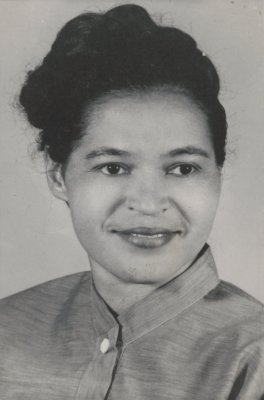
Rosa Parks

Civil-rights activist

Recorded said elsewhere, not written here
Back in Montgomery during my growing up there, it was completely legally enforced racial segregation, and of course, I struggled against it for a long time. I felt that it was not right to be deprived of freedom when we were living in the Home of the Brave and Land of the Free. Of course, when I refused to stand up, on the orders of the bus driver, for a white passenger to take the seat, and I was not sitting in the front of the bus, as so many people have said, and neither was my feet hurting, as many people have said. But I made up my mind that I would not give in any longer to legally-imposed racial segregation and of course my arrest brought about the protests for more than a year.

Academy of Achievement interview source ↗

Others on this question

View all 35 →
Winston Churchill Prime Minister of the United Kingdom, 1940–1945 and 1951–1955; Member of Parliament 1900–1964
Prisoner of War! That is the least unfortunate kind of prisoner to be, but it is nevertheless a melancholy state. You are in the power of your enemy. You owe your life to his humanity, and your daily bread to his compassion. You must obey his orders, go where he tells you, stay where you are bid, await his pleasure, possess your soul in patience. Meanwhile the war is going on, great events are in progress, fine opportunities for action and adventure are slipping away. Also the days are very long. Hours crawl like paralytic centipedes. Nothing amuses you. Reading is difficult; writing impossible. Life is one long boredom from dawn till slumber. Moreover, the whole atmosphere of prison, even the most easy and best regulated prison, is odious. Companions in this kind of misfortune quarrel about trifles and get the least possible pleasure from each other's society. If you have never been under restraint before and never known what it was to be a captive, you feel a sense of constant humiliation in being confined to a narrow space, fenced in by railings and wire, watched by armed men, and webbed about with a tangle of regulations and restrictions. I certainly hated every minute of my captivity more than I have ever hated any other period in my whole life. ... Therefore in after years, when I was Home Secretary and had all the prisons of England in my charge, I did my utmost consistent with public policy to introduce some sort of variety and indulgence into the life of their inmates, to give to educated minds books to feed on
Recorded Chapter of his autobiography, written at Chartwell in 1930, Winston S. Churchill, My Early Life (Thornton Butterworth, 1930), Project Gutenberg Canada, October 1930 source ↗
Roger Ebert Film critic
Thank God I found sobriety. I could sustain myself with my work, my reading, the movies, my friends. And walking, walking, walking. Of all the purposes of education, I think the most useful is this: It prepares you to keep yourself entertained. It gives you a better chance of an interesting job. ... I can't remember the last time I felt bored. I can't eat, drink or talk, and yet I have so many other resources to keep myself entertained. I think I must be a case study.
Recorded Roger Ebert's Journal, rogerebert.com, 6 November 2010 source ↗
When Milton's Satan stood in the pit of hell and raged at heaven, he was merely a trifle miffed compared to how I felt on that day. I felt totally alone, with the world receding away from me in every direction, and you could have used my anger to weld steel. Only my family and the fact I had fans in the medical profession, who were able to give me useful advice, got me through that moment.
Recorded Written for the Alzheimer's Society in 2008; reprinted by the Observer in the week of his death, The Guardian, 2008 source ↗
Ram Dass Spiritual teacher and author
everyone saw me as a victim of a terrible illness. But what happened to my body was far less frightening than what happened to my soul. The stroke wiped out my faith. It took me so far from my guru that I felt my oxygen cord had been cut. ... I couldn't put the two together. Then I thought, maybe the stroke is a form of grace, and I hunted for that: how could the stroke be seen as grace? ... The stroke was giving me lessons, advanced lessons. ... It brought me into my soul, and that's grace.
Recorded Sara Davidson, Keynote talk at a conference on body and soul, Hyatt Regency, San Francisco, reported in the New York Times Magazine, The New York Times Magazine, 21 May 2000 source ↗

More from Rosa Parks

View profile →
Question What side project are you most glad you pursued? Craft & work
We work with young people, from the ages of 11 to 17. Our main program is the Pathways to Freedom. And we’ll be going from Memphis, Tennessee through ten other states, and Washington, DC, and to Canada. It began July 13th and ends August 8th. We hope to take as many young people and their chaperons as possible throughout these areas, and stop and have workshops and programs. They’ll be traveling in buses, and we hope that will inspire and give them a sense of history and also to encourage them to be concerned about their self and history and motivated to reach their highest potential.
Recorded Academy of Achievement interview source ↗
Question Which teacher, parent, coach, or friend most made you who you are, and what did you learn from them? Relationships
My family, I would say, my mother, and my maternal grandparents. I grew up with them. My mother was a teacher in a little school, and she believed in freedom and equality for people, and did not have the notion that we were supposed to live as we did, under legally enforced racial segregation. She didn’t believe in it.
Recorded Academy of Achievement interview source ↗

More on failure & regret

Also answered this

Bill Clinton, Malala Yousafzai, George H. W. Bush, Lynsey Addario, Elie Wiesel, Albie Sachs

Search the directory for somebody in particular.

Explore further

Report this answer