Skip to content
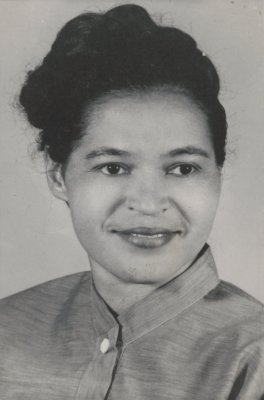
Rosa Parks

Civil-rights activist

Recorded said elsewhere, not written here
The advice I would give any young person is, first of all, to rid themselves of prejudice against other people and to be concerned about what they can do to help others. And of course, to get a good education, and take advantage of the opportunities that they have. In fact, there are more opportunities today than when I was young.

Academy of Achievement recorded interview, American Academy of Achievement, 2 June 1995 source ↗

Others on this question

View all 78 →
Paul Farmer Physician and medical anthropologist; co-founder of Partners In Health
I think a lot of people, when they’re really young, and in their 20s, they are on their own quest for personal efficacy. And I understand that. ... But the sooner that people can discover that it’s really about building teams, and not about personal efficacy, I think the better — the more quickly — we can move forward. I believe that.
Recorded Academy of Achievement recorded interview, American Academy of Achievement, 3 July 2009 source ↗
Ellen Ochoa Electrical engineer and astronaut; director of NASA’s Johnson Space Center, 2013–2018
It’s a very interesting and challenging field! It’s important to study math and science throughout high school and college, and major in some technical area. Take advantage of all of the opportunities that colleges provide, including professor office hours, tutoring, student chapters of organizations like Society of Hispanic Professional Engineers (SHPE) and Society of Physics Students (SPS), and project-based hands-on classes.
Recorded Written interview published by the National Women’s History Museum, 8 August 2018 source ↗
Marina Abramović Performance artist
Spend your time on something meaningful. Not on parties, and not on taking it easy. That’s not good enough. […] When you’re young, you think: Let’s party, do drugs, drink, waste it all, right? But as you get older, you look at what you’ve accomplished. And when you get old, you’ve run out of time. You have to ask yourself: Why am I here? Can I contribute anything to humanity, to society, my work?
Recorded University Post, University of Copenhagen public talk, University Post (uniavisen.dk), University of Copenhagen source ↗
Ellen Johnson Sirleaf President of Liberia, 2006–2018
So I urge my sisters, and my brothers, not to be afraid. Be not afraid to denounce injustice, though you may be outnumbered. Be not afraid to seek peace, even if your voice may be small. Be not afraid to demand peace.
Recorded Oslo City Hall, The Nobel Foundation, 10 December 2011 source ↗

More from Rosa Parks

View profile →
Question What side project are you most glad you pursued? Craft & work
We work with young people, from the ages of 11 to 17. Our main program is the Pathways to Freedom. And we’ll be going from Memphis, Tennessee through ten other states, and Washington, DC, and to Canada. It began July 13th and ends August 8th. We hope to take as many young people and their chaperons as possible throughout these areas, and stop and have workshops and programs. They’ll be traveling in buses, and we hope that will inspire and give them a sense of history and also to encourage them to be concerned about their self and history and motivated to reach their highest potential.
Recorded Academy of Achievement interview source ↗
Question What is the hardest thing that has happened to you, and what did you carry out of it? Failure & regret
Back in Montgomery during my growing up there, it was completely legally enforced racial segregation, and of course, I struggled against it for a long time. I felt that it was not right to be deprived of freedom when we were living in the Home of the Brave and Land of the Free. Of course, when I refused to stand up, on the orders of the bus driver, for a white passenger to take the seat, and I was not sitting in the front of the bus, as so many people have said, and neither was my feet hurting, as many people have said. But I made up my mind that I would not give in any longer to legally-imposed racial segregation and of course my arrest brought about the protests for more than a year.
Recorded Academy of Achievement interview source ↗
Question Which teacher, parent, coach, or friend most made you who you are, and what did you learn from them? Relationships
My family, I would say, my mother, and my maternal grandparents. I grew up with them. My mother was a teacher in a little school, and she believed in freedom and equality for people, and did not have the notion that we were supposed to live as we did, under legally enforced racial segregation. She didn’t believe in it.
Recorded Academy of Achievement interview source ↗

More on time & hindsight

Also answered this

Margaret Thatcher, Wendy Kopp, Andrew Young, Óscar Arias Sánchez, Elie Wiesel, Eleanor Roosevelt

Search the directory for somebody in particular.

Explore further

Report this answer