Skip to content
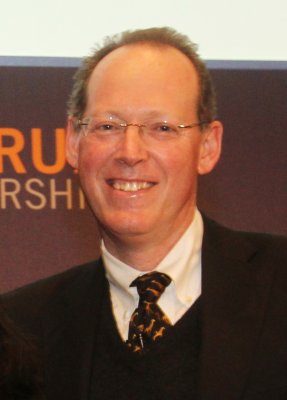
Paul Farmer

Physician and medical anthropologist; co-founder of Partners In Health

Recorded said elsewhere, not written here
I think a lot of people, when they’re really young, and in their 20s, they are on their own quest for personal efficacy. And I understand that. ... But the sooner that people can discover that it’s really about building teams, and not about personal efficacy, I think the better — the more quickly — we can move forward. I believe that.

Academy of Achievement recorded interview, American Academy of Achievement, 3 July 2009 source ↗

Others on this question

View all 78 →
Frank M. Johnson Jr. United States district judge, Middle District of Alabama, 1955–1979; judge of the Eleventh Circuit
Study. Be honest. Don’t violate the laws and get in trouble. Get you a good spouse that will support you, because you never stop working and studying. The fact that you get the place just means you’ve started as far as the work and the pressure is concerned. That’s the only advice I’d know to give.
Recorded Academy of Achievement recorded interview, American Academy of Achievement, 16 March 1991 source ↗
Richard Leakey Palaeoanthropologist and conservationist; head of the Kenya Wildlife Service
It’s very hard to give people advice, because you don’t know their personality. Personality is a big part of that. Everybody is faced with passing opportunities. Many people watch the opportunity come and watch it go. I say, if an opportunity comes and you have got the self-confidence, grab it. Ride it for a bit. If it’s not the right opportunity, do something else, but be positive about opportunities.
Recorded Academy of Achievement recorded interview, American Academy of Achievement, 21 June 2007 source ↗
Marina Abramović Performance artist
Spend your time on something meaningful. Not on parties, and not on taking it easy. That’s not good enough. […] When you’re young, you think: Let’s party, do drugs, drink, waste it all, right? But as you get older, you look at what you’ve accomplished. And when you get old, you’ve run out of time. You have to ask yourself: Why am I here? Can I contribute anything to humanity, to society, my work?
Recorded University Post, University of Copenhagen public talk, University Post (uniavisen.dk), University of Copenhagen source ↗
Grace Hopper United States Navy rear admiral; computer scientist; co-designer of COBOL
Always remember that it's much easier to apologize than to get permission. In this world of computers, the best thing to do is to do it.
Recorded Lake Forest College, Chicago Tribune, 9 December 1982 (via Quote Investigator), 9 December 1982 source ↗

More from Paul Farmer

View profile →
Question What counsel has proved most valuable to you? Time & hindsight
I had lots of teachers encourage me. And I still know some of them, my high school teachers. But one of them encouraged me. She said, “Well, what do you want to do?” I said, “I want to be a doctor.” And she asked me where I wanted to go to school, and so I named all the Florida public universities which seemed within reach, financially. And she said, “Well, maybe you ought to apply to Duke, and maybe you’ll get a scholarship.” And I did both those things. I applied and got a scholarship.
Recorded Academy of Achievement interview, Cape Town, South Africa, 3 July 2009 source ↗
Question How has a setback or failure set you up for later success? Failure & regret
And some of the things that we saw in the ’80s, really, they were failures, because patients died. But they allowed us to diagnose the systems’ problems and say, “This is where we need a community health worker system. This is where we need to make sure patients have food support while they’re getting these medicines,” et cetera. So those are examples of tragedies that certainly lead to — not just personal epiphanies — but collective epiphanies, where you say, “You know what? We can do this better if we have the system fixed.”
Recorded Academy of Achievement recorded interview, American Academy of Achievement, 3 July 2009 source ↗
Question Which teacher, parent, coach, or friend most made you who you are, and what did you learn from them? Relationships
I had lots of teachers encourage me. And I still know some of them, my high school teachers. But one of them encouraged me. She said, “Well, what do you want to do?” I said, “I want to be a doctor.” And she asked me where I wanted to go to school, and so I named all the Florida public universities which seemed within reach, financially. And she said, “Well, maybe you ought to apply to Duke, and maybe you’ll get a scholarship.” And I did both those things. I applied and got a scholarship. Her name is Wendy Tellone, and she’s still involved in public school teaching. I think she’s still in Florida.
Recorded Academy of Achievement interview source ↗

More on time & hindsight

Also answered this

Richard Feynman, George Schaller, Frederick Sanger, Norman Borlaug, Christiane Nüsslein-Volhard, Richard Leakey

Search the directory for somebody in particular.

Explore further

Report this answer