Skip to content

The question

What period or moment in your life brought you the most joy?

Originally asked

The Guardian, to a different person each week, The Q&A

Asked in 52 of the 131 consecutive instalments of The Guardian's The Q&A harvested on 2026-08-29.

You answer as yourself. Nobody on FLAPSS answers as anybody else.

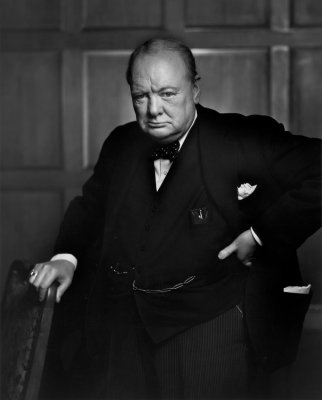
Winston Churchill

Prime Minister of the United Kingdom, 1940–1945 and 1951–1955; Member of Parliament 1900–1964

Recorded said elsewhere, not written here
But the years 1895 to 1900 which are the staple of this story exceed in vividness, variety and exertion anything I have known—except of course the opening months of the Great War. When I look back upon them I cannot but return my sincere thanks to the high gods for the gift of existence. All the days were good and each day better than the other. Ups and downs, risks and journeys, but always the sense of motion, and the illusion of hope.

Chapter of his autobiography, written at Chartwell in 1930, Winston S. Churchill, My Early Life (Thornton Butterworth, 1930), Project Gutenberg Canada, October 1930 source ↗

Others on this question

View all 577 →
Desmond Tutu Anglican Archbishop of Cape Town; chair of South Africa’s Truth and Reconciliation Commission; Nobel Peace Prize, 1984
Well, when in 1994 he was elected and I was given the privilege of introducing him to South Africa as our new president and to the world, I sort of whispered to God and said, “God, I don’t really mind now. I mean, if I die now, it would be almost the perfect moment.
Recorded Academy of Achievement interview source ↗
Escaping an abusive teen marriage and being blessed with the opportunity to create a new life for myself and my two young children in London at the height of the swinging 60s.
Recorded The Q&A, The Guardian, 7 October 2023 source ↗

More from Winston Churchill

View profile →
Question In the last five years, what have you become better at saying no to? Daily life
I hope not too much on them. Well, really, we have to concentrate on the grim emergencies, and when we have solved them, we shall be in a position to deal with the future of the world in a manner to give the best results, and the most lasting results, for the common peoples of all the lands. But one has only a certain amount of life and strength, and only so many hours in the day, and other emergencies press upon us too much to be drawn into those very, very complicated, tangled, and not in all cases attractive jungles.
Recorded An unnamed correspondent at the White House press conference, Joint press conference with President Franklin D. Roosevelt, the White House, The American Presidency Project, 23 December 1941 source ↗
Question What is the hardest thing that has happened to you, and what did you carry out of it? Failure & regret
Prisoner of War! That is the least unfortunate kind of prisoner to be, but it is nevertheless a melancholy state. You are in the power of your enemy. You owe your life to his humanity, and your daily bread to his compassion. You must obey his orders, go where he tells you, stay where you are bid, await his pleasure, possess your soul in patience. Meanwhile the war is going on, great events are in progress, fine opportunities for action and adventure are slipping away. Also the days are very long. Hours crawl like paralytic centipedes. Nothing amuses you. Reading is difficult; writing impossible. Life is one long boredom from dawn till slumber. Moreover, the whole atmosphere of prison, even the most easy and best regulated prison, is odious. Companions in this kind of misfortune quarrel about trifles and get the least possible pleasure from each other's society. If you have never been under restraint before and never known what it was to be a captive, you feel a sense of constant humiliation in being confined to a narrow space, fenced in by railings and wire, watched by armed men, and webbed about with a tangle of regulations and restrictions. I certainly hated every minute of my captivity more than I have ever hated any other period in my whole life. ... Therefore in after years, when I was Home Secretary and had all the prisons of England in my charge, I did my utmost consistent with public policy to introduce some sort of variety and indulgence into the life of their inmates, to give to educated minds books to feed on
Recorded Chapter of his autobiography, written at Chartwell in 1930, Winston S. Churchill, My Early Life (Thornton Butterworth, 1930), Project Gutenberg Canada, October 1930 source ↗
Question What are you best at that nobody watching would notice? Craft & work
Mr. Somervell—a most delightful man, to whom my debt is great—was charged with the duty of teaching the stupidest boys the most disregarded thing—namely, to write mere English. He knew how to do it. He taught it as no one else has ever taught it. Not only did we learn English parsing thoroughly, but we also practised continually English analysis. Mr. Somervell had a system of his own. He took a fairly long sentence and broke it up into its components by means of black, red, blue and green inks. Subject, verb, object: Relative Clauses, Conditional Clauses, Conjunctive and Disjunctive Clauses! Each had its colour and its bracket. It was a kind of drill. We did it almost daily. ... I learned it thoroughly. Thus I got into my bones the essential structure of the ordinary British sentence—which is a noble thing.
Recorded Chapter of his autobiography, written at Chartwell in 1930, Winston S. Churchill, My Early Life (Thornton Butterworth, 1930), Project Gutenberg Canada, October 1930 source ↗
Question How much rewriting or revision do you typically do? Craft & work
First of all, you can correct mistakes much more easily. One sweep of the palette-knife 'lifts' the blood and tears of a morning from the canvas and enables a fresh start to be made; indeed the canvas is all the better for past impressions.
Recorded Essay first published in the Strand Magazine in 1921–22 and collected in Amid These Storms, 1932, Winston S. Churchill, Painting as a Pastime, Project Gutenberg Canada, 1932 source ↗
Question What worries you about getting older? Time & hindsight
One by one the more vigorous sports and exacting games fall away. Exceptional exertions are purchased only by a more pronounced and more prolonged fatigue. Muscles may relax, and feet and hands slow down; the nerve of youth and manhood may become less trusty. But painting is a friend who makes no undue demands, excites to no exhausting pursuits, keeps faithful pace even with feeble steps, and holds her canvas as a screen between us and the envious eyes of Time or the surly advance of Decrepitude. Happy are the painters, for they shall not be lonely.
Recorded Essay first published in the Strand Magazine in 1921–22 and collected in Amid These Storms, 1932, Winston S. Churchill, Painting as a Pastime, Project Gutenberg Canada, 1932 source ↗
Question What makes you want to keep learning? Attention & the world
At this school I was allowed to learn things which interested me: French, History, lots of Poetry by heart, and above all Riding and Swimming. The impression of those years makes a pleasant picture in my mind, in strong contrast to my earlier schoolday memories.
Recorded Chapter of his autobiography, written at Chartwell in 1930, Winston S. Churchill, My Early Life (Thornton Butterworth, 1930), Project Gutenberg Canada, October 1930 source ↗

More on time & hindsight

Also answered this

Rachel Maddow, Caroline Lucas, Clive Myrie, Mike Wallace, Desmond Tutu, Samira Ahmed

Search the directory for somebody in particular.

Explore further

Report this answer