Skip to content

The question

How much rewriting or revision do you typically do?

Originally asked

The Paris Review, to novelists and poets, The Art of Fiction

A recurring Art of Fiction craft question, sometimes asked about daily rewriting and sometimes about the number of drafts.

You answer as yourself. Nobody on FLAPSS answers as anybody else.

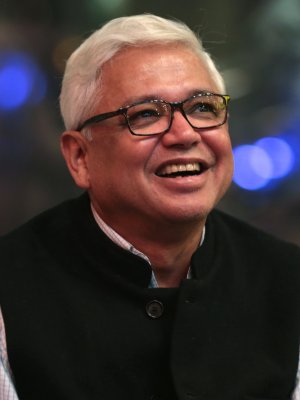
Amitav Ghosh

Writer

Recorded said elsewhere, not written here
All of the above is the answer to that. I mean, I edit what I wrote yesterday before starting writing again today, so that’s the first sort of layer of editing. Then, suppose I have a chapter, then I’ll edit it again and again. Every word I publish has been through 30 edits. My first draft I do with a pencil. I just write freehand with a pencil. I do that for quite a while, and then I write with a pen. I make a draft with a pen. And then I get onto the computer. For me, it would be really kind of crippling if I were to go straight onto a computer. I would just freeze up. I think there’s a lot to be said for trying to find ways of not freezing up, of being able to be loose.

Maddie Crum, The Creative Independent interview, 20 August 2019 source ↗

Others on this question

View all 46 →
I take a break. I need some distance, and then I start getting edits. Generally they’re pretty macro at the beginning. I work with an editor here in Canada and another at FSG. They’re truly brilliant, and they pose the initial questions, again, on a macro scale. They pose, I mull, and then basically re-enter the work and try to… I keep talking about aliveness, but I realize that’s the central point with this book. It’s like I try to preserve the aliveness while engaging with their queries about what can be built out, what might not be as clear to the reader as it is in my head. All of that very subtle, hyper-intelligent work that editors do, the way they inhabit the work and illuminate it for you—it sounds like an act of mercy which on many levels it is.
Recorded Shy Watson, The Creative Independent interview, 26 January 2024 source ↗
Jessica Hopper American writer
There were things that I wanted to add. Things that I wanted to take out. Things I wanted to correct. Things had changed for me as a writer, as an author, as a thinker.
Recorded Caitlin Wolper Phillips, The Creative Independent interview source ↗
I workshopped that first full draft with them and got some feedback and then I set it aside for three months and deliberately didn’t look at it or think about it at all and then came back to it a month ago. I think it’s really crucial for me to get some distance from my writing so that I can then come back to it with fresh eyes and read it as if someone else wrote it and be able to see, from there, the work that’s needed.
Recorded Shy Watson, The Creative Independent interview, 7 March 2023 source ↗
Steve Jobs Co-founder and chief executive of Apple; co-founder of NeXT; chief executive of Pixar
We tried make something much more holistic and simple. When you first start off trying to solve a problem, the first solutions you come up with are very complex, and most people stop there. But if you keep going, and live with the problem and peel more layers of the onion off, you can oftentimes arrive at some very elegant and simple solutions. Most people just don't put in the time or energy to get there.
Recorded Steven Levy, Newsweek interview, 16 October 2006 source ↗

More on craft & work

Also answered this

John Gallaher, Tayi Tibble, Anna Dorn, Wayne Koestenbaum, Lillian Li, Chloe Benjamin

Search the directory for somebody in particular.

Explore further

Report this answer