Skip to content

The question

As a child, what career or life did you imagine for yourself?

Originally asked

The Guardian, to a different person each week, The Q&A

This is a standing question in The Guardian's decades-long The Q&A and also recurs independently in career and life interviews.

You answer as yourself. Nobody on FLAPSS answers as anybody else.

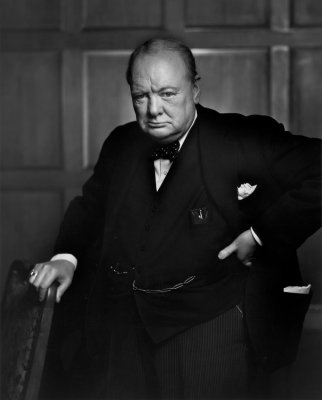
Winston Churchill

Prime Minister of the United Kingdom, 1940–1945 and 1951–1955; Member of Parliament 1900–1964

Recorded said elsewhere, not written here
At the end he asked me if I would like to go into the Army. I thought it would be splendid to command an Army, so I said 'Yes' at once: and immediately I was taken at my word. ... I was told later that he had only come to the conclusion that I was not clever enough to go to the Bar. However that may be, the toy soldiers turned the current of my life.

Chapter of his autobiography, written at Chartwell in 1930, Winston S. Churchill, My Early Life (Thornton Butterworth, 1930), Project Gutenberg Canada, October 1930 source ↗

Others on this question

View all 197 →
Adwoa Aboah British fashion model
I wanted to be a cooker. Not a cook: I wanted to actually be the stove.
Recorded The Guardian, The Q&A, The Guardian, 2 March 2019 source ↗
Martin Freeman English actor
I wanted to be a footballer and then a squash player – I was in with a chance because I was very good. But I fell out of love with that by 14 or 15 and joined a youth theatre.
Recorded The Guardian, The Q&A, The Guardian, 19 January 2019 source ↗

More from Winston Churchill

View profile →
Question What is the hardest thing that has happened to you, and what did you carry out of it? Failure & regret
Prisoner of War! That is the least unfortunate kind of prisoner to be, but it is nevertheless a melancholy state. You are in the power of your enemy. You owe your life to his humanity, and your daily bread to his compassion. You must obey his orders, go where he tells you, stay where you are bid, await his pleasure, possess your soul in patience. Meanwhile the war is going on, great events are in progress, fine opportunities for action and adventure are slipping away. Also the days are very long. Hours crawl like paralytic centipedes. Nothing amuses you. Reading is difficult; writing impossible. Life is one long boredom from dawn till slumber. Moreover, the whole atmosphere of prison, even the most easy and best regulated prison, is odious. Companions in this kind of misfortune quarrel about trifles and get the least possible pleasure from each other's society. If you have never been under restraint before and never known what it was to be a captive, you feel a sense of constant humiliation in being confined to a narrow space, fenced in by railings and wire, watched by armed men, and webbed about with a tangle of regulations and restrictions. I certainly hated every minute of my captivity more than I have ever hated any other period in my whole life. ... Therefore in after years, when I was Home Secretary and had all the prisons of England in my charge, I did my utmost consistent with public policy to introduce some sort of variety and indulgence into the life of their inmates, to give to educated minds books to feed on
Recorded Chapter of his autobiography, written at Chartwell in 1930, Winston S. Churchill, My Early Life (Thornton Butterworth, 1930), Project Gutenberg Canada, October 1930 source ↗
Question What one change would most improve the quality of your daily life? Daily life
The cultivation of a hobby and new forms of interest is therefore a policy of first importance to a public man. But this is not a business that can be undertaken in a day or swiftly improvised by a mere command of the will. The growth of alternative mental interests is a long process. The seeds must be carefully chosen; they must fall on good ground; they must be sedulously tended, if the vivifying fruits are to be at hand when needed. To be really happy and really safe, one ought to have at least two or three hobbies, and they must all be real.
Recorded Essay first published in the Strand Magazine in 1921–22 and collected in Amid These Storms, 1932, Winston S. Churchill, Painting as a Pastime, Project Gutenberg Canada, 1932 source ↗
Question Which thinking habit do you wish you could break? Craft & work
They had large resources of compulsion at their disposal, but I was stubborn. Where my reason, imagination or interest were not engaged, I would not or I could not learn. In all the twelve years I was at school no one ever succeeded in making me write a Latin verse or learn any Greek except the alphabet. I do not at all excuse myself for this foolish neglect of opportunities procured at so much expense by my parents and brought so forcibly to my attention by my Preceptors.
Recorded Chapter of his autobiography, written at Chartwell in 1930, Winston S. Churchill, My Early Life (Thornton Butterworth, 1930), Project Gutenberg Canada, October 1930 source ↗
Question What do you do when you feel creatively stuck? Craft & work
At that moment the loud approaching sound of a motor-car was heard in the drive. From this chariot there stepped swiftly and lightly none other than the gifted wife of Sir John Lavery. 'Painting! But what are you hesitating about? Let me have a brush—the big one.' Splash into the turpentine, wallop into the blue and the white, frantic flourish on the palette—clean no longer—and then several large, fierce strokes and slashes of blue on the absolutely cowering canvas. Anyone could see that it could not hit back. No evil fate avenged the jaunty violence. The canvas grinned in helplessness before me. The spell was broken. The sickly inhibitions rolled away. I seized the largest brush and fell upon my victim with Berserk fury. I have never felt any awe of a canvas since.
Recorded Essay first published in the Strand Magazine in 1921–22 and collected in Amid These Storms, 1932, Winston S. Churchill, Painting as a Pastime, Project Gutenberg Canada, 1932 source ↗
Question What counsel would you give your twenty-year-old self — and what should they ignore? Time & hindsight
Come on now all you young men, all over the world. You are needed more than ever now to fill the gap of a generation shorn by the War. You have not an hour to lose. You must take your places in life's fighting line. Twenty to twenty-five! These are the years! Don't be content with things as they are. 'The earth is yours and the fulness thereof'. Enter upon your inheritance, accept your responsibilities. Raise the glorious flags again, advance them upon the new enemies, who constantly gather upon the front of the human army, and have only to be assaulted to be overthrown. Don't take No for an answer. Never submit to failure.
Recorded Chapter of his autobiography, written at Chartwell in 1930, Winston S. Churchill, My Early Life (Thornton Butterworth, 1930), Project Gutenberg Canada, October 1930 source ↗
Question How much rewriting or revision do you typically do? Craft & work
First of all, you can correct mistakes much more easily. One sweep of the palette-knife 'lifts' the blood and tears of a morning from the canvas and enables a fresh start to be made; indeed the canvas is all the better for past impressions.
Recorded Essay first published in the Strand Magazine in 1921–22 and collected in Amid These Storms, 1932, Winston S. Churchill, Painting as a Pastime, Project Gutenberg Canada, 1932 source ↗

More on identity & self

Also answered this

Gloria Steinem, Clive Myrie, Desmond Tutu, Robert Peston, John Prescott, Emma Barnett

Search the directory for somebody in particular.

Explore further

Report this answer