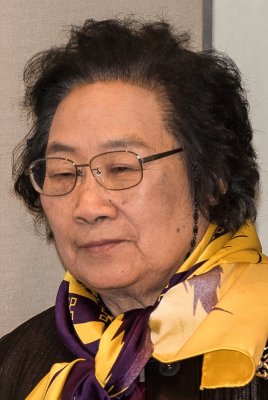
In Ge Hong's A Handbook of Prescriptions for Emergencies (肘后备急方), I noticed one sentence "A handful of Qinghao immersed in two liters of water, wring out the juice and drink it all" (青蒿一握, 以水二升渍, 绞取汁, 尽服之) when Qinghao was mentioned for alleviating malaria fevers. Most herbs were typically boiled in water and made into a decoction before taken by the patients. This unique way of using Qinghao gave me the idea that heating during extraction might have destroyed the active components and the high temperature might need to be avoided in order to preserve the herb's activity.
Tu Youyou has not joined FLAPSS and has not endorsed it. This page is a reference record assembled from published interviews and public remarks. Every answer below is a direct quotation with the source and date shown next to it.
Tu Youyou
Pharmaceutical chemist; Nobel laureate in Physiology or Medicine, 2015
China · b. 1930
Science and medicine
About
Pharmaceutical chemist at the China Academy of Chinese Medical Sciences who isolated artemisinin from sweet wormwood as a treatment for malaria, working on a Chinese government programme begun in 1969. Awarded a share of the 2015 Nobel Prize in Physiology or Medicine, the first Chinese woman to receive a Nobel Prize.
3 answers
Every quotation above is reproduced from the source shown beside it and has not been edited. Tu Youyou did not write these answers for FLAPSS. Request a correction or removal.