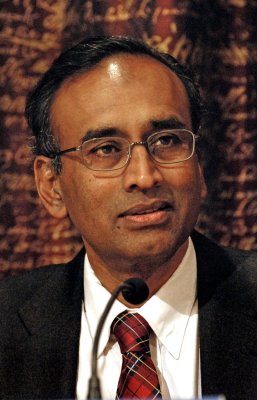
Often, what happens in science is you got a problem and you solve it, and then there’s not much else to do and you have to move on. But the ribosome turned out to be a rather rich gold mine. Perhaps I’m a little intellectually lazy and feel like, “Why should I bother thinking about something else?” Maybe at some point, I should have thought, “I should do something different.”
Managed profile
Not claimed by Venkatraman Ramakrishnan
Venkatraman Ramakrishnan has not joined FLAPSS and has not endorsed it. This page is a reference record assembled from published interviews and public remarks. Every answer below is a direct quotation with the source and date shown next to it.
Venkatraman Ramakrishnan
Structural biologist; Nobel laureate in Chemistry, 2009
India / United Kingdom · b. 1952
Science and medicine
About
Structural biologist at the MRC Laboratory of Molecular Biology in Cambridge. Trained as a theoretical physicist before moving to biology, and shared the 2009 Nobel Prize in Chemistry for studies of the structure and function of the ribosome. Served as President of the Royal Society from 2015 to 2020.
3 answers
Well, I'll be honest with you. I was a theoretical physicist but my Ph.D. work was on a problem that was not particularly interesting to me at the time. And I used to subscribe to Scientific American and I found that there were all these wonderful discoveries happening in biology and I also knew that a number of physicists had gone into biology and been successful. So, I decided to switch.
Recorded
Adam Smith, Telephone interview recorded minutes after the prize announcement, Nobel Prize Outreach, 7 October 2009
source ↗
No, because I started working on ribosomes when I was a post doc, in 1978, when it would have been impossible, really, to solve it. But, it was just a fundamental problem in biology. And we felt, no matter, anything we do to chip away at the problem would be useful. So it was more that that attracted me. And I think the fact that it was large and kind of difficult to come to grips with, yes, it was attractive. Really what was attractive was that it was a fundamental problem.
Recorded
Adam Smith, Telephone interview recorded minutes after the prize announcement, Nobel Prize Outreach, 7 October 2009
source ↗
Every quotation above is reproduced from the source shown beside it and has not been edited. Venkatraman Ramakrishnan did not write these answers for FLAPSS. Request a correction or removal.