Skip to content
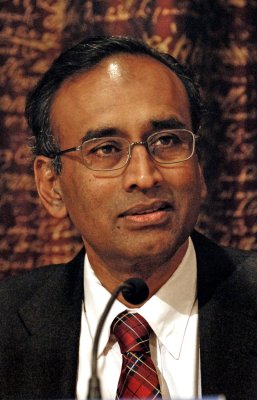
Venkatraman Ramakrishnan

Structural biologist; Nobel laureate in Chemistry, 2009

Recorded said elsewhere, not written here
No, because I started working on ribosomes when I was a post doc, in 1978, when it would have been impossible, really, to solve it. But, it was just a fundamental problem in biology. And we felt, no matter, anything we do to chip away at the problem would be useful. So it was more that that attracted me. And I think the fact that it was large and kind of difficult to come to grips with, yes, it was attractive. Really what was attractive was that it was a fundamental problem.

Adam Smith, Telephone interview recorded minutes after the prize announcement, Nobel Prize Outreach, 7 October 2009 source ↗

Others on this question

View all 42 →
Mario Molina Atmospheric chemist; Nobel laureate in Chemistry, 1995
Sherry offered me a list of research options: the one project that intrigued me the most consisted of finding out the environmental fate of certain very inert industrial chemicals – the chlorofluorocarbons (CFCs) – which had been accumulating in the atmosphere and which at that time were thought to have no significant effects on the environment. This project offered me the opportunity to learn a new field – atmospheric chemistry – about which I knew very little; trying to solve a challenging problem appeared to be an excellent way to plunge into a new research area.
Recorded Laureate-written autobiography, provided by the laureate in November 2007, Nobel Prize Outreach, 1 November 2007 source ↗
Shinya Yamanaka Stem cell biologist; Nobel laureate in Physiology or Medicine, 2012
However, it was very natural that a failed surgeon with little experience in molecular biology had a hard time finding a position. A turning point came when I got a fax from Thomas Innerarity at the Gladstone Institute of Cardiovascular Diseases in San Francisco. After a short telephone conversation, Tom was brave enough to give me a postdoctoral position in his lab! Working at Gladstone was one of the best decisions I ever made in my life.
Recorded Laureate-written autobiography for Les Prix Nobel, Nobel Prize Outreach, 1 December 2012 source ↗
David Vélez Co-founder and chief executive of Nubank
we should invest the majority of our wealth the same way we are investing the majority of our time- by helping to improve people's lives.
Recorded pledge letter, The Giving Pledge, 11 August 2021 source ↗
Svante Pääbo Geneticist; Nobel laureate in Physiology or Medicine, 2022
Well, it is of course a step-by-step process that started back in the 80s. I was struggling to retrieve a little bit of DNA from things that were just a few … starting with just dried tissues that, you know, that were just a few months old, going back in time and struggling with the technological issues with that over a decade. And then it became possible to retrieve DNA from things like the mammoths or cave bears that lived at a similar time as the Neanderthals. And then I was very lucky to get a job in Germany, where of course Neanderthals is a big presence in our, in the imagination of people, so it was then very, an obvious next step, in a way, to try to do that.
Recorded Adam Smith, Telephone interview recorded shortly after the prize announcement, Nobel Prize Outreach, 3 October 2022 source ↗

More from Venkatraman Ramakrishnan

View profile →
Question Which thinking habit do you wish you could break? Craft & work
Often, what happens in science is you got a problem and you solve it, and then there’s not much else to do and you have to move on. But the ribosome turned out to be a rather rich gold mine. Perhaps I’m a little intellectually lazy and feel like, “Why should I bother thinking about something else?” Maybe at some point, I should have thought, “I should do something different.”
Recorded Academy of Achievement interview source ↗
Question How has a setback or failure set you up for later success? Failure & regret
Well, I'll be honest with you. I was a theoretical physicist but my Ph.D. work was on a problem that was not particularly interesting to me at the time. And I used to subscribe to Scientific American and I found that there were all these wonderful discoveries happening in biology and I also knew that a number of physicists had gone into biology and been successful. So, I decided to switch.
Recorded Adam Smith, Telephone interview recorded minutes after the prize announcement, Nobel Prize Outreach, 7 October 2009 source ↗

More on money & investment

Also answered this

Jocelyn Bell Burnell, Emmanuelle Charpentier, Elizabeth Iro, Richard Feynman, Ahmed Zewail, Daniel Kahneman

Search the directory for somebody in particular.

Explore further

Report this answer