Skip to content
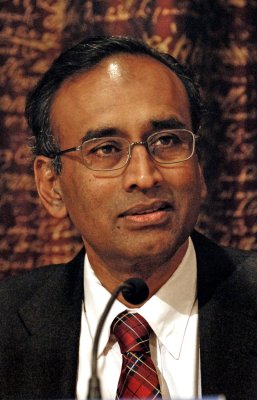
Venkatraman Ramakrishnan

Structural biologist; Nobel laureate in Chemistry, 2009

Recorded said elsewhere, not written here
Well, I'll be honest with you. I was a theoretical physicist but my Ph.D. work was on a problem that was not particularly interesting to me at the time. And I used to subscribe to Scientific American and I found that there were all these wonderful discoveries happening in biology and I also knew that a number of physicists had gone into biology and been successful. So, I decided to switch.

Adam Smith, Telephone interview recorded minutes after the prize announcement, Nobel Prize Outreach, 7 October 2009 source ↗

Others on this question

View all 69 →
Christiane Nüsslein-Volhard Developmental biologist; Nobel laureate in Physiology or Medicine, 1995
As I was lazy and rarely did my homework, I finished high school with a rather mediocre exam. I almost did not pass in English language. Recently, my previous teachers allowed me to see their report on my high school performances, which included the following statements: Despite the fact that her talents are rather equally spread among many areas of knowledge, her performances are rather different depending on the distribution of her interests. Thus, with her strong display of self will she can be decidedly lazy in some topics over years, while in her areas of interests she performs to a degree far extending that required for normal school purposes.
Recorded Laureate-written autobiography for Les Prix Nobel, Nobel Prize Outreach, 1 December 1995 source ↗
Richard Leakey Palaeoanthropologist and conservationist; head of the Kenya Wildlife Service
So Cambridge rejected me. Quite rightly, although at the time I thought it was a little churlish. So, I had to do it without any university training. ... and I began to realize that there were probably a lot more of these things, and that if you find these things, you get a position in the ladder which you can’t get to unless you have either got an education or something else. So by finding important things, you immediately get into the game, which you’d been excluded from otherwise.
Recorded Academy of Achievement recorded interview, American Academy of Achievement, 21 June 2007 source ↗
Warren Buffett Chairman and chief executive of Berkshire Hathaway, 1970–2025
My first mistake, of course, was in buying control of Berkshire. Though I knew its business - textile manufacturing - to be unpromising, I was enticed to buy because the price looked cheap. Stock purchases of that kind had proved reasonably rewarding in my early years, though by the time Berkshire came along in 1965 I was becoming aware that the strategy was not ideal. If you buy a stock at a sufficiently low price, there will usually be some hiccup in the fortunes of the business that gives you a chance to unload at a decent profit, even though the long-term performance of the business may be terrible. I call this the "cigar butt" approach to investing. A cigar butt found on the street that has only one puff left in it may not offer much of a smoke, but the "bargain purchase" will make that puff all profit. Unless you are a liquidator, that kind of approach to buying businesses is foolish.
Recorded Berkshire Hathaway annual shareholder letter, Berkshire Hathaway Inc., 2 March 1990 source ↗
Carlos Slim Helú Businessman and investor; chairman of Grupo Carso and América Móvil
Well yes, but like I said, small mistakes or small failures. We take small failures very often. We have failures in investment. We have failures in operation, but no big mistakes or big failures. How do we take that? Like ordinary business.
Recorded Academy of Achievement interview, 2 December 2007 source ↗

More from Venkatraman Ramakrishnan

View profile →
Question What is one of the best investments you have made — of money, time, or energy? Money & investment
No, because I started working on ribosomes when I was a post doc, in 1978, when it would have been impossible, really, to solve it. But, it was just a fundamental problem in biology. And we felt, no matter, anything we do to chip away at the problem would be useful. So it was more that that attracted me. And I think the fact that it was large and kind of difficult to come to grips with, yes, it was attractive. Really what was attractive was that it was a fundamental problem.
Recorded Adam Smith, Telephone interview recorded minutes after the prize announcement, Nobel Prize Outreach, 7 October 2009 source ↗
Question Which thinking habit do you wish you could break? Craft & work
Often, what happens in science is you got a problem and you solve it, and then there’s not much else to do and you have to move on. But the ribosome turned out to be a rather rich gold mine. Perhaps I’m a little intellectually lazy and feel like, “Why should I bother thinking about something else?” Maybe at some point, I should have thought, “I should do something different.”
Recorded Academy of Achievement interview source ↗

More on failure & regret

Also answered this

Frederick Sanger, Norman Borlaug, Jocelyn Bell Burnell, Richard Feynman, Tasuku Honjo, Peter Doherty

Search the directory for somebody in particular.

Explore further

Report this answer