Skip to content
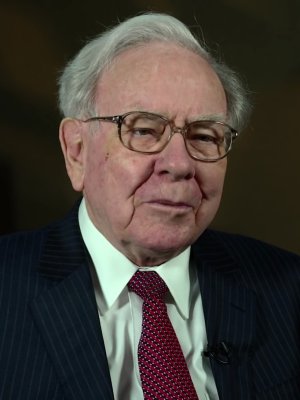
Warren Buffett

Chairman and chief executive of Berkshire Hathaway, 1970–2025

Recorded said elsewhere, not written here
My first mistake, of course, was in buying control of Berkshire. Though I knew its business - textile manufacturing - to be unpromising, I was enticed to buy because the price looked cheap. Stock purchases of that kind had proved reasonably rewarding in my early years, though by the time Berkshire came along in 1965 I was becoming aware that the strategy was not ideal. If you buy a stock at a sufficiently low price, there will usually be some hiccup in the fortunes of the business that gives you a chance to unload at a decent profit, even though the long-term performance of the business may be terrible. I call this the "cigar butt" approach to investing. A cigar butt found on the street that has only one puff left in it may not offer much of a smoke, but the "bargain purchase" will make that puff all profit. Unless you are a liquidator, that kind of approach to buying businesses is foolish.

Berkshire Hathaway annual shareholder letter, Berkshire Hathaway Inc., 2 March 1990 source ↗

Others on this question

View all 69 →
George Lucas Filmmaker; creator of Star Wars and founder of Lucasfilm
Whenever you’re making a movie, especially when you’re writing, you always have self-doubts. I did the first location shooting in Tunisia.
Recorded Academy of Achievement, Academy of Achievement interview, Skywalker Ranch, California, 1 June 1999 source ↗
Mohamed ElBaradei Director General of the International Atomic Energy Agency, 1997-2009; Nobel Peace Prize 2005
Unfortunately, in the case of Iraq, I believe we could have done that through an inspection process. I was calling for a few months more to complete our work. We hadn’t seen indications of weapons of mass destruction. We hadn’t seen indications of nuclear weapons. ... Unfortunately, it didn’t work that way. There was faulty intelligence. There were lots of other considerations that made a decision to go to war tempting, to get rid of Saddam Hussein.
Recorded Academy of Achievement interview, 2006 source ↗
Daniel Ek Co-founder and former chief executive of Spotify
It was like switching out the engines mid-flight. I remember the day we turned on this free service, had we probably gone on for about six more months, I think we might have died as a company. That was a defining moment and that was as late as 2013. I think every great company has at least three near-death experiences.
Recorded Slush conference, Helsinki, Music Ally, 30 November 2016 source ↗
Sheryl Sandberg Former chief operating officer of Facebook; founder of LeanIn.org
Day one of my first job out of college, my boss found out that I didn't know how to enter data into Lotus 1-2-3. That's a spreadsheet—ask your parents. His mouth dropped open and he said, ‘I can't believe you got this job without knowing that”—and then walked out of the room. I went home convinced that I was going to be fired. I thought I was terrible at everything… but it turns out I was only terrible at spreadsheets.
Recorded University of California, Berkeley Commencement, Los Angeles Times, 14 May 2016 source ↗

More from Warren Buffett

View profile →
Question Which thinking habit do you wish you could break? Craft & work
Ironically, though, this is also the purchase in which I made my biggest mistake - of a kind, however, never recognized on financial statements. We paid $600 million in 1989 for Gillette preferred shares that were convertible into 48 million (split-adjusted) common shares. Taking an alternative route with the $600 million, I probably could have purchased 60 million shares of common from the company. The market on the common was then about $10.50, and given that this would have been a huge private placement carrying important restrictions, I probably could have bought the stock at a discount of at least 5%. I can't be sure about this, but it's likely that Gillette's management would have been just as happy to have Berkshire opt for common. But I was far too clever to do that.
Recorded His letter to Berkshire Hathaway shareholders in the 1995 annual report, Berkshire Hathaway Inc., February 1996 source ↗
Question What bad recommendations do people in your field repeat too often? Craft & work
Most investors, of course, have not made the study of business prospects a priority in their lives. If wise, they will conclude that they do not know enough about specific businesses to predict their future earning power. I have good news for these non-professionals: The typical investor doesn't need this skill. ... The goal of the non-professional should not be to pick winners – neither he nor his "helpers" can do that – but should rather be to own a cross-section of businesses that in aggregate are bound to do well. A low-cost S&P 500 index fund will achieve this goal.
Recorded Berkshire Hathaway annual shareholder letter, Berkshire Hathaway Inc., 28 February 2014 source ↗
Question What worries you about getting older? Time & hindsight
I go in every day to the office. I don't accomplish hardly anything. I mean, in terms of – it just takes me way longer to do things. And Greg is so good. It was kind of embarrassing how good he is, because he has covered – you know, we've got about 200 businesses within Berkshire, you know, that came about, and I can't name the manager's names or their wives names, or – and I haven't seen them, you know, in a long time. It's easier just to write the letter once a year and kind of do my own thing. Greg covers more ground in a day than I would in a week, even when I was at my peak, let alone my present condition.
Recorded Becky Quick, CNBC “Squawk Box”, recorded in Omaha; CNBC's own transcript of its own broadcast, 31 March 2026 source ↗
Question What are you unwilling to optimise? Values & belief
Charlie and I decided long ago that in an investment lifetime it's just too hard to make hundreds of smart decisions. That judgment became ever more compelling as Berkshire's capital mushroomed and the universe of investments that could significantly affect our results shrank dramatically. Therefore, we adopted a strategy that required our being smart - and not too smart at that - only a very few times. Indeed, we'll now settle for one good idea a year. (Charlie says it's my turn.)
Recorded His letter to Berkshire Hathaway shareholders in the 1993 annual report, Berkshire Hathaway Inc., February 1994 source ↗
Question What has life taught you about being human? Values & belief
Well, I won't say what I thought about them, particularly related to Bill Gates, but I would say it's astounding to me how human people are. I mean, it, here you had a guy that was a convicted guy, a sensational con man, and the percentage of people that he knocked off. I mean, whether it was, he found their weakness, it might have been sex. It might be power, it might be, whatever it might be.
Recorded Becky Quick, CNBC “Squawk Box”, recorded in Omaha; CNBC's own transcript of its own broadcast, 31 March 2026 source ↗
Question What lesson has mattered most in your life? Time & hindsight
The number one rule I give them is just not give them the golden rule. Do unto others, I'm not a religious guy, but, I mean, nobody said it any better in a couple thousand years than that, which may be why it's lasted to a certain degree too. I mean, more people are reading a 2000-year-old book about how to behave than anything that anybody's coming up with lately. Now it's got a lot of, particularly the Old Testament, it's got different kinds of stories, to some extent, but if the whole world lived by the golden rule, it would be such a more wonderful society.
Recorded Becky Quick, Interview at the 2026 Berkshire Hathaway annual meeting; CNBC's own transcript of its own broadcast, 2 May 2026 source ↗

More on failure & regret

Also answered this

Derek Sivers, Carlos Slim Helú, Charlie Munger, Larry Ellison, Frederick W. Smith, Jensen Huang

Search the directory for somebody in particular.

Explore further

Report this answer