Skip to content
Nobu Matsuhisa

Chef and restaurateur

Recorded said elsewhere, not written here
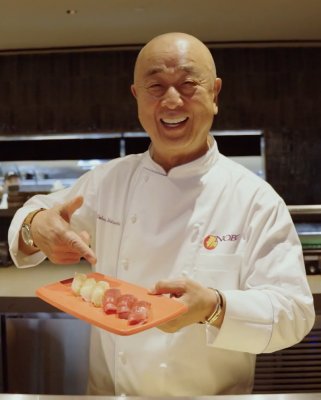
My training took seven years. I didn’t learn how to make sushi for the first three years. I only got two days off a month, and slept on the restaurant floor. But I loved the job. I’d go to the fish market every morning. I got to open the restaurant and see the customers. I’d watch my mentor making sushi and would copy him under the table, practising with my fingers.

The Observer / The Guardian, 12 April 2025 source ↗

Others on this question

View all 42 →
Indra Nooyi Chief executive of PepsiCo, 2006–2018
So I decided I was going to invest my time. I spent Monday through Thursday at Frito-Lay, commuting from New York to Texas. Then Friday, Saturday and Sunday, I did my regular job in New York. It was an incredible commitment of time but it was an amazing developmental experience. It was challenging, broadening, and helped me reach the position I have today.
Recorded Wake Forest University commencement, 2011 source ↗
Demis Hassabis Co-founder and chief executive of Google DeepMind; Nobel laureate in Chemistry
I think chess — actually, a number of things that I learned when I was young — it wasn't so much the chess itself; it was the skills that you were training while you were playing chess. So problem-solving, imagination, creative thinking, strategic thinking, all of these things — if you play chess to a high level, what you're really honing is those meta-skills. And I realized from quite young, that's one of the reasons I liked chess was this is a great practice for me to get good — sort of like a mental gym, if you like — to get really good at those other skills, which you could then translate to all sorts of other subjects like science or business.
Recorded Academy of Achievement interview, 2017 source ↗
Shinya Yamanaka Stem cell biologist; Nobel laureate in Physiology or Medicine, 2012
However, it was very natural that a failed surgeon with little experience in molecular biology had a hard time finding a position. A turning point came when I got a fax from Thomas Innerarity at the Gladstone Institute of Cardiovascular Diseases in San Francisco. After a short telephone conversation, Tom was brave enough to give me a postdoctoral position in his lab! Working at Gladstone was one of the best decisions I ever made in my life.
Recorded Laureate-written autobiography for Les Prix Nobel, Nobel Prize Outreach, 1 December 2012 source ↗
Ahmed Zewail Chemist; Nobel laureate in Chemistry, 1999
My science family came from all over the world, and members were of varied backgrounds, cultures, and abilities. The diversity in this "small world" I worked in daily provided the most stimulating environment, with many challenges and much optimism. Over the years, my research group has had close to 150 graduate students, postdoctoral fellows, and visiting associates. Many of them are now in leading academic, industrial and governmental positions. Working with such minds in a village of science has been the most rewarding experience – Caltech was the right place for me.
Recorded Laureate-written autobiography for Les Prix Nobel, Nobel Prize Outreach, 1 December 1999 source ↗

More from Nobu Matsuhisa

View profile →
Question What is the hardest thing that has happened to you, and what did you carry out of it? Failure & regret
I moved to Argentina, then back to Tokyo and then to Anchorage, in Alaska, where I ran a restaurant. After 50 days the restaurant burnt down – an electrical fire. I lost my dream. I lost my money. I lost my passion. I thought about suicide, but thinking of my family and my kids made me realise I had to wake up.
Recorded The Observer / The Guardian, 12 April 2025 source ↗

More on money & investment

Also answered this

Yaa Gyasi, Mellody Hobson, Óscar Arias Sánchez, Venkatraman Ramakrishnan, Lewis Hamilton, Aung San Suu Kyi

Search the directory for somebody in particular.

Explore further

Report this answer