Skip to content

The question

Do you rely more on inspiration or discipline to make your work?

Originally asked

The Creative Independent, to working artists, its interview series

A repeated Creative Independent tension, asked as inspiration, muse, discipline, ritual, or the requirement to show up.

You answer as yourself. Nobody on FLAPSS answers as anybody else.

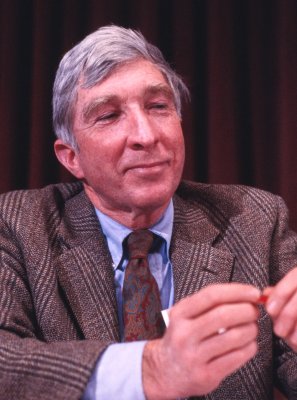
John Updike

Novelist, poet and critic; twice winner of the Pulitzer Prize for Fiction

Recorded said elsewhere, not written here
Right. It saves you from giving up. This present novel that will be out — Villages — I several times thought it might be a bad idea and kind of abandoned it. So, it was really the habit — the habit of writing that kept me at it in the end. It was like a bad marriage. I mean, whatever. This is the wife I’m married to here, and I’m going to finish this book. Finishing it becomes the only way to get rid of it. So yes, it’s good to have a certain doggedness to your technique.

Academy of Achievement interview, Chicago, Illinois, 12 June 2004 source ↗

Others on this question

View all 27 →
László Krasznahorkai Novelist; Nobel laureate in literature
The bitterness. I am very sad if I think of the status of the world now. This is my deepest inspiration. This could be also an inspiration for the next generation or generations in literature. Inspiration to give something for the next generation, somehow to survive this time because these are very, very dark times and we need much more power in us to survive this time than before.
Recorded Nobel Prize telephone interview with Jenny Rydén, published by Nobel Prize Outreach, The Nobel Prize, 9 October 2025 source ↗
Danny Elfman Film composer and songwriter; founder of Oingo Boingo
Well, the reason I’ve survived for this long is because any film composer that has an extended career learns to work within deadlines. The deadline becomes the motivating factor in the same way that a pro athlete can do these incredible things with two seconds left in the game. It forces them into their best mode. For film composers, the clock does get us into a higher gear.
Recorded The Talks, published interview, 12 August 2022 source ↗
Tiler Peck Principal dancer, New York City Ballet; choreographer
Well, you’re right, I think the hard work definitely paid off. My grandmother drove me three hours to dance and three hours back from age six to age 11. I would do my school work in the car on the way there and then get home at like 11 o’clock at night, five days a week for many years. My training was seriously intense, and nothing came easy. I worked for everything I’ve ever been given.
Recorded The Talks, published interview, 6 July 2022 source ↗
Edward O. Wilson, Ph.D. Biologist and entomologist; founder of the field of sociobiology
Yes, that’s right. I saw what I could succeed in. I never considered myself very bright, and I always thought of myself as mathematically mediocre. So I figured that probably, like your college runner who has difficulty breaking a ten-second hundred — well, breaking an 11-second, shall we say, 100-meter — realizes that their best shot is to rely less on strength and speed and more on self-discipline, planning, and long hard work. Yes. That’s the way I do science.
Recorded Academy of Achievement interview, Cambridge, Massachusetts, 5 April 2001 source ↗

More from John Updike

View profile →

More on craft & work

Also answered this

Carlos Fuentes, Arlo Parks, Suzan-Lori Parks, László Krasznahorkai, Gore Vidal, Athol Fugard

Search the directory for somebody in particular.

Explore further

Report this answer