Skip to content
Tony Elumelu

Chairman of Heirs Holdings and of the United Bank for Africa

Recorded said elsewhere, not written here
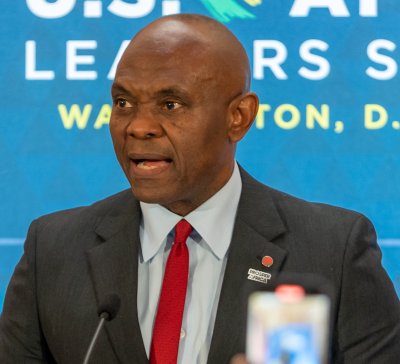
I will start by stating the obvious. No one here questions whether development is desirable. No one questions the inherent need to save lives and help others by giving. However, I believe that we need to rethink the ways in which we help others. We need to give from the perspective of empowering the recipient, instead of making them dependent on us.

Georgetown University, Washington DC, The Tony Elumelu Foundation, 12 May 2015 source ↗

Others on this question

View all 80 →
John Hopfield American scientist
I’d read some of the things that Don Glaser wrote, for example, and they’re imaginative physics, they’re not quite such good biology. There was a consensus that said you had to be able to reach out from physics and get to some of these things you’d like to, but then you have to know enough about the biology that the whole thing makes sense. And you really have to present things in such a way that a community develops. I didn’t realize that at the time, but certainly one of the important things of what I did had to do with enabling people who came from physics, or who came from biology, become a community, working on not just one little problem or piece, but somehow collectively working together toward trying to get an understanding.
Recorded Adam Smith, Telephone interview recorded shortly after the prize announcement, Nobel Prize Outreach, 1 October 2024 source ↗
Some people think that anti-Semitism didn’t really exist in Germany until 1933. I certainly don’t want to take anything away from Hitler’s guilt, but the anti-Semitism I grew up with predated Hitler. We were called names. We had stones thrown at us. And, yes, this created real sorrow. We defended ourselves as well as we could. Funny thing, the common name we were called was Isaac—the way Muslims are called Ali or Mohammed. They’d call out, Isaac, go back to Palestine, leave our home, go to your place. They threw stones at us and shouted, Go to Palestine. Then in Palestine we were told to leave Palestine—history juxtaposed can be very ironic.
Recorded Lawrence Joseph, Cafés in Greenwich Village, New York, The Paris Review, Issue 122, Spring 1992, 1992 source ↗
Jessye Norman Operatic soprano and recitalist
I went to the opera practically every night. I went to something practically every night, just learning and seeing and absorbing, and what I noticed is that there were singers that were only sort of slightly older than I whose voices sounded as though they were many decades older than that, and didn’t sound pretty, and I needed to understand what was happening. I mean there were singers that were 28 or 30 years old or something, and I would speak to them afterwards to say, “Was your voice tired tonight? Tell me what’s happening,” because I didn’t understand it. Their voices should have sounded fresh and blooming and wonderful, but instead they sounded different, and it was because they were singing a different opera every night, and singing whatever was offered, and I didn’t understand and needed to understand — because no one was telling me these things — why they just didn’t say no. Why didn’t they just say, “Oh no, I don’t think I should.”
Recorded Academy of Achievement (achievement.org) source ↗
Wisława Szymborska Poet and essayist; Nobel laureate in Literature, 1996
But my answer is this: inspiration is not the exclusive privilege of poets or artists generally. There is, has been, and will always be a certain group of people whom inspiration visits. It’s made up of all those who’ve consciously chosen their calling and do their job with love and imagination. It may include doctors, teachers, gardeners – and I could list a hundred more professions. Their work becomes one continuous adventure as long as they manage to keep discovering new challenges in it. Difficulties and setbacks never quell their curiosity. A swarm of new questions emerges from every problem they solve. Whatever inspiration is, it’s born from a continuous “I don’t know.”
Recorded Swedish Academy, Stockholm, 7 December 1996, The Nobel Foundation (nobelprize.org), 7 December 1996 source ↗

More on values & belief

Also answered this

Ngozi Okonjo-Iweala, Charlie Munger, Daron Acemoglu, Satya Nadella, John C. Bogle, Jacqueline Novogratz

Search the directory for somebody in particular.

Explore further

Report this answer