Skip to content
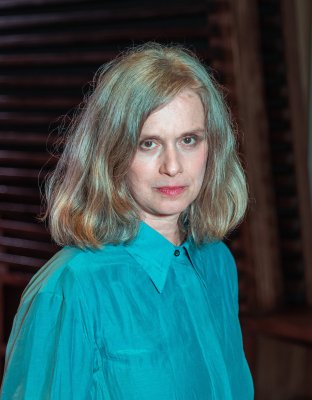
Juana Molina

Singer, songwriter and former television comedian

Recorded said elsewhere, not written here
I have a problem with my ears. I really have a problem. When I was living in the city, I threatened people because of some noise they were making that was bothering me. It sounds psychotic, I know. Once it was a beep from a fax that I heard in the night, very far away. I went to every floor, to every neighbor, putting my ear to the door, until I discovered where the sound was coming from. Then I would tell them, “You have a fax machine that’s making this sound and it’s driving me crazy.” “You’re four floors away from me—how can you hear that?” they said. “You’re crazy, you’re a hysterical woman.” Whatever, call me whatever you want, but I hear it, and I can’t sleep because of it.

Josh Kun, Conducted by telephone, The Believer, Issue 35, 5 April 2006 source ↗

Others on this question

View all 31 →
Will Self Novelist, essayist and journalist
Always carry a notebook. And I mean always. The short-term memory only retains information for three minutes; unless it is committed to paper you can lose an idea for ever.
Recorded The Guardian Review, 20 February 2010 source ↗
Aung San Suu Kyi Leader of the National League for Democracy; Nobel Peace Prize laureate; State Counsellor of Myanmar, 2016–2021
Long years ago, sometimes it seems many lives ago, I was at Oxford listening to the radio programme Desert Island Discs with my young son Alexander. It was a well-known programme (for all I know it still continues) on which famous people from all walks of life were invited to talk about the eight discs, the one book beside the bible and the complete works of Shakespeare, and the one luxury item they would wish to have with them were they to be marooned on a desert island.
Recorded Oslo City Hall, The Nobel Foundation, 16 June 2012 source ↗
Rafael Nadal Spanish professional tennis player, 2001–2024
If I don't do that with the bottles, then I sit down, I could be thinking of something else. If I do always the same things, it means that I am focused and I'm alert to think purely about tennis.
Recorded Jon Wertheim, 60 Minutes, CBS, CBS News / 60 Minutes, 5 July 2020 source ↗
Richard Feynman Theoretical physicist; Nobel laureate in Physics, 1965
one of my diseases, one of my things in life, is that anything that is secret I try to undo. And so the locks to those filing cabinets represented a challenge to me. How the hell to open them? So I worked and worked on them. There are all kinds of stories about how you can feel the numbers and listen to things and so on. That's true; I understand it very well - for old- 19 fashioned safes. But these had a new design so that nothing would be pushing against the wheels while you were trying them, and none of the old methods would work. I read books by locksmiths, which always say in the beginning how they opened the locks when the safe is under water and the woman in it is drowning or some-thing, and the great locksmith opened the safe. And then in the back they tell you how they do it, and they don't tell you anything sensible. It doesn't sound like they could really open safes that way — like guess the combination on the basis of the psychology of the person who owns it! So I always figured they were keeping the method a secret, and like a kind of disease, I kept working on these things until I found out a few things. First, I found out how big a range you need to open the combination, how close you have to be. And then I invented a system by which you could try all the necessary combinations - 8,000, as it turned out, because the woman DROWNING عزه Books are always telling how the great locksmith opens the safe under water when the woman in it is drowning. 20 you could be within two of every number. And then I worked out a scheme by which I could try numbers without altering a number that I had already set, by correctly moving the wheels, so that I could try all the combinations in eight hours. And then finally I discovered (this took me about two years of researching) that it's easy to take the last two numbers of the combination off the safe if the safe is open. If the drawer was pulled out, you could turn the number and see the bolt go up and play around and find out what number it comes back at, and stuff like that. With a little trickery, you can get the combination off. So I used to practice it like a cardsharp practices cards, you know - all the time. Quicker and quicker and more and more unobtrusively I would come in and talk to some guy. I'd sort of lean against his filing cabinet, and you wouldn't even notice I'm doing any-thing. I'm not doing anything— just playing with the dial, that's all, just playing with the dial. But all the time I was taking the two numbers off! And then I would go back to my office and write the two numbers down, the last two numbers of the three. Now, if you have the last two numbers, it takes just a minute to try for the first number; there's only 20 possibilities, and it's open. OK? It takes about three minutes to open a safe if you know the last two numbers. So I got an excellent reputation for safe-cracking.
Recorded Engineering and Science / Caltech Magazine, 1976 source ↗

More from Juana Molina

View profile →
Question What made you stop something you were known for, and how did you know it was time? Time & hindsight
No, I think they were two totally different careers, because when I was acting, I was always impersonating different people, so it was never me—it was never myself. When I started to sing, I suddenly felt naked. I mean, I knew that was going to happen, because that’s the reason why I couldn’t do it before—when I was a teenager, I just couldn’t play in front of anyone at all—it was impossible, my hands started to shake, my voice was gone, and I was so self-conscious of what people would think about what I was doing. Because I didn’t know how to play songs that anybody knew—all I knew how to play were my own songs, and so I had this feeling of having my own chords and my own things that weren’t—I was afraid of being judged as doing nonsense music. But then maybe what the acting did to me was that I got more courage to do what I really wanted to do, even though I had all these fears that were still inside me.
Recorded Josh Kun, Conducted by telephone, The Believer, Issue 35, 5 April 2006 source ↗
Question In the last five years, what new belief, behaviour, or habit has most improved your life? Daily life
Yeah, I remember exactly that—I was in San Francisco, playing at a beautiful venue, and the siren of an ambulance came through, and it fit so well with the song that I started to play more to draw it out. I like to play in more noisy places so that I can take advantage of all the sounds helping me to build new things. But the one I remember the most is that siren in that venue. Sometimes I’ll play in venues where they’ll have coffee machines or milkshake machines—all these noises that I hated maybe five years ago—I love them now.
Recorded Josh Kun, Conducted by telephone, The Believer, Issue 35, 5 April 2006 source ↗

More on daily life

Also answered this

Ryuichi Sakamoto, Brian Eno, Alice Waters, Richard Feynman, Jocelyn Bell Burnell, Rafael Nadal

Search the directory for somebody in particular.

Explore further

Report this answer