Skip to content

The question

How does a new piece of work usually begin for you?

Originally asked

The Paris Review, to novelists and poets, The Art of Fiction

A recurrent craft question in The Paris Review's Art of Fiction interviews; wording varies between character, theme, first sentence, image, and idea.

You answer as yourself. Nobody on FLAPSS answers as anybody else.

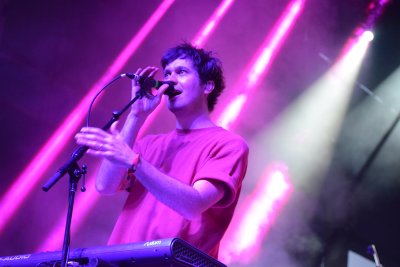
Ernest Greene

musician, visual artist

Recorded said elsewhere, not written here
That’s tough. At this point, with both visual art and music, I’ve done it enough where it’s very much this flow state where I’m not really thinking about any technical stuff. I’m just putting one thing down, and that leads to the next thing, and then you’re off to the races. There’s very little rationalization or any real plan, especially at the very beginning of the project. It’s literally just trying things to see where I can end up. As an album project starts shaping up, there’s a handful of songs or maybe…there’s some parameters in place, and you’re working within that.

Max Freedman, The Creative Independent interview, 27 September 2024 source ↗

Others on this question

View all 60 →
For every painting, I first use the one-quarter inch masking tape to create the grid, dividing the surface across equally. There are four stages of taping. It begins with taping one layer on the whole canvas vertically, then proceeds the same horizontally. The next thing is to apply the selected color with a small brush, then remove the tape. Repeat this same process on the unpainted squares one more time vertically, then horizontally, then apply the last layer of colors. What I love is the degrees of surprise every time; to take each layer of tape off the canvas is to reveal new worlds of optical symphony.
Recorded Phong H. Bui, The Brooklyn Rail, In Conversation, 1 December 2023 source ↗
Ja’Tovia Gary visual artist and filmmaker
When I start a project, it’s a kind of investigation and curiosity at the beginning. I’m basically culling materials. I’m gathering. A lot of the work takes on a collage aesthetic. So I am thinking through an idea and then gathering all of the supporting documents. In some ways it’s essayistic. I’m attempting to put forth an idea or a thesis. There are assertions that are being made, and what can I use visually, whether it is 16 millimeter film from the past or things that I shoot myself, whether it’s interview that I go out and get, whether it’s me painting on film and creating some sort of abstraction that alludes to or gestures towards the assertion. It’s playtime at the beginning. It’s almost like a very active brainstorming that requires me to go out and find materials as well as make notes, as well as look at footage as well as read. It’s investigative curiosity at the beginning, this phase of questioning and garnering. And at the end it’s instinctual. It’s a sweet spot. There have been times where I’ve gone out and presented something thinking that it’s done and then brought it back. I’ve gotten audience reactions, brought it back, turned it up a little bit, and then it was done. Sometimes my finishing process requires me to see it with a large group of people.
Recorded Pola Pucheta, The Creative Independent interview, 14 May 2024 source ↗
Jóhann Jóhannsson Icelandic musician and composer
It’s different every time. The physical or mental acts of composing are always kind of the same. It really involves, for me, turning off the more critical faculties of the brain and reaching a state where things just flow. It takes many days to get into that because normally you’re in this critical mode, this analytical mode where you’re structuring things and putting things in order. To create the material, to create the building blocks, you have to go into another state, which is much more receptive and much more intuitive.
Recorded The Talks interview, 21 October 2015 source ↗
Agathe Snow French artist
It’s funny. Before, it used to be that I’d travel somewhere. I always had a storyline, some kind of grounding element. I used to go somewhere and just take over a space and go find things and find elements. That was how I used to do it. But since I had Cyrus I’ve had to do things only in the studio and shift it, so it’s very different for me now. I’m constantly writing in my book and coming up with things, mostly from things I read. I have all these ideas and I just write them and then some make it out. Most of them don’t. I was reading [Jorge Luis] Borges’ Labyrinths about six months ago. That really spoke to me, and that’s when I started doing the [painting series titled] Endless Sunsets. It’s like a labyrinth, something you can never get out of and there’s really no point in it, a brain maze kind of thing.
Recorded Annie Bielski, The Creative Independent interview source ↗

More on craft & work

Also answered this

Thomas Mars, Jason Williamson, Buck Meek, Black Belt Eagle Scout, Haley Blais, Danny Elfman

Search the directory for somebody in particular.

Explore further

Report this answer