Skip to content
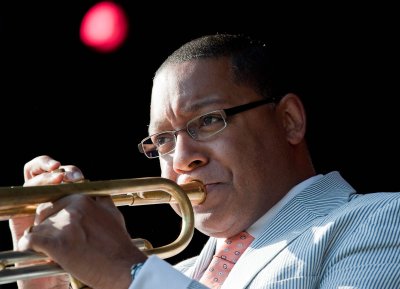
Wynton Marsalis

Trumpeter and composer; artistic director of Jazz at Lincoln Center

Recorded said elsewhere, not written here
Well, I am always trying to study, and when I came to New York, I was fortunate enough to meet Stanley Crouch, who is a writer. He had tremendous influence on me intellectually, because he had like a million books in his apartment, and a thousand records. So when I met him and saw all the records and books and stuff, and he didn’t graduate from college either, he just would voraciously read books. Every time I’d see him, he’d be talking about, “Hey, check this book out.” And I didn’t know any of that stuff, and I felt stupid when I was around him. And he knew more about the music than I did. I was 17 or 18, and he’d be saying “Well what about this record?” Him and also Albert Murray, who was Stanley Crouch’s mentor. Albert Murray has written the greatest books on jazz, Stomping the Blues, which is on blues, but it is one of the greatest books written about the poetics of jazz music, what the musician should be trying to do. And from having the opportunity to be around Stanley and Albert Murray, Stanley much more than Albert Murray, because I’m always too embarrassed to be around him, because he knows so much I always feel like I’m just in the way. But it really made me develop my intellectual curiosity, and Al Murray would give me books to read, and tell me where to go, and tell me about an important exhibit in town, “Go check this out.” I talk to Stanley almost every day. We never talk about just anything, it’s always something definite: “Did you check out this new Romare Bearden book that they put out?” He keeps me on a certain level of intellectual engagement. And always understand that you have to constantly work to develop your intellect, and just increase your curiosity.

Academy of Achievement interview source ↗

Others on this question

View all 57 →
Julius Erving Basketball player; ABA and NBA champion
There are three teachers who are still involved in my life. Ray Wilson — who is my office manager, and who was a teacher in my high school, as well as my basketball coach in high school — is very much involved in my life, and is a real father figure for me. A gentleman named Earl Mosley, who never specifically taught me, but was always there, and was a role model for me, was a coach when I was a freshman. And then a guy named Charles McIlwaine, who is a teacher and a coach. In my high school years those three really stood out, really helped to become part of the support group that’s necessary when you’re experiencing all types of physical changes and mental changes, to help to explain things, and put them in the proper perspective.
Recorded Academy of Achievement interview source ↗
Rita Dove Poet; Poet Laureate of the United States, 1993-1995; Pulitzer Prize for Poetry 1987
Well, I had a couple. I had a couple teachers who did inspire me. One was this eleventh grade English teacher — eleventh and twelfth grade. She and I, we still have tea together sometimes today. I was frightened before I went into her class. I heard she was a battle axe. I heard that she would flunk you if you split an infinitive. And it’s true. She would, but she also would tell you what a split infinitive was, and then once you knew, you never did it again. She just opened up to me, how language — how the written word — can also sing. And she spent, I remember once, 45 minutes on one page: the first page of a novel. By the end of the class, no one had taken down a single note, because we were absolutely enthralled. It was incredible.
Recorded Academy of Achievement interview source ↗
Christiane Nüsslein-Volhard Developmental biologist; Nobel laureate in Physiology or Medicine, 1995
we had a wonderful education because my parents were so practical … Christiane Nüsslein-Volhard: Yes I mean, I have a strong likeness of culture and also I mean my grandmother was a painter and we do music in the family quite a lot and I think that’s very important. What was also important, I thought about that recently, also maybe as a follow-up of an interview but I was asked what my parents did and so on and looking at my brothers and sisters, we had a wonderful education because my parents were so practical, they did books themselves and we did a lot of handicrafts and I knew how to knit and sew and cook and we learnt a lot to do things ourselves, to make things ourselves so we all have some dexterity in doing things ourselves and this is also very important for Science
Recorded Marika Griehsel, Interview at the 53rd Lindau Nobel Laureate Meeting, 30 June–4 July 2003, Nobel Prize Outreach, 1 July 2003 source ↗
Benjamin Carson Paediatric neurosurgeon; director of paediatric neurosurgery at Johns Hopkins, 1984-2013
I definitely had some teachers who were important. My fifth grade science teacher, Mr. Jake, was really the first teacher to express confidence in my academic abilities because I was the only person who could identify a rock, which was obsidian and it was because of the reading that I had been doing because after I got through with the animal books, I went to plants, and when I finished all the plant books, I went to rocks because we lived on the railroad tracks and there were a lot of rocks, so I became an expert in geology, and this was while I was still a dummy in the class. So, it was like the first time that I had an opportunity to raise my hand and demonstrate my knowledge because nobody else knew the answer. Everybody was absolutely flabbergasted, but Mr. Jake said to me, “Benjamin, that’s incredible.” He said, “Why don’t you come by the laboratory after school and we can talk about starting a rock collection for you.” And, from there I started going to the laboratory every day, getting involved with feeding the squirrel, a red squirrel named Maynard. There was a tarantula, crayfish, a Jack Dempsey fish and I got involved in all this stuff. There was a microscope and I started looking at water specimens and learned all about paramecium and volvox and amoebas, and it was just incredible. That really was what started me on my way.
Recorded Academy of Achievement interview source ↗

More from Wynton Marsalis

View profile →
Question What fills you with the most pride? Identity & self
I’m the most proud when I get something from cities, or people. At first I was against awards, you know. I would always say, “This is so fake. The people who vote on this stuff, they never listen to the music.” But for me it’s when I received awards or something from the city. Just to go to somebody’s house and eat. Or people come and say, “We spent our anniversary checking you out,” or “We were making love to one of your records, and we had a child!” See that kind of stuff makes me feel good. Like you get a key to the city and the people are really into it. Not just, “Oh, let’s give him the key to the city because he got some publicity.” It will be some people you knew, and you were there at their school, and you worked in the community.
Recorded Academy of Achievement interview, New York, New York, 8 January 1991 source ↗

More on relationships

Also answered this

Francis Ford Coppola, Nora Ephron, James Earl Jones, James Cameron, Henry R. Kravis, Maya Angelou

Search the directory for somebody in particular.

Explore further

Report this answer