Skip to content
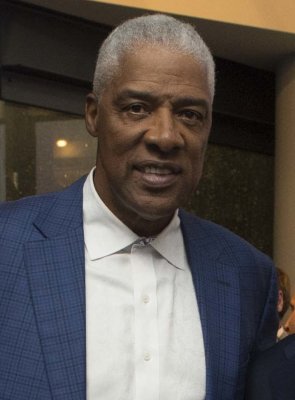
Julius Erving

Basketball player; ABA and NBA champion

Recorded said elsewhere, not written here
There are three teachers who are still involved in my life. Ray Wilson — who is my office manager, and who was a teacher in my high school, as well as my basketball coach in high school — is very much involved in my life, and is a real father figure for me. A gentleman named Earl Mosley, who never specifically taught me, but was always there, and was a role model for me, was a coach when I was a freshman. And then a guy named Charles McIlwaine, who is a teacher and a coach. In my high school years those three really stood out, really helped to become part of the support group that’s necessary when you’re experiencing all types of physical changes and mental changes, to help to explain things, and put them in the proper perspective.

Academy of Achievement interview source ↗

Others on this question

View all 57 →
Wole Soyinka Playwright, poet and novelist; Nobel laureate in Literature, 1986
The early influence in my life I think was my father. That’s the earliest influence. He and his circle of friends. Usually, in our society, children are supposed to be neither seen nor heard. When elders are around, they’re supposed to very respectfully leave them alone. But I was curious. I just loved their debates. They used to get excited over issues, and so somehow I was allowed to eavesdrop, unlike the other children. And I picked up some of the ideas that they had, and I would ask questions. I was known as the questioner. Afterwards, I would ask questions, and my father would indulge me by trying to explain things to me. So that’s one of the reasons I consider him the earliest influence. And also, he had a small library, and I used to go into his library and try and read the books which I found there. Later on, as my circle of adult acquaintances increased, I think the next influence on me was my uncle, the Reverend I.O. Ransome-Kuti, who was another very erudite person, a great educationist. I used to visit them in Igbein, where he lived with his wife and they ran a school. So on weekends sometimes I would go there. And of course it was the usual story. I wanted to listen to them discussing and so on. Don’t misunderstand me. I was also very playful. I loved disappearing by myself, climbing trees, all that I did. But additionally, I was just fascinated by the whole discourse. Exchange of ideas between adults just used to fascinate me for some reason. I was never tired of listening to them. So my uncle was my next great influence.
Recorded Academy of Achievement interview source ↗
James Cameron Filmmaker and deep-sea explorer
There was. The critical moment for me was in the 11th grade. My biology teacher, Mr. McKenzie, decided that what our school needed was a theater arts program and we didn’t have it. There was wrestling, basketball, football, it was a very jock oriented school and there was no theater program whatsoever. So we started a theater program from scratch. We bootstrapped it. He taught it, and I think he might have done it for nothing. We had to build the props and the scenery and the costumes and do everything ourselves. We had to turn the stage into a proper working stage. It took a year, but we started putting on our own productions. I think that was really a pivotal moment. My biology teacher was our muse at that time. And I think the fact that we were having to do everything, that it wasn’t handed to us, may have created a kind of a work ethic that paid off then in independent film production because it’s the same thing. You know, you’re finding scraps and bits and pieces, and putting it all together and putting on a show. And it’s that sense of being able to create some moment of glory, some showmanship — out of nothing, out of baling wire — that is maybe a lesson that was learned there as a result of this man who just decided to have a theater arts program.
Recorded Academy of Achievement interview source ↗
Khaled Hosseini Afghan-American novelist
I had really good teachers in high school. Probably I connected the best with an English teacher that I had my junior year in high school, Miss Sanchez, Jan Sanchez — God bless her. I’m still in touch with her, had lunch a couple of years ago, and we email each other and still exchange, recommend books to each other: “What novel are you reading lately? I read this book — you want to read this.” That kind of thing. But she really was the first time — I remember it was in her class that I read The Grapes of Wrath , which was the first time I had read a novel in English where I felt like I got it at the time. I had the, I felt really connected to the writer and to the story. I told her how much I loved that book and what it meant to me, and I think I saw part of my own family, and a lot of the Afghans in that story — people who would, they become uprooted and homeless and kind of drifting around trying to find a new home. So Jan Sanchez was probably my favorite teacher in high school, and although I never shared with her any of my writing, she came to one of my book readings as a surprise. I hadn’t seen her in over two decades, and she showed up, and she goes, “Remember me?” Obviously, I knew immediately who she was, and it made me so proud that she had read my book and she had loved it. I felt like I had done good. You know, when your teacher comes up to you, even if you are middle-aged and have your own family, having your teacher come up to you and pat you on the back is still a pretty special feeling.
Recorded Academy of Achievement interview source ↗
Francis Ford Coppola Film director, producer and screenwriter; director of The Godfather and Apocalypse Now
I had a number of very strong personalities in my family. My father was a concert flutist, the solo flute for Toscanini. That was an unusual profession for a kid to have as his father. He would dress up in a tuxedo. A concert musician has to practice a lot, and my earliest memories are of that. He was a great musician, very knowledgeable, and he used to tell us the stories of the operas, and all about the composers. He had a lot of knowledge, and he would make a point of telling us about it. I had an older brother who was five years older than me. He was a very successful student, a very handsome kid. Having an older brother by that many years was really an edge that I had. I had an older brother who would protect me. He was a very sensitive and talented boy, and he became interested in literature. So at the same time that I had all this information from my father, I also had a brother who was giving me books at a young age that I would not normally have run into. Brave New World, of course, which was fun, because it was sort of science fiction. As a kid, he was showing me books by James Joyce, and André Gide. So I was really stimulated at a younger age than I normally would have been exposed to that kind of thing.
Recorded Academy of Achievement interview source ↗

More from Julius Erving

View profile →
Question What became visible only after your working life slowed down or ended? Time & hindsight
No two weeks have been the same since I retired. Since this is my fifth year out of professional basketball, I'm at a point where I want to evaluate and make a decision whether I want more consistency and continuity, or I want things to continue in that mode. This is a transitional time.
Recorded Academy of Achievement interview, Las Vegas, Nevada, 26 June 1992 source ↗
Question What fills you with the most pride? Identity & self
Being respected, because I have to deal with this each and every day of my life. Each and every day of my life, when I go to a public place, someone might recognize me, or might not, that doesn’t make or break my day. The thing that I walk in expecting is that, whether they recognize me or not, I’m going to be treated with respect.
Recorded Academy of Achievement interview, Las Vegas, Nevada, 26 June 1992 source ↗

More on relationships

Also answered this

Herschel Walker, Arnold Palmer, Pete Rozelle, Mike Krzyzewski, Willie Mays, Peyton Manning

Search the directory for somebody in particular.

Explore further

Report this answer