My dad certainly, and coaches I had that I was very close to. They took a big part in my developing an interest in sports, actually. One has passed away I was very close to. His name was Bill Slybaum. He was my coach in junior high school for tennis and then he moved up the ladder academically and went to the high school about the time I got there. He was my high school coach in basketball. I became very close to him. Later on, when I came back after the service, I went to Compton Junior College near Los Angeles, and he was the junior college basketball coach. I was very close to him.
Managed profile
Not claimed by Pete Rozelle
Pete Rozelle has not joined FLAPSS and has not endorsed it. This page is a reference record assembled from published interviews and public remarks. Every answer below is a direct quotation with the source and date shown next to it.
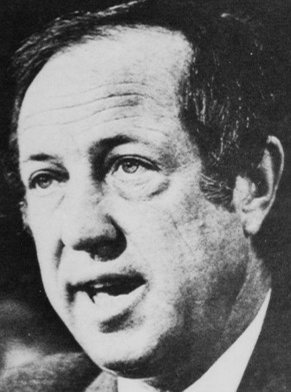
Pete Rozelle
Commissioner of the National Football League, 1960–1989
United States
Sport
23 answers
No, I wanted to be sports editor of the Los Angeles Times. That was my goal.
It was basically writing. I loved watching sports and writing about them. So I was sports editor of the school paper and I worked weekends at the Long Beach Press Telegram, near my home in southern California. Just primarily an interest in sports, then from that developed the athletic publicity work that I did in school.
It was a very simple thing. It was a church camp, I think. I was there about two or three days, very young, and I just remember some counselor telling us that reputation is what people think you are, and your character is what you are. So if you have a bad reputation, you might as well have a bad character, and it pays to have a good reputation and a good character.
reputation is what people think you are, and your character is what you are.
Because of my love for sports, and the nature of my job, it was pretty intense for 30 years, and you have to be sure. I would take it home. My wife would know when things were tight, and she would hear me get up in the night, and walk around and sit and think. It’s not something you can leave at the office.
I think to a certain respect, yes. But also, you try to follow the best guidelines you have, the constitutional by-laws. You have to interpret them from time to time, but in the final analysis, in some instances, it would be a gut reaction. But a gut based on preparation and study. Not just a fly-by-night gut reaction.
Yes, it’s very important. Whether you’re conducting a league meeting, you want to study up on all the issues and the potential pluses and minuses, and be prepared for anything that might come up. Your dealings with Congress, congressional hearings and so forth, litigation, press conferences. My staff would brief me, of course, prior to the big press conference I have every year at the Super Bowl. And the preparation is always a big factor.
The main thing is trying to be patient. Be sure to give them a chance to speak to the issue on both sides, and so forth. Then I would have a policy of taking straw votes, and seeing how close it was to passing, if I was trying to get it passed. And if it won by one or two, then you might recess, and then talk to those one or two, and see if they have changed their vote.
You can’t make decisions based upon whether it will be popular or not. You have to make decisions based on whether they’re right.
Not really on a major basis. We lost the court case when the Raiders moved, so now you have more or less free agency on the part of franchises. They move from city to city. I thought that was a loss. But I tend to discount extreme praise or extreme criticism. You just have to do what you think is right.
That was a direct challenge to the NFL constitution, which said you have to have a three-quarters approving vote if you’re going to move your franchise. And we had Davis challenge that in his move from Oakland to Los Angeles. And it was sitting there in the constitution, and I couldn’t just say, “Oh, I’m not going to press this.” I brought it to the attention of the owners, and I said, “I think we have to defend this constitution.” So we had two trials over a couple of years.
I think it’s probably a natural, adversarial position between a commissioner in any sport and their players association, or union. I was very concerned about this problem. I wanted to be sure that we were clean, so I set up a testing program. Their union took it to arbitration, and got it softened a great deal. So now I will be criticized in the future for drug incidents, yet I was unable to execute a testing program that could stop it.
I personally feel that drugs constitute the biggest major problem we have in this country, forgetting sports, because drugs create the medical problems that cause the increase in all our medical costs. They contribute to the homeless, that’s a big problem many people see today, and a lot of that stems from drugs. So I feel very, very uptight about it, and I wanted to do as much as I could.
It’s difficult. You really have to do it as best you can. Because your family is important too. You can’t be so totally absorbed that you are not involved in their activities as well. So, I tried to divorce the two as best I could.
We had a no-cut agreement when we got married, and the league honored it. She traveled with me at the time, I would not travel alone. She was very helpful, sitting through all the trials with me, and general travels, Washington, Congress, and so forth. She was very supportive. They just put it in the contract that she could always travel with me, which I wanted. It worked out very well. She was quite an asset.
I became interested in the United Way, because, in our contract with the television networks, we had a certain amount of promo time for ourselves. It was so much money, about $40 million a year. We had a couple of extra minutes on each tape, on each network. We used them for a while on relatively self-serving things, and I thought, rather than have that time be spent on saying “the NFL is great,” we should try to use it for some good. That’s when we bound our relationship with the United Way.
Because everyone has to have an outlet. Otherwise you can get so involved in your job, or any one thing, that you’re not a very well-balanced person, and you’re not happy either, normally. I think it’s very important to take up an avocation. Sports — that was mine. But gosh, it could be music. It could be any number of things that can help give you that escape from your job or your family problems.
Never underestimate the power of an education. Everyone will tell you that, and you say, “Well, it’s not for me.” But if you can get it, it’s the most valuable thing you can get. Because it leads to happiness in your general life, and also can be your basis for a great vocation. Be patient. Learn to get along with people. It just doesn’t make sense to have an antagonistic personality. Try to get along with people. And when you have a project, prepare carefully for it. Prepare carefully.
There really wasn’t. That’s one thing I kind of regret. I started reading, and became interested in reading very young. But I read sports books. I read sports pages and newspapers. That’s one thing that I would like to have had that I missed, reading more scholarly books than I did. I was so devoted to sports.
Every quotation above is reproduced from the source shown beside it and has not been edited. Pete Rozelle did not write these answers for FLAPSS. Request a correction or removal.