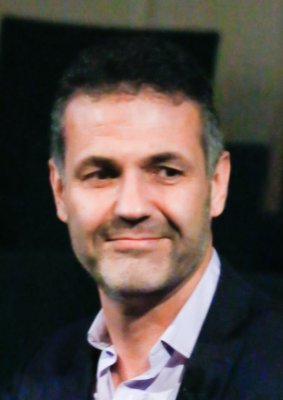
I had really good teachers in high school. Probably I connected the best with an English teacher that I had my junior year in high school, Miss Sanchez, Jan Sanchez — God bless her. I’m still in touch with her, had lunch a couple of years ago, and we email each other and still exchange, recommend books to each other: “What novel are you reading lately? I read this book — you want to read this.” That kind of thing. But she really was the first time — I remember it was in her class that I read The Grapes of Wrath , which was the first time I had read a novel in English where I felt like I got it at the time. I had the, I felt really connected to the writer and to the story. I told her how much I loved that book and what it meant to me, and I think I saw part of my own family, and a lot of the Afghans in that story — people who would, they become uprooted and homeless and kind of drifting around trying to find a new home. So Jan Sanchez was probably my favorite teacher in high school, and although I never shared with her any of my writing, she came to one of my book readings as a surprise. I hadn’t seen her in over two decades, and she showed up, and she goes, “Remember me?” Obviously, I knew immediately who she was, and it made me so proud that she had read my book and she had loved it. I felt like I had done good. You know, when your teacher comes up to you, even if you are middle-aged and have your own family, having your teacher come up to you and pat you on the back is still a pretty special feeling.
Managed profile
Not claimed by Khaled Hosseini
Khaled Hosseini has not joined FLAPSS and has not endorsed it. This page is a reference record assembled from published interviews and public remarks. Every answer below is a direct quotation with the source and date shown next to it.
Khaled Hosseini
Afghan-American novelist
United States · b. 1965
Arts and letters
About
Khaled Hosseini or Khalid Husseini (born March 4, 1965) is an Afghan and American novelist, UNHCR goodwill ambassador, and former physician. His debut novel The Kite Runner (2003) was a critical and commercial success; the book and his subsequent novels have all been at least partially set in Afghanistan and have featured an Afghan as the protagonist.
2 answers
So I use the first draft purely as a frame on which to build the actual story. So a lot of my writing is done through rewriting. And I don’t become discouraged by the notion that my first draft is not going to win any prizes or that it’s not going to be — I understand that it’s going to be lousy, but I want all of the essential elements to be there. The heart of the story has to be in that first draft, and then I can use that to create something and discover things about the story. When I wrote, for instance, The Kite Runner , there were a lot of things in that first draft that stayed, but some things in that first draft were tossed, and the transformation in some passages were very dramatic. I wrote an entire draft where the two kids were not brothers, and it really wasn’t until a subsequent draft when I realized that the kids, suddenly the idea came — well, what if the kids are brothers, and that changed the whole tone of the story. And when I rewrote it, writing it with that knowledge, it changed everything. And so you can get discouraged. Writing is largely about rewriting, and I abhor writing the first draft. I love writing subsequent drafts because that’s when I can see the story getting closer and closer to what I intended and what my original hopes for it were.
Every quotation above is reproduced from the source shown beside it and has not been edited. Khaled Hosseini did not write these answers for FLAPSS. Request a correction or removal.