Skip to content

The question

How much rewriting or revision do you typically do?

Originally asked

The Paris Review, to novelists and poets, The Art of Fiction

A recurring Art of Fiction craft question, sometimes asked about daily rewriting and sometimes about the number of drafts.

You answer as yourself. Nobody on FLAPSS answers as anybody else.

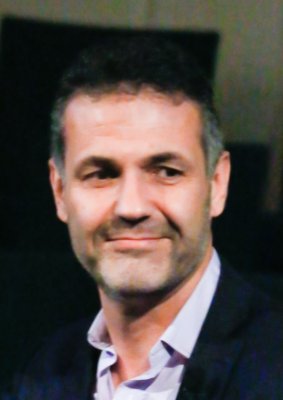
Khaled Hosseini

Afghan-American novelist

Recorded said elsewhere, not written here
So I use the first draft purely as a frame on which to build the actual story. So a lot of my writing is done through rewriting. And I don’t become discouraged by the notion that my first draft is not going to win any prizes or that it’s not going to be — I understand that it’s going to be lousy, but I want all of the essential elements to be there. The heart of the story has to be in that first draft, and then I can use that to create something and discover things about the story. When I wrote, for instance, The Kite Runner , there were a lot of things in that first draft that stayed, but some things in that first draft were tossed, and the transformation in some passages were very dramatic. I wrote an entire draft where the two kids were not brothers, and it really wasn’t until a subsequent draft when I realized that the kids, suddenly the idea came — well, what if the kids are brothers, and that changed the whole tone of the story. And when I rewrote it, writing it with that knowledge, it changed everything. And so you can get discouraged. Writing is largely about rewriting, and I abhor writing the first draft. I love writing subsequent drafts because that’s when I can see the story getting closer and closer to what I intended and what my original hopes for it were.

Academy of Achievement interview, 2008 source ↗

Others on this question

View all 46 →
All of the above is the answer to that. I mean, I edit what I wrote yesterday before starting writing again today, so that’s the first sort of layer of editing. Then, suppose I have a chapter, then I’ll edit it again and again. Every word I publish has been through 30 edits. My first draft I do with a pencil. I just write freehand with a pencil. I do that for quite a while, and then I write with a pen. I make a draft with a pen. And then I get onto the computer. For me, it would be really kind of crippling if I were to go straight onto a computer. I would just freeze up. I think there’s a lot to be said for trying to find ways of not freezing up, of being able to be loose.
Recorded Maddie Crum, The Creative Independent interview, 20 August 2019 source ↗
In the same way that I’m rigid about my routine, I’m very rigid about how editing works. I like to start at the top. I can’t write the fourth session before I write the first. I basically have to write it in order, and I can’t really do rough drafts. I have to like the first section, and the shape it’s in before I move to the second one. So basically, everyday I just start at the top, and go down, and hopefully I get further and further down every day. But I generally can’t start in the middle, or be like, “Eh, that section’s a little wonky, but I’ll get back to it.” I kind of need to shore it up, and edit it, and polish it as I go along. And then you give it to an editor, and you start all over again.
Recorded Brandon Stosuy, The Creative Independent interview, 29 November 2018 source ↗
Kristen Radtke American writer and illustrator
It’s arduous and time consuming. A sentence can be revised ad nauseam forever. If you know what needs to happen in a scene, you may be revising that for a while to get the language right, but you’re creating the whole time. With drawing it’s different. If I storyboard something and I know, for example, that in this picture I’m going to draw myself with my feet up on my desk, talking on the phone, as I am now, I can see that exactly in my mind. Then I just have to spend the hours to put it on the paper… but that takes much longer than revising the sentences.
Recorded T. Cole Rachel, The Creative Independent interview source ↗
Carlos Fuentes Novelist and essayist; Mexico's ambassador to France
Not that important. I seem to rewrite in my head a great deal. I write in these English ruled notebooks. So I write on the right, and then I correct on the left. Then, when it’s typed out, I even make another correction, and then maybe in the typed sheets also. But not that much. I seem to have a great facility to go right into what I want to say. I do correct, but not like Balzac, who went crazy over the printing presses. He was correcting at the last minute.
Recorded Academy of Achievement interview, 2006 source ↗

More from Khaled Hosseini

View profile →
Question Which teacher, parent, coach, or friend most made you who you are, and what did you learn from them? Relationships
I had really good teachers in high school. Probably I connected the best with an English teacher that I had my junior year in high school, Miss Sanchez, Jan Sanchez — God bless her. I’m still in touch with her, had lunch a couple of years ago, and we email each other and still exchange, recommend books to each other: “What novel are you reading lately? I read this book — you want to read this.” That kind of thing. But she really was the first time — I remember it was in her class that I read The Grapes of Wrath , which was the first time I had read a novel in English where I felt like I got it at the time. I had the, I felt really connected to the writer and to the story. I told her how much I loved that book and what it meant to me, and I think I saw part of my own family, and a lot of the Afghans in that story — people who would, they become uprooted and homeless and kind of drifting around trying to find a new home. So Jan Sanchez was probably my favorite teacher in high school, and although I never shared with her any of my writing, she came to one of my book readings as a surprise. I hadn’t seen her in over two decades, and she showed up, and she goes, “Remember me?” Obviously, I knew immediately who she was, and it made me so proud that she had read my book and she had loved it. I felt like I had done good. You know, when your teacher comes up to you, even if you are middle-aged and have your own family, having your teacher come up to you and pat you on the back is still a pretty special feeling.
Recorded Academy of Achievement interview source ↗

More on craft & work

Also answered this

Taika Waititi, Elisa Gabbert, Kazuo Ishiguro, Kristen Radtke, Carlos Fuentes, Eugene Marten

Search the directory for somebody in particular.

Explore further

Report this answer