Skip to content
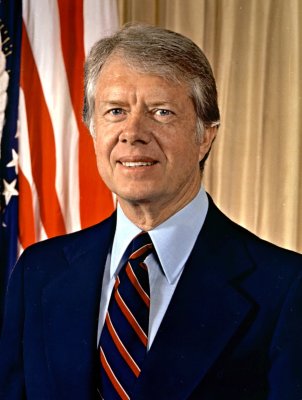
Jimmy Carter

39th President of the United States, 1977–1981; Governor of Georgia 1971–1975

Recorded said elsewhere, not written here
I thought often during my years in the White House of an admonition that we received in our small school in Plains, Georgia, from a beloved teacher, Miss Julia Coleman. She often said: "We must adjust to changing times and still hold to unchanging principles."

Oslo City Hall, The Nobel Foundation, 10 December 2002 source ↗

Others on this question

View all 23 →
Anthony Fauci Physician and immunologist; director of the U.S. National Institute of Allergy and Infectious Diseases, 1984–2022
And what this person told me was that what you need to do is that, when you go to the White House, always say in the back of your mind that this may be the last time I’m going there because I might have to tell this president something he doesn’t like.
Recorded Academy of Achievement recorded interview, American Academy of Achievement, 22 August 2017 source ↗
Henry R. Kravis Financier; co-founder of Kohlberg Kravis Roberts & Co.
One person that is my role model is my father. ... He’s a man who taught me something very important. And that was — give back to society what you’ve taken out.
Recorded Academy of Achievement interview, 12 February 1991 source ↗
Bill Clinton 42nd President of the United States, 1993–2001
And I think it had something to do with my grandmother and my mother being nurses, and my mother once said to me, “Once you see people bleed it’s hard to believe there’s much difference in race.
Recorded Academy of Achievement interview source ↗
Edmund Hillary Mountaineer and explorer; first ascent of Everest, 1953
My mother used to say to me a thing which, when I look back on it, wasn’t terribly logical. — and I had a pretty hearty appetite, but when I had had a large meal put in front of me, and even I couldn’t get through it, she would say, “Edmund, remember the starving millions in Asia.” Now what possible use my consuming it would do for the starving millions in Asia, I don’t really know, but the fact remains that I was brought up to think about the starving millions in Asia. That meant I had to clean my plate up and not waste it. Later on, I got more involved with the starving millions in Asia, perhaps in a slightly more practical way: helping some of them with schooling and hospitaling and even in agriculture.
Recorded Academy of Achievement interview source ↗

More from Jimmy Carter

View profile →
Question What became visible only after your working life slowed down or ended? Time & hindsight
I'm the only president that's ever visited Africa south of the Sahara Desert. I went to two (African) countries while I was president, and I didn't know the potential of that continent, nor the challenges that faced those people. Now I do. To a much greater extent I didn't understand the [widespread] problems in our own country, from a personal point of view. I was dealing with billions of dollars that would be allocated for education or health or welfare or housing, or whatever. But I didn't know from a personal point of view the people that actually were in need or that were the recipients of those quite often inadequate and ill-designed programs.
Recorded Academy of Achievement interview, Atlanta, Georgia, 25 October 1991 source ↗
Question How would you want people to remember you? Death & what remains
Well, the best thing I ever did was marrying Rosalynn. That's the pinnacle of my life. And we've had 69 years together. Still together. And so that's the best thing that happened to me. But I think getting involved in politics and going up, you know, as a state senator, then governor, and then president of the United States is, obviously a glorious event. So - and we have a growing family. We have 22 grandchildren and great-grandchildren, 12 grandchildren and 10 great-grandchildren now and they're coming every year. So - so we have a good, harmonious family.
Recorded News conference at the Carter Center, Atlanta, as transcribed by CNN, 20 August 2015 source ↗
Question What are you still hoping to finish? Death & what remains
As far as the Carter Center's concerned, I would like to see guinea worm completely eradicated before -- before I die. I'd like for the last guinea worm to die before I do. ... I think right now, we have 11 cases. We started out with 3.6 million cases. And I think we have two cases in South Sudan and one case in Ethiopia and one case in Mali and seven cases in Chad. That's all the guinea worms in the world, and we know where all of them are. So obviously, that would be my top priority.
Recorded Maria Saporta, News conference at the Carter Center, Atlanta, as transcribed by CNN, 20 August 2015 source ↗
Question Which book reshaped how you think, and in what way? Taste & recommendation
When I was a young boy, [my schoolteacher Julia Coleman] introduced me to Leo Tolstoy's novel, "War and Peace." She interpreted that powerful narrative as a reminder that the simple human attributes of goodness and truth can overcome great power. She also taught us that an individual is not swept along on a tide of inevitability but can influence even the greatest human events.
Recorded Oslo City Hall, The Nobel Foundation, 10 December 2002 source ↗
Question What counsel has proved most valuable to you? Time & hindsight
And my sister, whose name is Ruth Stapleton, was a famous evangelist. She wrote four or five books, and she would give lectures to 50,000 people at a time. She and I had a long walk in the woods on my farm, and she said, "Jimmy, quite often, when you have a blow to your pride and a horrible defeat, you can either give up, or you can look on it as a way that God opens to you to do different and even better things."
Recorded Academy of Achievement interview, Atlanta, Georgia, 25 October 1991 source ↗

More on time & hindsight

Also answered this

Bill Clinton, Gustavo Dudamel, Susan Butcher, August Wilson, Sachin Tendulkar, Chuck Jones

Search the directory for somebody in particular.

Explore further

Report this answer