Skip to content

The question

Does the thought of dying frighten you?

Originally asked

The Talks, to its interviewees, its interview series

The Talks asks this directly or through an equivalent risk-and-mortality formulation across interviews.

You answer as yourself. Nobody on FLAPSS answers as anybody else.

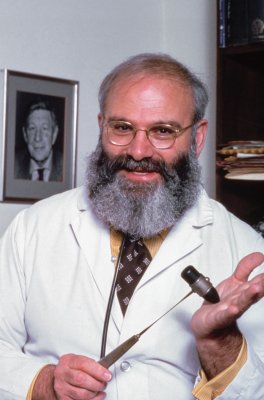
Oliver Sacks

Neurologist and writer

Recorded said elsewhere, not written here
I cannot pretend I am without fear. But my predominant feeling is one of gratitude. I have loved and been loved; I have been given much and I have given something in return; I have read and traveled and thought and written. I have had an intercourse with the world, the special intercourse of writers and readers. Above all, I have been a sentient being, a thinking animal, on this beautiful planet, and that in itself has been an enormous privilege and adventure.

The New York Times, Op-Ed, 19 February 2015 source ↗

Others on this question

View all 18 →
Tony Judt Historian and essayist
But if I was sitting in an armchair with bits and pieces of rubber sticking out of me and my son came over and said, you know, would you like a banana? Wink once for yes, wink twice for no, I dont think the interest of the conversation would get me past the sense that this is horrible. It's horrible for me but above all, horrible for them. There are things worse than death.
Recorded Terry Gross, Fresh Air, NPR, 29 March 2010 source ↗
Christopher Hitchens Essayist, critic and journalist
The chief side effect of this pain is numbness in the extremities, filling me with the not irrational fear that I shall lose the ability to write. Without that ability, I feel sure in advance, my “will to live” would be hugely attenuated. I often grandly say that writing is not just my living and my livelihood but my very life, and it’s true. Almost like the threatened loss of my voice, which is currently being alleviated by some temporary injections into my vocal folds, I feel my personality and identity dissolving as I contemplate dead hands and the loss of the transmission belts that connect me to writing and thinking.
Recorded Vanity Fair, January 2012 source ↗
Yes, these are subjects that we think about all the time but don’t necessarily talk about. Everybody has thought about if they want to be cremated, buried, or whatever.
Recorded The Talks, 29 June 2011 source ↗
Alex Honnold Rock climber; first person to free solo El Capitan
I’ve had a couple of ex-girlfriends sort of accuse me of having a personality disorder! … No, I don’t know. I’ve always been afraid of death. I’ve never wanted to die. Last year, I watched this guy die in Red Rock. It was this horrible freak accident thing. He fell and he cracked his head and basically just bled out. That was the first time I’d ever actually seen a climbing accident like that. It was kind of sobering — he was even wearing a helmet — it was a reminder of how dangerous climbing can be if things go wrong even when you have all the ropes on.
Recorded The Talks, 6 February 2019 source ↗

More from Oliver Sacks

View profile →
Question What kind of death would you consider a good one? Death & what remains
It was this celestial splendor that suddenly made me realize how little time, how little life, I had left. My sense of the heavens’ beauty, of eternity, was inseparably mixed for me with a sense of transience — and death. ... I told my friends Kate and Allen, “I would like to see such a sky again when I am dying.” “We’ll wheel you outside,” they said.
Recorded The New York Times, Sunday Review, 24 July 2015 source ↗
Question Has knowing you will die changed how you live? Death & what remains
I feel a sudden clear focus and perspective. There is no time for anything inessential. I must focus on myself, my work and my friends. I shall no longer look at “NewsHour” every night. I shall no longer pay any attention to politics or arguments about global warming. This is not indifference but detachment — I still care deeply about the Middle East, about global warming, about growing inequality, but these are no longer my business; they belong to the future. I rejoice when I meet gifted young people — even the one who biopsied and diagnosed my metastases. I feel the future is in good hands.
Recorded The New York Times, Op-Ed, 19 February 2015 source ↗
Question What has life taught you about being human? Values & belief
My generation is on the way out, and each death I have felt as an abruption, a tearing away of part of myself. There will be no one like us when we are gone, but then there is no one like anyone else, ever. When people die, they cannot be replaced. They leave holes that cannot be filled, for it is the fate — the genetic and neural fate — of every human being to be a unique individual, to find his own path, to live his own life, to die his own death.
Recorded The New York Times, Op-Ed, 19 February 2015 source ↗
Question What are you unwilling to optimise? Values & belief
I’ve had this concern all the time, but I can only hope that if one writes with appreciation and delicacy and respect, then it’s okay. I have to say that I’ve written a hundred times as much as I’ve published, because if there’s any thought of offense or embarrassment, then I will put the thing quietly away.
Recorded Academy of Achievement recorded interview, American Academy of Achievement, 17 June 2000 source ↗
Question What is the hardest thing that has happened to you, and what did you carry out of it? Failure & regret
And I spent four years at a boarding school in the country, probably a rather abusive boarding school, and seeing very little of my parents, and that was a very bad time for me. A bad and almost a mad time. ... I think that some sort of trust, and ability for closeness, may have been compromised. And I think I’ve perhaps, to some extent, sort of kept a distance since that time, although this is not a distance I feel with my patients or my students.
Recorded Academy of Achievement recorded interview, American Academy of Achievement, 17 June 2000 source ↗
Question If you could revise one chapter of your past, what would you change? Failure & regret
The peace of the Sabbath, of a stopped world, a time outside time, was palpable, infused everything, and I found myself drenched with a wistfulness, something akin to nostalgia, wondering what if: What if A and B and C had been different? What sort of person might I have been? What sort of a life might I have lived?
Recorded The New York Times, Sunday Review, 14 August 2015 source ↗

More on death & what remains

Also answered this

Henry Marsh, Roger Ebert, Jenny Diski, Diana Athill, Terry Pratchett, Jimmy Carter

Search the directory for somebody in particular.

Explore further

Report this answer