Skip to content
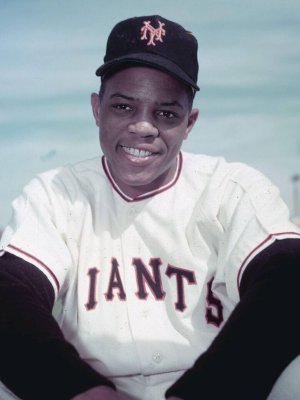
Willie Mays

Baseball centre fielder; twice National League Most Valuable Player

Recorded said elsewhere, not written here
I had an uncle that played a great role in my life as far as sports. Like I said, in the South we would always play like three or four o’clock in the afternoon. I would have to go to school, and he would do my chores. When I say chores, that means I had to cut the wood, I had to wash the clothes; I had to do everything that everybody in the house had to do. So he would do all that stuff for me, and I was very happy about it because I wasn’t about to mess my arms up and my hands, so I could go and play ball and didn’t have to do too much.

Academy of Achievement interview source ↗

Others on this question

View all 57 →
Benazir Bhutto Prime Minister of Pakistan, 1988–1990 and 1993–1996
A very important influence. Now when I look back on it, it was my father who was against the gender constraints of my time. And my mother, she used to be a working woman herself, she joined the National Guards. She was a captain in the National Guards. She was the first woman in Karachi to own a car and to drive, and people used to talk about her because they said, you know, “We’re not supposed to drive cars.” But when I look back on it, it was my mother who taught that a woman grew up to be married and to have children, and she would tell my father in front of me, “Why do you want to educate her? No man will want to marry her.” So all the time, for her, success depended on having a good catch as a husband, and having children. Whereas for my father, he broke free of those constraints, and he insisted that I have an education. He said, “Boys and girls are equal. I want my daughter to have the same opportunities.”
Recorded Academy of Achievement interview source ↗
Wole Soyinka Playwright, poet and novelist; Nobel laureate in Literature, 1986
The early influence in my life I think was my father. That’s the earliest influence. He and his circle of friends. Usually, in our society, children are supposed to be neither seen nor heard. When elders are around, they’re supposed to very respectfully leave them alone. But I was curious. I just loved their debates. They used to get excited over issues, and so somehow I was allowed to eavesdrop, unlike the other children. And I picked up some of the ideas that they had, and I would ask questions. I was known as the questioner. Afterwards, I would ask questions, and my father would indulge me by trying to explain things to me. So that’s one of the reasons I consider him the earliest influence. And also, he had a small library, and I used to go into his library and try and read the books which I found there. Later on, as my circle of adult acquaintances increased, I think the next influence on me was my uncle, the Reverend I.O. Ransome-Kuti, who was another very erudite person, a great educationist. I used to visit them in Igbein, where he lived with his wife and they ran a school. So on weekends sometimes I would go there. And of course it was the usual story. I wanted to listen to them discussing and so on. Don’t misunderstand me. I was also very playful. I loved disappearing by myself, climbing trees, all that I did. But additionally, I was just fascinated by the whole discourse. Exchange of ideas between adults just used to fascinate me for some reason. I was never tired of listening to them. So my uncle was my next great influence.
Recorded Academy of Achievement interview source ↗
Edward O. Wilson, Ph.D. Biologist and entomologist; founder of the field of sociobiology
quite early I was picked up by teachers in these small schools in Alabama who encouraged that interest.
Recorded Academy of Achievement, Academy of Achievement interview, Cambridge, Massachusetts, 1 April 2006 source ↗
Mohamed ElBaradei Director General of the International Atomic Energy Agency, 1997-2009; Nobel Peace Prize 2005
My father was a lawyer. My mother was a homemaker. My father was president of the Egyptian Bar Association. He was involved very much during the Nasser era — which was one of the most repressive eras in Egyptian history — in fighting for democracy, fighting for human rights, and I think that to a lot of extent shaped my view as to what I wanted to do in the future. I wanted to have a world where people are free to express their views, to have freedom of worship, to have freedom from want, and I saw poverty in Egypt when I grew up. To me, freedom, in the larger sense — to be able to speak, to worship, free from want, free from fear — I think it was a key as to what I thought I would like to do when I grow up.
Recorded Academy of Achievement interview source ↗

More from Willie Mays

View profile →

More on relationships

Also answered this

Julius Erving, Peyton Manning, John Wooden, Herschel Walker, Mike Krzyzewski, Pete Rozelle

Search the directory for somebody in particular.

Explore further

Report this answer