Skip to content

The question

Do you rely more on inspiration or discipline to make your work?

Originally asked

The Creative Independent, to working artists, its interview series

A repeated Creative Independent tension, asked as inspiration, muse, discipline, ritual, or the requirement to show up.

You answer as yourself. Nobody on FLAPSS answers as anybody else.

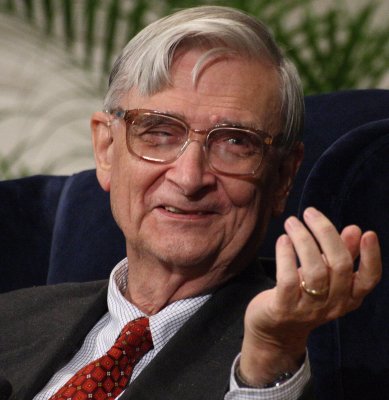
Edward O. Wilson, Ph.D.

Biologist and entomologist; founder of the field of sociobiology

Recorded said elsewhere, not written here
Yes, that’s right. I saw what I could succeed in. I never considered myself very bright, and I always thought of myself as mathematically mediocre. So I figured that probably, like your college runner who has difficulty breaking a ten-second hundred — well, breaking an 11-second, shall we say, 100-meter — realizes that their best shot is to rely less on strength and speed and more on self-discipline, planning, and long hard work. Yes. That’s the way I do science.

Academy of Achievement interview, Cambridge, Massachusetts, 5 April 2001 source ↗

Others on this question

View all 27 →
Donald C. Johanson, Ph.D. Palaeoanthropologist; discovered the Lucy skeleton in Ethiopia
I agree with him, essentially, 100 percent. One has to devote oneself to a particular pursuit. To be successful at anything, you have to make a total commitment to it. We so often see students who would love to play baseball like one of their heroes, or would love to be on the basketball court or the football field. They don’t see the 99 percent effort that went into practicing making baskets, or practicing hitting the baseball, or practicing catching a pass on the football field. It takes a tremendous amount of perspiration, a tremendous amount of hard work that you don’t always see or appreciate in the end result. You will find this over and over. Most achievers I know are people who have made a strong and deep dedication to pursuing a particular goal. That dedication took a tremendous amount of effort. That is certainly true in my case. It took a tremendous amount of work to get from point A to point B.
Recorded Academy of Achievement interview, Berkeley, California, 25 January 1991 source ↗
Suzan-Lori Parks Playwright, screenwriter and novelist; Pulitzer Prize for Drama, 2002
It’s just a devotion to the greater beautiful thing that allows us all to be here. It sounds a little “woo-woo,” but basically, it’s manifested in me because I’m a writer. I get up every morning, and I write. I sit. As Paul knows, I sit. I have my notebook. I’m scribbling. “Don’t talk to me right now, honey. I’m writing.” That’s my thing. That’s how I manifest it. Someone who runs the hurdles, or a tennis player, would manifest it daily, going out there and hitting balls or whatever they do.
Recorded Academy of Achievement interview, Washington, D.C., 22 June 2007 source ↗
Denton Cooley Cardiothoracic surgeon; founder of the Texas Heart Institute
I think so. I really do. With your own effort, you can improve yourself, but people find they can’t improve beyond a certain point. I like to play golf, but I know that no matter how much I practice, I will never get above a certain level. I think that’s also true of surgery. Some people are born with the gifts and the mind for surgery, and they may go on to great heights. Others may try and try, only to reach a certain plateau.
Recorded Academy of Achievement interview, Houston, Texas, 11 April 1991 source ↗
Danny Elfman Film composer and songwriter; founder of Oingo Boingo
Well, the reason I’ve survived for this long is because any film composer that has an extended career learns to work within deadlines. The deadline becomes the motivating factor in the same way that a pro athlete can do these incredible things with two seconds left in the game. It forces them into their best mode. For film composers, the clock does get us into a higher gear.
Recorded The Talks, published interview, 12 August 2022 source ↗

More from Edward O. Wilson, Ph.D.

View profile →

More on craft & work

Also answered this

Charles H. Townes, Richard Feynman, General Chuck Yeager, USAF, Donald C. Johanson, Ph.D., Stephen Jay Gould, Ph.D., Denton Cooley

Search the directory for somebody in particular.

Explore further

Report this answer