Skip to content

The question

Which writers or artists have most influenced your work?

Originally asked

The Paris Review, to novelists and poets, The Art of Fiction

A durable Art of Fiction question asked through named literary influences and artistic models.

You answer as yourself. Nobody on FLAPSS answers as anybody else.

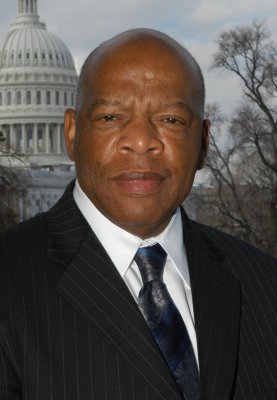
John Lewis

U.S. Representative from Georgia, 1987–2020; Chairman of the Student Nonviolent Coordinating Committee 1963–1966

Recorded said elsewhere, not written here
Jim Lawson. Jim Lawson was an unbelievable human being. Born in Ohio. He was a pacifist. He studied Gandhi. He was part of the Methodist Student Movement. He lived in India. He became an organizer for FOR, the Fellowship of Reconciliation.

Julian Bond, Explorations in Black Leadership interview, Explorations in Black Leadership, University of Virginia source ↗

Mentioned in this answer

Others on this question

View all 42 →
Clare Smyth Chef-patron of Core, London; first British woman to hold three Michelin stars
I think that I followed the influences of the people whose style and cooking I admired. When I went to Restaurant Gordon Ramsay in the early days, it was the best and the most exciting cooking in the UK at that time. Later on I worked with Thomas Keller and Alain Ducasse and eventually I chose to go to work in Le Louis XV because when I set foot in the kitchen, I just knew it was for me. I think you can see all of those influences in the techniques and the flavors that I use: there’s a real purity to the way that we cook and a real natural process here at my restaurant, Core, that always stayed with me from my time at Alain Ducasse.
Recorded The Talks, published interview, 27 December 2017 source ↗
Doris Kearns Goodwin, Ph.D. Historian and biographer of American presidents
When I was in high school, there was a book by James MacGregor Burns, a wonderful historian, called The Lion and the Fox, about FDR. And it was about his personality, his character, his early years in Hyde Park, his polio experience and… I remember that so vividly as the first real, live history book that I love so much. And I later met him, and have gotten to know him as a colleague, and he’s about 30 years older than I am, and I couldn’t wait to tell him, “You were the one who made it happen.
Recorded Academy of Achievement interview, Sun Valley, Idaho, 28 June 1996 source ↗
David Herbert Donald, Ph.D. Historian; twice winner of the Pulitzer Prize for Biography
Professor Randall was a great advisor and a great mentor. He taught me, I think, in the best possible way. He was not a brilliant lecturer. His courses were fairly pedestrian. I didn’t think his seminars were particularly interesting. But working with him on a one-to-one basis as his assistant, I think that’s the way one has to learn to be a historian. That is, he was writing, and if he needed some particular reference, I had to go find it and get it. If he was writing, he wanted everything checked meticulously over and over again. So I had to take the manuscript over to the library and check it all out. So that by working closely with him, I got to see, first of all, a lot of the library and its extensive holdings, but I got, even more important, to understand what a scholar is about. It is about care. It is about “pains-taking.” It is about judgment as well as it’s about very skillful writing. He was an excellent writer as well. So in that sense, Professor Randall and Mrs. Randall shaped my future career.
Recorded Academy of Achievement interview, Lincoln, Massachusetts, 19 October 2007 source ↗
Charles H. Townes Physicist; Nobel laureate in physics for the invention of the maser and laser
Most scientists do. Of course there are the classical figures. I might talk about Einstein a little bit, for example. Now, when I was in college, I was taking my second course in physics, I remember very well, and it had a chapter on relativity. And I took this relativity on a vacation in the mountains; my family went with me. And I remember very well sitting on a rock up in the hills there overlooking a stream, reading this relativity derivation. And it was just very exciting and interesting. It was a strange new world, relativity. I even thought I had found where Einstein made a mistake. And I went back for lunch, and I thought about it, came back. And I said, “No, he was right after all,” but it was still very exciting. To see a completely different kind of idea and world from what one’s normal intuition shows. Of course, Einstein was one of the great scientists; I’ve always admired him. I fortunately had a chance to talk with him and interact with him a little bit as well.
Recorded Academy of Achievement interview, Berkeley, California, 18 March 1991 source ↗

More from John Lewis

View profile →

More on taste & recommendation

Also answered this

Elie Wiesel, Mohamed ElBaradei, Adam Gopnik, Kazuo Ishiguro, Noah Baumbach, Marco Brambilla

Search the directory for somebody in particular.

Explore further

Report this answer