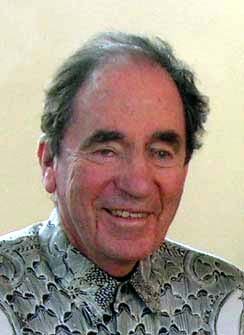
Anti-apartheid lawyer; Justice of the Constitutional Court of South Africa
It’s art that influenced me while I was in exile – Dumile Feni’s work.
Lee Tankle, SA Jewish Report, 26 February 2026 source ↗
The question
Which writers or artists most influenced your work?Originally asked
The Paris Review, to novelists and poets, The Art of Fiction
A durable Art of Fiction question asked through named literary influences and artistic models.
You answer as yourself. Nobody on FLAPSS answers as anybody else.
Anti-apartheid lawyer; Justice of the Constitutional Court of South Africa
It’s art that influenced me while I was in exile – Dumile Feni’s work.
Lee Tankle, SA Jewish Report, 26 February 2026 source ↗
When I was in high school, there was a book by James MacGregor Burns, a wonderful historian, called The Lion and the Fox, about FDR. And it was about his personality, his character, his early years in Hyde Park, his polio experience and… I remember that so vividly as the first real, live history book that I love so much. And I later met him, and have gotten to know him as a colleague, and he’s about 30 years older than I am, and I couldn’t wait to tell him, “You were the one who made it happen.
Thrust into my profession without any training whatsoever, I had to just flounder and just find my way. It was an agonizing experience. It’s like jumping off a diving board in the Olympic contest without knowing how to swim or dive, and I just had to find my way. So one day, I said to Jimmy Cagney, “Jimmy, what is acting?” and he said, “I don’t know.” He said, “All I can tell you is whatever you say, mean it,” and I thought that marvelous counsel.
I did think about Woody Allen’s movies with Frances Ha because Woody Allen’s movies were also in black and white and very contemporary. Manhattan and Stardust Memories are not period pictures. Particularly in Manhattan you have the grandeur of the black and white and the Gershwin music sort of playing up against a more intimate storyline in which, when you break it down, is really just people sleeping with each other and trying to figure out their lives. But something about the filmmaking and the approach to it makes it feel almost epic. And, ultimately, the concerns of those people are epic. That movie is a masterpiece.
I didn’t have a lot of mentors when I – I mean I kind of just grew up in the gym, just climbing a lot. So I didn’t really have mentors. I mean I definitely had people that I looked up to and people in the climbing community, but that’s just sort of the typical hero worship style, you know. Like Peter Croft was a really prominent soloist from the generation before me and I was like, “Oh, Peter’s the man!”
But there’s nothing like that quality of leading a decent, dignified life, meeting up with other people who have similar ideals, expressing kindness and love and curiosity and challenging and argument and the excitement of ideas. Ideas can be marvelous.
And I get so upset when I hear that, because are you saying: Poor people only want a roof over their heads and want food? That poor people are not interested in beauty and rights and fairness and justice?
I’d say, “I’m going to be a doctor.” I don’t know why I changed. I know my dad had something to do with it.
I think of two great personalities who were locked up in the prison where we’ve now built the Constitutional Court: Gandhi and Mandela.
I was part of a very big ANC team, and I worked very, very closely with Oliver Tambo, who was the president of the ANC in exile, who had an enormous influence in my life.
Monday to Friday, very, very industriously from ten in the morning ’til about six in the evening, I just sat and wrote, and revised and revised, and wrote.
Elie Wiesel, Mohamed ElBaradei, John Lewis, Adam Gopnik, Alan Cumming, George Lucas
Search the directory for somebody in particular.