Skip to content
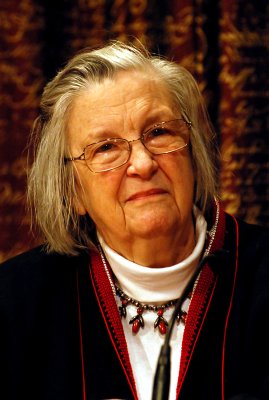
Elinor Ostrom

Political economist; laureate of the Sveriges Riksbank Prize in Economic Sciences, 2009

Recorded said elsewhere, not written here
Yes, we're showing that. But we're also showing a very important role for face-to-face or even written communication. So, the prediction was that nobody would self-monitor because that's a second level social dilemma, if you go to Game Theory. But, what we've found is that people will, but it can be … people can escalate into, 'I'll punish you, you punish him, mamamamamma,' and it gets worse and worse. So, with communication, where there's an agreement on what is going to be the … what we are going to do. The 'we' then being well-defined, then people can follow rules, be cooperative and, occasionally, sanction one another to help that continue.

Adam Smith, Telephone interview recorded immediately after the prize announcement, Nobel Prize Outreach, 12 October 2009 source ↗

Others on this question

View all 80 →
Barack Obama 44th President of the United States, 2009–2017; United States Senator from Illinois 2005–2008
And democracy requires compromise, even when you are 100 percent right. This is hard to explain sometimes. You can be completely right, and you still are going to have to engage folks who disagree with you. If you think that the only way forward is to be as uncompromising as possible, you will feel good about yourself, you will enjoy a certain moral purity, but you're not going to get what you want.
Recorded Howard University, Washington, D.C., The White House (Obama administration archive), 7 May 2016 source ↗
Richard Hamming Mathematician and computer scientist; Turing Award, 1968
When you are famous it is hard to work on small problems. This is what did Shannon in. After information theory, what do you do for an encore? The great scientists often make this error. They fail to continue to plant the little acorns from which the mighty oak trees grow. They try to get the big thing right off. And that isn't the way things go. So that is another reason why you find that when you get early recognition it seems to sterilize you. In fact I will give you my favorite quotation of many years. The Institute for Advanced Study in Princeton, in my opinion, has ruined more good scientists than any institution has created, judged by what they did before they came and judged by what they did after.
Recorded Bell Communications Research Colloquium Seminar, Morristown, New Jersey, Bell Communications Research Colloquium Seminar (transcription hosted by the University of Virginia Department of Computer Science), 7 March 1986 source ↗
John Hopfield American scientist
I’d read some of the things that Don Glaser wrote, for example, and they’re imaginative physics, they’re not quite such good biology. There was a consensus that said you had to be able to reach out from physics and get to some of these things you’d like to, but then you have to know enough about the biology that the whole thing makes sense. And you really have to present things in such a way that a community develops. I didn’t realize that at the time, but certainly one of the important things of what I did had to do with enabling people who came from physics, or who came from biology, become a community, working on not just one little problem or piece, but somehow collectively working together toward trying to get an understanding.
Recorded Adam Smith, Telephone interview recorded shortly after the prize announcement, Nobel Prize Outreach, 1 October 2024 source ↗
Ngozi Okonjo-Iweala Director-General of the World Trade Organization from 2021; Finance Minister of Nigeria, 2003–2006 and 2011–2015
What I want to do this morning is share with you a couple of stories and talk about a different Africa. Already this morning there were some allusions to the Africa that you hear about all the time: the Africa of HIV/AIDS, the Africa of malaria, the Africa of poverty, the Africa of conflict, and the Africa of disasters. While it is true that those things are going on, there's an Africa that you don't hear about very much. And sometimes I'm puzzled, and I ask myself why. This is the Africa that is changing, that Chris alluded to. This is the Africa of opportunity. This is the Africa where people want to take charge of their own futures and their own destinies.
Recorded TED2007, 3 March 2007 source ↗

More from Elinor Ostrom

View profile →
Question What bad recommendations do people in your field repeat too often? Craft & work
Yes, but not with a formula. So there are many, many efforts now to decentralize and they create a rigid formula and give people rules from on top and say, 'Now it's yours.' And that isn't worked very well either. … And, you think about the variety. If you look at a countryside, think of the variety out there in terms of the ecological variety. Well, if people are going to manage ecological variety, no single set of rules will work in a semi-arid versus a tropical-wet region. They have to be different.
Recorded Adam Smith, Telephone interview recorded immediately after the prize announcement, Nobel Prize Outreach, 12 October 2009 source ↗

More on values & belief

Also answered this

Mario Molina, Shinya Yamanaka, Jennifer Doudna, Willem Kolff, Sylvia Earle, Elizabeth Blackburn

Search the directory for somebody in particular.

Explore further

Report this answer