Skip to content
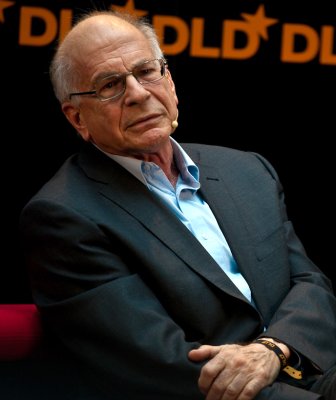
Daniel Kahneman

Psychologist; laureate of the Sveriges Riksbank Prize in Economic Sciences, 2002

Recorded said elsewhere, not written here
Amos and I shared the wonder of together owning a goose that could lay golden eggs – a joint mind that was better than our separate minds. … Some of the greatest joys of our collaboration-and probably much of its success – came from our ability to elaborate each other's nascent thoughts: if I expressed a half-formed idea, I knew that Amos would be there to understand it, probably more clearly than I did, and that if it had merit he would see it. Like most people, I am somewhat cautious about exposing tentative thoughts to others – I must first make sure that they are not idiotic. In the best years of the collaboration, this caution was completely absent.

Laureate-written autobiography for Les Prix Nobel, Nobel Prize Outreach, 1 December 2002 source ↗

Others on this question

View all 42 →
Tadao Ando Architect; Pritzker Prize laureate, 1995
More than 500 children under the age of 18 lost a parent in the Hanshin Earthquake; 88 of them lost both parents and became orphans. I have proposed the establishment of a foundation in order to support the education of these children so that they can sustain their hopes for the future. To that end, I would like to contribute the hundred thousand dollar prize awarded to me today by The Hyatt Foundation towards this new foundation for these young earthquake victims.
Recorded Grand Trianon Palace, Versailles, 22 May 1995, The Hyatt Foundation / The Pritzker Architecture Prize, 22 May 1995 source ↗
Shinya Yamanaka Stem cell biologist; Nobel laureate in Physiology or Medicine, 2012
However, it was very natural that a failed surgeon with little experience in molecular biology had a hard time finding a position. A turning point came when I got a fax from Thomas Innerarity at the Gladstone Institute of Cardiovascular Diseases in San Francisco. After a short telephone conversation, Tom was brave enough to give me a postdoctoral position in his lab! Working at Gladstone was one of the best decisions I ever made in my life.
Recorded Laureate-written autobiography for Les Prix Nobel, Nobel Prize Outreach, 1 December 2012 source ↗
Dan Carter New Zealand international rugby union fly-half, 2003–2015
When I started getting my first fan letters, I made a point to try to respond to every single one. The wins always felt that much more special because I knew I was making so many people happy. And losses hurt that much worse because I truly was invested in not wanting to disappoint those who supported my side. But more than anything, I always appreciated the fact so many fans invested their emotions in my performance.
Recorded Retirement letter, The Players' Tribune, 20 February 2021 source ↗
Venkatraman Ramakrishnan Structural biologist; Nobel laureate in Chemistry, 2009
No, because I started working on ribosomes when I was a post doc, in 1978, when it would have been impossible, really, to solve it. But, it was just a fundamental problem in biology. And we felt, no matter, anything we do to chip away at the problem would be useful. So it was more that that attracted me. And I think the fact that it was large and kind of difficult to come to grips with, yes, it was attractive. Really what was attractive was that it was a fundamental problem.
Recorded Adam Smith, Telephone interview recorded minutes after the prize announcement, Nobel Prize Outreach, 7 October 2009 source ↗

More from Daniel Kahneman

View profile →
Question How has a setback or failure set you up for later success? Failure & regret
I got quite nice results in my one-question studies, but never wrote up any of the work, because I had set myself impossible standards: in order not to pollute the literature, I wanted to report only findings that I had replicated in detail at least once, and the replications were never quite perfect. I realized only gradually that my aspirations demanded more statistical power and therefore much larger samples than I was intuitively inclined to run. This observation also came in handy some time later.
Recorded Laureate-written autobiography for Les Prix Nobel, Nobel Prize Outreach, 1 December 2002 source ↗
Question What does everyone in your world seem to agree on that you think is wrong? Values & belief
Under the stress of the event, we felt, the soldiers' true nature would reveal itself, and we would be able to tell who would be a good leader and who would not. But the trouble was that, in fact, we could not tell. Every month or so we had a "statistics day," during which we would get feedback from the officer-training school, indicating the accuracy of our ratings of candidates' potential. The story was always the same: our ability to predict performance at the school was negligible. But the next day, there would be another batch of candidates to be taken to the obstacle field, where we would face them with the wall and see their true natures revealed. I was so impressed by the complete lack of connection between the statistical information and the compelling experience of insight that I coined a term for it: "the illusion of validity."
Recorded Laureate-written autobiography for Les Prix Nobel, Nobel Prize Outreach, 1 December 2002 source ↗

More on money & investment

Also answered this

Svante Pääbo, Venkatraman Ramakrishnan, Mario Molina, Shinya Yamanaka, Jocelyn Bell Burnell, Elizabeth Iro

Search the directory for somebody in particular.

Explore further

Report this answer