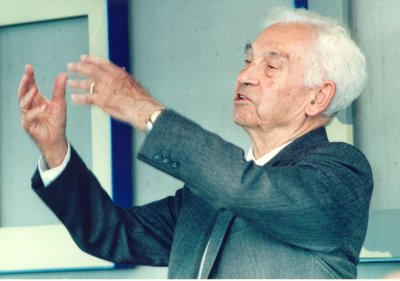
One of the answers is that very often I see a statement made by somebody which clearly to me is wrong, and then I work out what is the real right answer, and this happens to me very often.
Academy of Achievement interview, 5 April 2001 source ↗
The question
How does a new work begin for you?Originally asked
The Paris Review, to novelists and poets, The Art of Fiction
A recurrent craft question in The Paris Review's Art of Fiction interviews; wording varies between character, theme, first sentence, image, and idea.
You answer as yourself. Nobody on FLAPSS answers as anybody else.
One of the answers is that very often I see a statement made by somebody which clearly to me is wrong, and then I work out what is the real right answer, and this happens to me very often.
Academy of Achievement interview, 5 April 2001 source ↗
Rather than trying to do something within your own circle or looking to gain approval, I think the first step toward a new project is making others feel the potential of working together.
When I start a project, it’s a kind of investigation and curiosity at the beginning. I’m basically culling materials. I’m gathering. A lot of the work takes on a collage aesthetic. So I am thinking through an idea and then gathering all of the supporting documents. In some ways it’s essayistic. I’m attempting to put forth an idea or a thesis. There are assertions that are being made, and what can I use visually, whether it is 16 millimeter film from the past or things that I shoot myself, whether it’s interview that I go out and get, whether it’s me painting on film and creating some sort of abstraction that alludes to or gestures towards the assertion. It’s playtime at the beginning. It’s almost like a very active brainstorming that requires me to go out and find materials as well as make notes, as well as look at footage as well as read. It’s investigative curiosity at the beginning, this phase of questioning and garnering. And at the end it’s instinctual. It’s a sweet spot. There have been times where I’ve gone out and presented something thinking that it’s done and then brought it back. I’ve gotten audience reactions, brought it back, turned it up a little bit, and then it was done. Sometimes my finishing process requires me to see it with a large group of people.
I’m very much like Hans, yes! I think part of the reason is just because I learned from Hans, he has been a big mentor and a great friend for me, and I remember when he told me this, it actually made me feel comfortable in my process! We’re the same way, and so that actually made me relax a bit. Once I realized that, it helped me to see that the steps I need to take, you know, sitting down, thinking about what were my initial ideas? What instrumentation do I need? You just place yourself into the project and the ideas will hopefully come. Sometimes it comes easier than other times, sometimes it’s tough especially when a deadline is looming… But that’s the nature of the game. I just try to do the best I can do in the moment.
One of the things I worked on with this album was focusing on the lyrics and the melody more so than everything else. A lot of my songs have started with the music and the texture, and then the lyrics and melodies are all framed inside of that. I wanted to do the opposite with this one and have melodies that could stand on their own without the instrumentation. I wanted it to sound just as natural if you were walking in the woods, whistling them as they do with accompaniment. A lot of these songs started with melodies that I would hum into my phone while I was walking somewhere. “Dancing in the Club” and “All Fucked Up” were both written that way.
Professor [Bernhard] Rensch influenced me a great deal because I talked with him about these matters and in his book he raised all the problems that would... or at least most of the problems that would occupy my mind in the later years.
That is a difficult question to answer because I’ve worked in so many fields. I’ve worked in five different fields. Now which are the most important? In some ways, the development of the biological species concept, which I did not invent, but I certainly was the person that brought it to general knowledge. And the whole field of new systematics — I really am the one who developed it — was one of my major contributions. There’s another one, which is still not yet realized by almost anybody. I have done more, I believe, for the development of a philosophy of biology than any other person.
Well, you know, the genotype. I'll mention something that nobody ever mentions. Let's say you have now a genotype that makes a certain protein. And that protein, and you can see this in every issue of Science practically, that protein is a very complex structure, incredibly complex. Now how that step from a group of amino acids to that polypeptide [happens] is an enormous jump. I think right now everybody leaves it alone because nobody yet has figured out just exactly how to attack this problem.
I always think about things, and if something puzzles me… Well, that of course was one of Darwin’s secrets. Whenever something puzzled him, he tried find a theory. He made a conjecture, as (Karl) Popper would call it, and see if it worked out and that’s true even today.
Well, I’ve completely reneged on that one and within a very short time, I think within three or four years.…Well, it has now been shown that it occurs very commonly in fishes, particularly cichlid fishes. So here’s another thing where my intuition was wrong.
What in a way pleases me and makes me very proud, and I probably shouldn't be, is that I am an honorary fellow of the five oldest academies of the world, all five of them and I don't know whether there's anybody else who can say that.
Willem Kolff, Robert S. Langer, Ahmed Zewail, Richard Feynman, Jocelyn Bell Burnell, Duncan Hannah
Search the directory for somebody in particular.