Skip to content
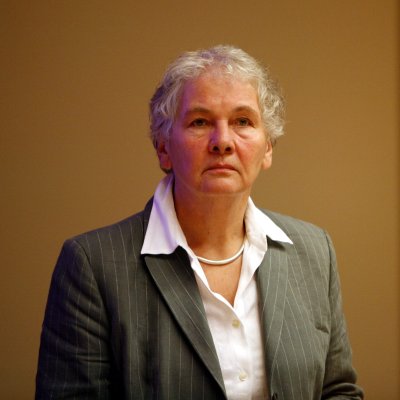
Christiane Nüsslein-Volhard

Developmental biologist; Nobel laureate in Physiology or Medicine, 1995

Recorded said elsewhere, not written here
They were blocked in their minds to do this because they thought, oh this is not done, we don’t do that in our field and you can’t do that, and I said: Why not?

Marika Griehsel, Interview at the 53rd Lindau Nobel Laureate Meeting, 30 June–4 July 2003, Nobel Prize Outreach, 1 July 2003 source ↗

Others on this question

View all 30 →
Yvon Chouinard Founder of Patagonia
One option was to sell Patagonia and donate all the money. But we couldn't be sure a new owner would maintain our values or keep our team of people around the world employed. Another path was to take the company public. What a disaster that would have been. Even public companies with good intentions are under too much pressure to create short-term gain at the expense of long-term vitality and responsibility. Truth be told, there were no good options available. So, we created our own.
Recorded Open letter published by Patagonia, 14 September 2022 source ↗
Halla Tómasdóttir Co-founder of Auður Capital; President of Iceland from 2024
We also believe in straight-talking, telling it as it is, using simple language that people understand, telling people about the downsides as well as the potential upsides, and even telling the bad news that no one wants to utter, like our lack of belief in the sustainability of the Icelandic financial sector that already we had months before the collapse hit us.
Recorded TEDWomen 2010, 8 December 2010 source ↗
Ursula K. Le Guin Novelist, poet and essayist
I’ve had a long career as a writer, and a good one, in good company. Here at the end of it, I don’t want to watch American literature get sold down the river. We who live by writing and publishing want and should demand our fair share of the proceeds; but the name of our beautiful reward isn’t profit. Its name is freedom.
Recorded National Book Awards ceremony, New York, 19 November 2014, ursulakleguin.com (the author's own site), 19 November 2014 source ↗
Tom Stoppard Playwright and screenwriter
I don’t think of it as research. I read for interest and enjoyment, and when I cease to enjoy it I stop. I didn’t research quantum mechanics but I was fascinated by the mystery that lies in the foundation of the observable world, of which the most familiar example is the wave/particle duality of light. I thought it was a good metaphor for human personality. The language of espionage lends itself to this duality—think of the double agent.
Recorded Shusha Guppy, The Paris Review, Issue 109, Winter 1988, 1988 source ↗

More from Christiane Nüsslein-Volhard

View profile →
Question Which teacher, parent, coach, or friend most made you who you are, and what did you learn from them? Relationships
we had a wonderful education because my parents were so practical … Christiane Nüsslein-Volhard: Yes I mean, I have a strong likeness of culture and also I mean my grandmother was a painter and we do music in the family quite a lot and I think that’s very important. What was also important, I thought about that recently, also maybe as a follow-up of an interview but I was asked what my parents did and so on and looking at my brothers and sisters, we had a wonderful education because my parents were so practical, they did books themselves and we did a lot of handicrafts and I knew how to knit and sew and cook and we learnt a lot to do things ourselves, to make things ourselves so we all have some dexterity in doing things ourselves and this is also very important for Science
Recorded Marika Griehsel, Interview at the 53rd Lindau Nobel Laureate Meeting, 30 June–4 July 2003, Nobel Prize Outreach, 1 July 2003 source ↗
Question What makes you want to keep learning? Attention & the world
I think a very big curiosity. I’m very curious and I like to understand things and not only science but also other things where I just try to find out why things work or how things work. Science and nature caught my attention as a small child already. I was growing up in a city but we had a garden and I loved the garden and then often on vacation I was at a farm and I loved these animals and plants and so on, so I was attracted very early on and then we had a very good teaching actually at my … I don’t know whether my teachers really had much of a role because I was determined very early, but then I also did music and I did languages and Literature and so on. I have broad interests actually other than science, but this is really true, this curiosity.
Recorded Marika Griehsel, Interview at the 53rd Lindau Nobel Laureate Meeting, 30 June–4 July 2003, Nobel Prize Outreach, 1 July 2003 source ↗
Question What counsel would you give your twenty-year-old self — and what should they ignore? Time & hindsight
so I sometimes think, why should I talk young women into being a scientist if they then end up being sort of disliked or not accepted by their contemporaries and so it’s a tricky business actually.
Recorded Marika Griehsel, Interview at the 53rd Lindau Nobel Laureate Meeting, 30 June–4 July 2003, Nobel Prize Outreach, 1 July 2003 source ↗
Question What does everyone in your world seem to agree on that you think is wrong? Values & belief
I continued the work on dorsal, discovered the recessive phenotype and interpreted the phenotype postulating a gradient determining the dorsoventral axis. At that time, gradients were not widely accepted as mechanisms, in particular biochemists were highly sceptical, however the Tübingen influence made such models attractive to me.
Recorded Laureate-written autobiography for Les Prix Nobel, Nobel Prize Outreach, 1 December 1995 source ↗
Question What lesson has mattered most in your life? Time & hindsight
Not really. I thought that getting the Nobel Prize was a big interruption in my career, I thought and it was very distracting. It takes a lot of time you know, it just takes time to be honoured, you have to travel and you have to give speeches of things you have, oh it’s so often that you get bored to tears when you hear your own voice. And it’s really taking a lot of your time and there’s no way that during this time you can start something new, I mean you just profit from what you’ve done and there is no time to develop new ideas.
Recorded Marika Griehsel, Interview at the 53rd Lindau Nobel Laureate Meeting, 30 June–4 July 2003, Nobel Prize Outreach, 1 July 2003 source ↗
Question What do you need to believe in order to get through an ordinary day? Values & belief
I sing yes sure and I garden, I have a large garden and I really recreate myself by doing gardening and thinking about something else so that when your mind gets free from all the burden of the daily troubles and then you can start putting something fresh in, you know.
Recorded Marika Griehsel, Interview at the 53rd Lindau Nobel Laureate Meeting, 30 June–4 July 2003, Nobel Prize Outreach, 1 July 2003 source ↗

More on values & belief

Also answered this

Mario Molina, Anthony Fauci, Richard Hamming, Oliver Sacks, Adam Zagajewski, Ursula K. Le Guin

Search the directory for somebody in particular.

Explore further

Report this answer