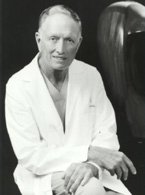
Denton Cooley

Cardiothoracic surgeon; founder of the Texas Heart Institute

Recorded said elsewhere, not written here
The man who inspired me most, I think, was Dr. Alfred Blalock, who was professor of surgery at Johns Hopkins. He was a rather simple man with a burning curiosity. It was through his curiosity that he made many real contributions to medical science. I didn’t think he was an especially brilliant man, I just admired him for his curiosity, and for his perseverance.

Academy of Achievement interview source ↗

Others on this question

View all 77 →
Rita Dove Poet; Poet Laureate of the United States, 1993-1995; Pulitzer Prize for Poetry 1987
Well, I had a couple. I had a couple teachers who did inspire me. One was this eleventh grade English teacher — eleventh and twelfth grade. She and I, we still have tea together sometimes today. I was frightened before I went into her class. I heard she was a battle axe. I heard that she would flunk you if you split an infinitive. And it’s true. She would, but she also would tell you what a split infinitive was, and then once you knew, you never did it again. She just opened up to me, how language — how the written word — can also sing. And she spent, I remember once, 45 minutes on one page: the first page of a novel. By the end of the class, no one had taken down a single note, because we were absolutely enthralled. It was incredible.
Recorded Academy of Achievement interview source ↗
Christiane Nüsslein-Volhard Developmental biologist; Nobel laureate in Physiology or Medicine, 1995
we had a wonderful education because my parents were so practical … Christiane Nüsslein-Volhard: Yes I mean, I have a strong likeness of culture and also I mean my grandmother was a painter and we do music in the family quite a lot and I think that’s very important. What was also important, I thought about that recently, also maybe as a follow-up of an interview but I was asked what my parents did and so on and looking at my brothers and sisters, we had a wonderful education because my parents were so practical, they did books themselves and we did a lot of handicrafts and I knew how to knit and sew and cook and we learnt a lot to do things ourselves, to make things ourselves so we all have some dexterity in doing things ourselves and this is also very important for Science
Recorded Marika Griehsel, Interview at the 53rd Lindau Nobel Laureate Meeting, 30 June–4 July 2003, Nobel Prize Outreach, 1 July 2003 source ↗
Rosa Parks Civil-rights activist
My family, I would say, my mother, and my maternal grandparents. I grew up with them. My mother was a teacher in a little school, and she believed in freedom and equality for people, and did not have the notion that we were supposed to live as we did, under legally enforced racial segregation. She didn’t believe in it.
Recorded Academy of Achievement interview source ↗
Benjamin Carson Paediatric neurosurgeon; director of paediatric neurosurgery at Johns Hopkins, 1984-2013
I definitely had some teachers who were important. My fifth grade science teacher, Mr. Jake, was really the first teacher to express confidence in my academic abilities because I was the only person who could identify a rock, which was obsidian and it was because of the reading that I had been doing because after I got through with the animal books, I went to plants, and when I finished all the plant books, I went to rocks because we lived on the railroad tracks and there were a lot of rocks, so I became an expert in geology, and this was while I was still a dummy in the class. So, it was like the first time that I had an opportunity to raise my hand and demonstrate my knowledge because nobody else knew the answer. Everybody was absolutely flabbergasted, but Mr. Jake said to me, “Benjamin, that’s incredible.” He said, “Why don’t you come by the laboratory after school and we can talk about starting a rock collection for you.” And, from there I started going to the laboratory every day, getting involved with feeding the squirrel, a red squirrel named Maynard. There was a tarantula, crayfish, a Jack Dempsey fish and I got involved in all this stuff. There was a microscope and I started looking at water specimens and learned all about paramecium and volvox and amoebas, and it was just incredible. That really was what started me on my way.
Recorded Academy of Achievement interview source ↗

More from Denton Cooley

View profile →
Question What is an unusual habit or an absurd thing that you love? Daily life
I don’t lead by force, I lead by example. And if I can, set a good example. If I can set an example to my staff and my group, by being punctual, I come to work every morning, walk onto the hospital floor within two or three minutes of the same time every day, and they can depend upon it.
Recorded Academy of Achievement recorded interview, American Academy of Achievement, 11 April 1991 source ↗
Question Do you rely on inspiration or discipline to make work? Craft & work
I think so. I really do. With your own effort, you can improve yourself, but people find they can’t improve beyond a certain point. I like to play golf, but I know that no matter how much I practice, I will never get above a certain level. I think that’s also true of surgery. Some people are born with the gifts and the mind for surgery, and they may go on to great heights. Others may try and try, only to reach a certain plateau.
Recorded Academy of Achievement interview, Houston, Texas, 11 April 1991 source ↗

More on relationships

Also answered this

Aaron Ciechanover, Ernst Mayr, Michael DeBakey, Edward Teller, Robert J. Lefkowitz, Paul Farmer

Search the directory for somebody in particular.

Explore further

Report this answer