Skip to content
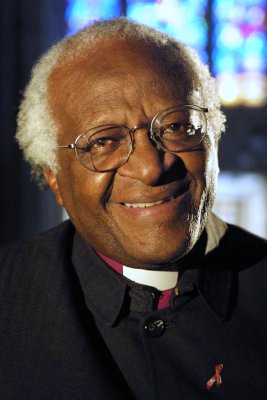
Desmond Tutu

Anglican Archbishop of Cape Town; chair of South Africa’s Truth and Reconciliation Commission; Nobel Peace Prize, 1984

Recorded said elsewhere, not written here
Remember that the resentment and the anger leveled at the United States is not leveled against Americans as Americans. It is leveled against a particular policy followed by a particular administration, and change the policy or maybe change the administration, and you will find, I mean, that there is very little anti-Americanism in the world. There is a lot of — I mean, there is a lot of anger at an America that has been arrogant and an America that believe it is good, go it alone. You know, your unilateralism where you went to the United Nations thinking that they would just endorse your view, and when they said no, you said go jump in the lake, and you went and you did your own thing, and you landed in a huge mess. Well, people don’t want to say we told you so, you know, because you realize, I mean, after 9/11, most of the world was deeply — I mean, America was held in the highest. People really felt deeply for you, and I’m sure you all felt loved, and you dissipated it in next to no time. You know, I mean, chop, chop, chop, and it disappeared, but it shows, you know, it isn’t that there is an ingrained hatred of America. There isn’t.

Academy of Achievement interview source ↗

Others on this question

View all 80 →
Jocelyn Bell Burnell Radio astronomer; discoverer of pulsars
The next generation of telescopes will see millions of events per night with computers that sift through huge amounts of data. If we had had access to a computer, we would never have programmed it to look for something so unexpected. How do you pick up the things you don't know exist, the things you can't tell it to look for? My project was to study quasars, and then we accidentally stumble over these things called pulsars. They were totally unexpected, totally unknown – and it's been huge fun.
Recorded Louise Walsh, University of Cambridge 'Journeys of Discovery' interview series, 1 January 2020 source ↗
Jacqueline Novogratz Founder and chief executive of Acumen
On the one hand, we have people that say the aid system is so broken we need to throw it out. And on the other we have people who say the problem is that we need more aid. ... Both sides are right. And the problem is that neither side is listening to the other. Even more problematic, they're not listening to poor people themselves.
Recorded TED, 3 June 2009 source ↗
John C. Bogle Founder of The Vanguard Group, 1974
Over the past two centuries, our nation has moved from being an agricultural economy, to a manufacturing economy, to a service economy, and now to a predominantly financial economy. But our financial economy, by definition, subtracts from the value created by our productive businesses. Think about it: while the owners of business enjoy the dividend yields and earnings growth that our capitalistic system creates, those who play in the financial markets capture those investment gains only after the costs of financial intermediation are deducted. Thus, while investing in American business is a winner's game, beating the stock market before those costs is a zero-sum game. But after intermediation costs are deducted, beating the market—for all of us as a group—becomes a loser's game.
Recorded Georgetown University commencement, Georgetown University / johncbogle.com, 18 May 2007 source ↗
Lisa Su Chair and chief executive of Advanced Micro Devices
Technology itself does not decide what the future looks like.
Recorded MIT OneMIT Commencement, MIT News, 28 May 2026 source ↗

More from Desmond Tutu

View profile →
Question When did you last change your mind about something important? Change of mind
I used to be “Mister Disinvestment.” Now I would like to be Mister Investment and say, “Come! Come and be part of an exciting, exhilarating process. Come in! Come in on the ground floor and see a people do something that’s probably never happened before, people seeking to become something radically different from what their antecedents would have made us believe they were likely to become.
Recorded Academy of Achievement interview source ↗
Question What accomplishment matters most to you? Craft & work
One moment, Nelson Mandela is in jail, and the next moment, he is walking, a free man. One moment, we are shackled as the oppressed of apartheid; the next, we are voting for the very first time. I was 63 when I voted for the first time in my life in the country of my birth. Nelson Mandela was 76 years of age. But it happened, it happened. It happened partly because the international community supported us. People prayed for us. People demonstrated on our behalf, especially young people. Students at universities and college campuses used to sit out in the baking sunshine to force their institutions to divest and the miracle happened. We became free because we were helped and we want to say a big “thank you” to the world. And, you can become free nonviolently.
Recorded Academy of Achievement interview source ↗
Question Which problem are you still chipping away at? Craft & work
So a great deal has changed, but we in the Truth and Reconciliation Commission said, “Watch it. You can kiss reconciliation and forgiveness goodbye, unless the gap between the rich and the poor — the haves and the have-nots — is narrowed, and narrowed quickly and dramatically.” So yes, we face very, very considerable problems.
Recorded Academy of Achievement interview source ↗
Question What has life taught you about being human? Values & belief
I have come to realize the extraordinary capacity for evil that all of us have because we have now heard the Truth and Reconciliation Commission, and there have been revelations of horrendous atrocities that people have committed. Any and every one of us could have perpetrated those atrocities. The people who were perpetrators of the most gruesome things didn’t have horns, didn’t have tails. They were ordinary human beings like you and me. That’s the one thing. Devastating! But the other, more exhilarating than anything that I have ever experienced — and something I hadn’t expected — to discover that we have an extraordinary capacity for good. People who suffered untold misery, people who should have been riddled with bitterness, resentment and anger come to the Commission and exhibit an extraordinary magnanimity and nobility of spirit in their willingness to forgive, and to say, “Hah! Human beings actually are fundamentally good.” Human beings are fundamentally good. The aberration, in fact, is the evil one, for God created us ultimately for God, for goodness, for laughter, for joy, for compassion, for caring.
Recorded Academy of Achievement interview source ↗
Question What made you stop something you were known for, and how did you know it was time? Time & hindsight
I stopped being a teacher when the South African Government introduced a deliberately inferior education for blacks called Bantu education, and I felt I wasn’t ready to collaborate with this apology for an educational system. Our children, the 1976 kids who revolted against apartheid in Soweto, called it “gutter education,” and it was gutter education. I left teaching. Of course, I didn’t have too many option, and mercifully, the Bishop of Johannesburg at that time accepted me for training for the priesthood. So I came to the priesthood, as it were, by default.
Recorded Academy of Achievement recorded interview, American Academy of Achievement, 12 June 2004 source ↗
Question What do you need to believe in order to get through an ordinary day? Values & belief
Many of us had moments when we doubted that apartheid would be defeated, certainly not in our lifetime. But, I never had that sense. I knew in a way that was unshakable, because you see, when you look at something like Good Friday, and saw God dead on the cross, nothing could have been more hopeless than Good Friday. And then, Easter happens, and whammo! Death is done to death, and Jesus breaks the shackles of death and devastation, of darkness, of evil. And, from that moment on, you see, all of us are constrained to be prisoners of hope. If God could do this with that utterly devastating thing, the desolation of a Good Friday, of the cross, well, what could stop God then from bringing good out of this great evil of apartheid? So, I never doubted that ultimately we were going to be free because ultimately, I knew there was no way in which a lie could prevail over the truth, darkness over light, death over life.
Recorded Academy of Achievement interview source ↗

More on values & belief

Also answered this

Corazon Aquino, Bill Clinton, Óscar Arias Sánchez, Mikhail Gorbachev, Barack Obama, Eleanor Roosevelt

Search the directory for somebody in particular.

Explore further

Report this answer