Skip to content
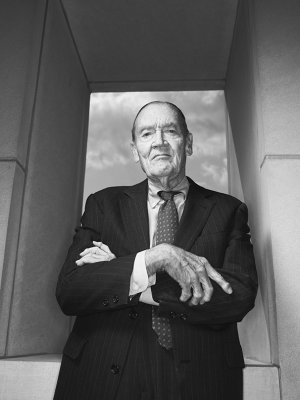
John C. Bogle

Founder of The Vanguard Group, 1974

Recorded said elsewhere, not written here
Over the past two centuries, our nation has moved from being an agricultural economy, to a manufacturing economy, to a service economy, and now to a predominantly financial economy. But our financial economy, by definition, subtracts from the value created by our productive businesses. Think about it: while the owners of business enjoy the dividend yields and earnings growth that our capitalistic system creates, those who play in the financial markets capture those investment gains only after the costs of financial intermediation are deducted. Thus, while investing in American business is a winner's game, beating the stock market before those costs is a zero-sum game. But after intermediation costs are deducted, beating the market—for all of us as a group—becomes a loser's game.

Georgetown University commencement, Georgetown University / johncbogle.com, 18 May 2007 source ↗

Others on this question

View all 80 →
Tony Elumelu Chairman of Heirs Holdings and of the United Bank for Africa
I will start by stating the obvious. No one here questions whether development is desirable. No one questions the inherent need to save lives and help others by giving. However, I believe that we need to rethink the ways in which we help others. We need to give from the perspective of empowering the recipient, instead of making them dependent on us.
Recorded Georgetown University, Washington DC, The Tony Elumelu Foundation, 12 May 2015 source ↗
Satya Nadella Chief executive of Microsoft
Most people think that culture is something that happens to them, but what is important is that you take responsibility for culture — after all it's just a reflection of all of us, our every behavior and every action of ours.
Recorded Interview originally given to Business Insider Polska, quoted by SmartCompany, 27 April 2017 source ↗
Desmond Tutu Anglican Archbishop of Cape Town; chair of South Africa’s Truth and Reconciliation Commission; Nobel Peace Prize, 1984
Remember that the resentment and the anger leveled at the United States is not leveled against Americans as Americans. It is leveled against a particular policy followed by a particular administration, and change the policy or maybe change the administration, and you will find, I mean, that there is very little anti-Americanism in the world. There is a lot of — I mean, there is a lot of anger at an America that has been arrogant and an America that believe it is good, go it alone. You know, your unilateralism where you went to the United Nations thinking that they would just endorse your view, and when they said no, you said go jump in the lake, and you went and you did your own thing, and you landed in a huge mess. Well, people don’t want to say we told you so, you know, because you realize, I mean, after 9/11, most of the world was deeply — I mean, America was held in the highest. People really felt deeply for you, and I’m sure you all felt loved, and you dissipated it in next to no time. You know, I mean, chop, chop, chop, and it disappeared, but it shows, you know, it isn’t that there is an ingrained hatred of America. There isn’t.
Recorded Academy of Achievement interview source ↗
Elinor Ostrom Political economist; laureate of the Sveriges Riksbank Prize in Economic Sciences, 2009
Yes, we're showing that. But we're also showing a very important role for face-to-face or even written communication. So, the prediction was that nobody would self-monitor because that's a second level social dilemma, if you go to Game Theory. But, what we've found is that people will, but it can be … people can escalate into, 'I'll punish you, you punish him, mamamamamma,' and it gets worse and worse. So, with communication, where there's an agreement on what is going to be the … what we are going to do. The 'we' then being well-defined, then people can follow rules, be cooperative and, occasionally, sanction one another to help that continue.
Recorded Adam Smith, Telephone interview recorded immediately after the prize announcement, Nobel Prize Outreach, 12 October 2009 source ↗

More from John C. Bogle

View profile →
Question If you could put a message on a giant billboard, what would it say and why? Time & hindsight
There's the world's work to be done, and there are never enough citizens with determined hearts, courageous character, intelligent minds, and idealistic souls to do it. Yes, our world already has quite enough guns, political platitudes, arrogance, disingenuousness, self-interest, snobbishness, superficiality, war, and the certainty that God is on one side or the other. But it never has enough conscience, nor enough tolerance, idealism, justice, compassion, wisdom, humility, self-sacrifice for the greater good, integrity, courtesy, poetry, laughter, and generosity of substance and spirit. It is these elements that I urge you to carry into your careers, and remember that the great game of life is not about money; it is about doing your best to build the world anew.
Recorded Georgetown University commencement, Georgetown University / johncbogle.com, 18 May 2007 source ↗

More on values & belief

Also answered this

Lisa Su, Mark Zuckerberg, Jacqueline Novogratz, Satya Nadella, Daron Acemoglu, Charlie Munger

Search the directory for somebody in particular.

Explore further

Report this answer