Skip to content
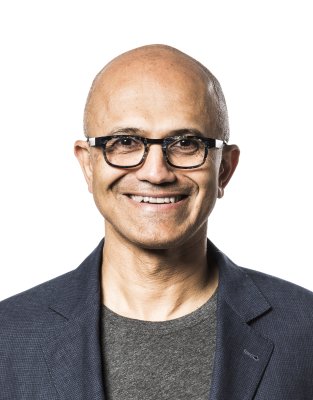
Satya Nadella

Chief executive of Microsoft

Recorded said elsewhere, not written here
Most people think that culture is something that happens to them, but what is important is that you take responsibility for culture — after all it's just a reflection of all of us, our every behavior and every action of ours.

Interview originally given to Business Insider Polska, quoted by SmartCompany, 27 April 2017 source ↗

Others on this question

View all 80 →
Frederick Douglass Abolitionist, orator, newspaper editor and U.S. diplomat; U.S. Marshal for the District of Columbia 1877–1881; U.S. Minister Resident to Haiti 1889–1891
I do not think much of the accident or good luck theory of self-made men. It is worth but little attention and has no practical value. An apple carelessly flung into a crowd may hit one person, or it may hit another, or it may hit nobody. The probabilities are precisely the same in this accident theory of self-made men. It divorces a man from his own achievements, contemplates him as a being of chance and leaves him without will, motive, ambition and aspiration. Yet the accident theory is among the most popular theories of individual success.
Recorded Lecture, delivered repeatedly 1859–1893, Teaching American History, reproducing Frederick Douglass Papers, Library of Congress Manuscript Division source ↗
Roger Penrose Mathematical physicist; Nobel laureate in Physics, 2020
Now according to me, and this is my cosmology scheme, which I'm having trouble persuading the cosmologists about, is that when the universe is rid of pretty well all its matter, it in a certain sense forgets how big it is. Now that's a crazy idea, but you see if you don't have any mass around you don't have any way of scaling the size of the universe, and so it in effect becomes the big bang of the next aeon as I'm calling it – A E O N. So according to my scheme, the universe as we currently understand it, which is from big bang, and then there's this inflationary phase which I don't believe in, which is supposed to take place very, very early on, and then the universe has this more sedate expansion, and then it has another exponential expansion, and that's it. According to me, that's not it. It morphs into the next big bang.
Recorded Adam Smith, Telephone interview recorded shortly after the prize announcement, Nobel Prize Outreach, 6 October 2020 source ↗
John Hopfield American scientist
I’d read some of the things that Don Glaser wrote, for example, and they’re imaginative physics, they’re not quite such good biology. There was a consensus that said you had to be able to reach out from physics and get to some of these things you’d like to, but then you have to know enough about the biology that the whole thing makes sense. And you really have to present things in such a way that a community develops. I didn’t realize that at the time, but certainly one of the important things of what I did had to do with enabling people who came from physics, or who came from biology, become a community, working on not just one little problem or piece, but somehow collectively working together toward trying to get an understanding.
Recorded Adam Smith, Telephone interview recorded shortly after the prize announcement, Nobel Prize Outreach, 1 October 2024 source ↗
Amartya Sen Economist and philosopher; laureate of the Sveriges Riksbank Prize in Economic Sciences, 1998
And yet, despite the high moral and ethical quality of social commiseration, political dedication and a deep commitment to equity, there was something rather disturbing about standard leftwing politics of that time: in particular, its scepticism of process-oriented political thinking, including democratic procedures that permit pluralism. The major institutions of democracy got no more credit than what could be portioned out to what was seen as "bourgeois democracy," on the deficiencies of which the critics were most vocal. The power of money in many democratic practices was rightly identified, but the alternatives – including the terrible abuses of non-oppositional politics – did not receive serious critical scrutiny.
Recorded Laureate-written autobiography for Les Prix Nobel, Nobel Prize Outreach, 1 December 1998 source ↗

More from Satya Nadella

View profile →
Question Which book do you recommend most often to others, and what makes you pass it on? Taste & recommendation
And this is where, a couple of years before I had become CEO, I had read this book by Carol Dweck out of Stanford [University] called “Mindset,” which was more in relation to my kids. And the simple concept in that book, which I loved a lot, was it's better to be a learn-it-all even if the know-it-all has more innate capability, because the learn-it-all ultimately will do better. And I said, well, that applies to CEOs. That applies to companies made up of people. And I said: What if we introduce that as the meme to have the cultural dialogue at Microsoft?
Recorded The Economic Club of Washington, D.C. (official transcript) source ↗

More on values & belief

Also answered this

Mark Zuckerberg, Nithin Kamath, David Vélez, Hiroshi Mikitani, Marvin Minsky, Lisa Su

Search the directory for somebody in particular.

Explore further

Report this answer