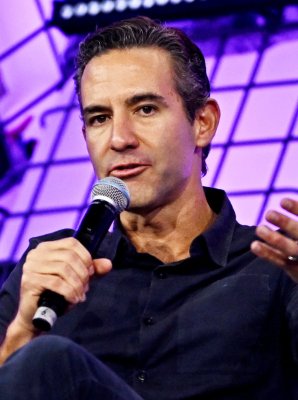
I always say the Nubank story was very unlikely. It was a very low probability event. Again. We were going after these very big incumbent banks. Everybody told me, you know, you're Colombian. You have no idea what you're doing in Brazil. They're going to crush you. Like, don't. Just don't do it. And I did it mostly because everybody told me I couldn't do it. And so, if somebody tells me I can't do something, I want to go do it.
Not claimed by David Vélez
David Vélez has not joined FLAPSS and has not endorsed it. This page is a reference record assembled from published interviews and public remarks. Every answer below is a direct quotation with the source and date shown next to it.
David Vélez
Co-founder and chief executive of Nubank
Colombia
Technology
20 answers
The second thing there was another thing I learned at Sequoia is that the culture of a business is built in the first six months by the first ten to 15 employees. These are magical, really, really important times. And I used to hear a lot even at Sequoia, a lot of entrepreneurs saying, “Hey, I'm too busy to think about culture. When we become a unicorn, when we grow, I'll worry about culture.” And for whoever has kids, it's almost like saying I'm too busy about educating my kids. When they turn 18, then I'll figure it out. Too late.
Sí, empezamos desde cero. Pedimos una licencia de financiamiento comercial, pero es difícil comenzar porque la banca se basa en confianza, regulación y escala. Hay barreras regulatorias que dificultan la entrada de nuevos jugadores. Es un sector históricamente cerrado, que favorece a los incumbentes. Aun así, logramos construir una marca fuerte y generar confianza en los consumidores.
Primero, lanzarse, incluso sin tener todas las respuestas. Segundo, tener resiliencia y disciplina, porque los mercados son volátiles. Tercero, buscar grandes problemas del consumidor. Muchas oportunidades nacen de la frustración.
Pix is probably the most successful payment infrastructure run by a government in history. I think Pix has been what has allowed a country like Brazil to leapfrog developed economies like the U.S. and in Europe, and has positioned Brazil today probably five years ahead of the U.S. I don't think anybody understands that, and probably in the U.S. they didn't really expect that.
I think a lot of that first wave of entrepreneurship was missing the product of localization, and they weren't really asking the question, "What are the big, impactful products or problems that we got to solve locally, and forget about the U.S. or forget about Europe?"
No, falta mucho por construir. Estoy muy contento con lo que hemos podido construir en Nubank en estos casi diez años. En lo personal, tengo una familia con cuatro niños chiquitos y eso es un desafío gigantesco, que crezcan, sean buenas personas y lleguen a ser buenos ciudadanos. Es un gran desafío en el que estoy muy enfocado.
¿Es la tecnología, el machine learning y la inteligencia artificial? Sí, es verdad, pero al final la diferencia es que hacemos algo que mi mamá me decía cuando era chiquito: "Tratemos a los demás como nos gustaría que nos traten a nosotros".
Queremos crear un ambiente familiar en donde no todo sea fácil, en donde no todo les caiga del cielo, sino que puedan construir su propio camino y tengan ese sentido de desesperación y esa hambre. Eso significa también que todo ese dinero no se les va a dejar a ellos. Se les dará muchísimo amor, como les damos, y muchas oportunidades de educación y de desarrollo, pero todo ese dinero no es para ellos.
Apenas me despierto, a las 5:00 a. m., cuando voy a hacer deporte. Es lo primero que cojo cuando me despierto. No es la mejor práctica, pero sí desde tempranito.
Vicky, qué pregunta más difícil (risas). Voy a hablarle de los casos que nos han inspirado, como Charles Feeney, cofundador de los Duty Free Shop en los aeropuertos. Él hizo eso en los años ochenta. Se volvió uno de los hombres más ricos del mundo cuando vendió su compañía e inmediatamente se dedicó a la filantropía y gastó todo su dinero en metas sociales.
Los diferentes trabajos en los que he estado, después de mi graduación, han sido de 100 y 120 horas a la semana, especialmente empezando con Nubank. Básicamente vivía en el lugar de trabajo. Empezamos la compañía en una casa de dos pisos. Mi cofundador vivía en el segundo piso. Yo básicamente dormía en el primer piso, o pasaba muchas noches en el primer piso. No salimos de esa casa por seis o 12 meses porque trabajábamos como locos.
Me gustaría que la gente se viera empoderada a construir, a resolver problemas. Que salgamos muchas veces de esa visión de víctimas en la que dependemos de muchas fuerzas. Que veamos problemas como grandes oportunidades para ayudar a resolver. Por ejemplo, frente a esa mala experiencia con los bancos, como me pasó en Brasil, mucha gente se hubiera sentado y quejado del banco. Pero vi una oportunidad gigantesca de ir y competir contra él.
Un constructor.
we should invest the majority of our wealth the same way we are investing the majority of our time- by helping to improve people's lives.
The simplicity and yet profoundness of the above logic leads us to conclude that for us the most natural and truthful path is to invest this wealth until "our last check bounces", as one of our personal heroes, Chuck Feeney, likes to say.
Moving closer to work. I live in São Paulo, Brazil, and I used to spend an hour or more in traffic every day, just sitting in the car getting frustrated and anxious. It was a waste of my time.
I wish I knew more about Clojure, which is the programming language we use most at Nubank. If I did, I could better understand some of the more complex problems we're trying to solve, and I think I could ask better questions when we're setting priorities. I'd like to be able to communicate at that level with the technical side of our team, and I think they would appreciate it, too.
In the first few months of Nubank, I asked everybody to be here by 8:00 a.m. every day. I saw it as a test of people's commitment, and I was pretty rigid about it.
Now I try to protect one hour in the morning and one in the afternoon where I turn off Slack, and I don't check email. I might read, or write in a journal, or just go for a walk. It's become one of the most important parts of my day. It's when I'm most creative, and when I hit on ideas that can take the company in new directions.
Every quotation above is reproduced from the source shown beside it and has not been edited. David Vélez did not write these answers for FLAPSS. Request a correction or removal.