Skip to content

The question

What makes you want to keep learning?

Originally asked

Vox, to writers and thinkers, 9 Questions, 2017

This exact prompt is one of Vox's nine recurring questions about intellectual habits.

You answer as yourself. Nobody on FLAPSS answers as anybody else.

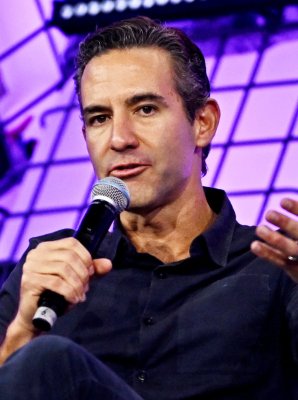
David Vélez

Co-founder and chief executive of Nubank

Recorded said elsewhere, not written here
I wish I knew more about Clojure, which is the programming language we use most at Nubank. If I did, I could better understand some of the more complex problems we're trying to solve, and I think I could ask better questions when we're setting priorities. I'd like to be able to communicate at that level with the technical side of our team, and I think they would appreciate it, too.

questionnaire, Sequoia Capital, 15 August 2018 source ↗

Others on this question

View all 9 →
Winston Churchill Prime Minister of the United Kingdom, 1940–1945 and 1951–1955; Member of Parliament 1900–1964
At this school I was allowed to learn things which interested me: French, History, lots of Poetry by heart, and above all Riding and Swimming. The impression of those years makes a pleasant picture in my mind, in strong contrast to my earlier schoolday memories.
Recorded Chapter of his autobiography, written at Chartwell in 1930, Winston S. Churchill, My Early Life (Thornton Butterworth, 1930), Project Gutenberg Canada, October 1930 source ↗
Christiane Nüsslein-Volhard Developmental biologist; Nobel laureate in Physiology or Medicine, 1995
I think a very big curiosity. I’m very curious and I like to understand things and not only science but also other things where I just try to find out why things work or how things work. Science and nature caught my attention as a small child already. I was growing up in a city but we had a garden and I loved the garden and then often on vacation I was at a farm and I loved these animals and plants and so on, so I was attracted very early on and then we had a very good teaching actually at my … I don’t know whether my teachers really had much of a role because I was determined very early, but then I also did music and I did languages and Literature and so on. I have broad interests actually other than science, but this is really true, this curiosity.
Recorded Marika Griehsel, Interview at the 53rd Lindau Nobel Laureate Meeting, 30 June–4 July 2003, Nobel Prize Outreach, 1 July 2003 source ↗
Shinya Yamanaka Stem cell biologist; Nobel laureate in Physiology or Medicine, 2012
I got very interested in so-called “knockout mouse” technology. Knockout mouse is a way to study the function of genes. You know, both human and mouse have approximately 20,000 genes. With knockout mouse technology, we can select one gene out of those 20,000 genes, and completely destroy that one particular gene so that we can understand the function of that particular gene. I got very interested in that technology. It was 1992 or 1993 when I graduated from my Ph.D. school. So I decided to study — I decided to learn about knockout mouse technology. But at that time in Japan, only a few scientists were working on knockout mouse technology. That’s why I decided to move to the States, San Francisco
Recorded Academy of Achievement interviewer, Academy of Achievement interview, 2008 source ↗
Mario Molina Atmospheric chemist; Nobel laureate in Chemistry, 1995
I have also benefited from teaching; as I try to explain my views to students with critical and open minds, I find myself continually being challenged to go back and rethink ideas. I now see teaching and research as complementary, mutually reinforcing activities.
Recorded Laureate-written autobiography, provided by the laureate in November 2007, Nobel Prize Outreach, 1 November 2007 source ↗

More from David Vélez

View profile →
Question How would you want people to remember you? Death & what remains
Me gustaría que la gente se viera empoderada a construir, a resolver problemas. Que salgamos muchas veces de esa visión de víctimas en la que dependemos de muchas fuerzas. Que veamos problemas como grandes oportunidades para ayudar a resolver. Por ejemplo, frente a esa mala experiencia con los bancos, como me pasó en Brasil, mucha gente se hubiera sentado y quejado del banco. Pero vi una oportunidad gigantesca de ir y competir contra él.
Recorded Vicky Dávila, interview, Semana, 1 October 2022 source ↗
Question What would you most want to leave your children? Death & what remains
Queremos crear un ambiente familiar en donde no todo sea fácil, en donde no todo les caiga del cielo, sino que puedan construir su propio camino y tengan ese sentido de desesperación y esa hambre. Eso significa también que todo ese dinero no se les va a dejar a ellos. Se les dará muchísimo amor, como les damos, y muchas oportunidades de educación y de desarrollo, pero todo ese dinero no es para ellos.
Recorded Vicky Dávila, interview, Semana, 1 October 2022 source ↗
Question What is the biggest professional obstacle you have faced? Craft & work
Sí, empezamos desde cero. Pedimos una licencia de financiamiento comercial, pero es difícil comenzar porque la banca se basa en confianza, regulación y escala. Hay barreras regulatorias que dificultan la entrada de nuevos jugadores. Es un sector históricamente cerrado, que favorece a los incumbentes. Aun así, logramos construir una marca fuerte y generar confianza en los consumidores.
Recorded Alejandra Rico Muñoz, interview, La República, 25 March 2026 source ↗

More on attention & the world

Also answered this

Steve Jobs, Winston Churchill, Desmond Tutu, Richard Feynman, Shinya Yamanaka, John Lewis

Search the directory for somebody in particular.

Explore further

Report this answer