Skip to content
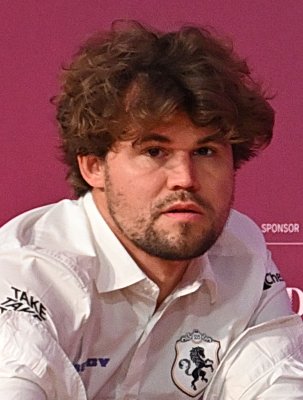
Magnus Carlsen

Norwegian chess grandmaster; World Chess Champion 2013–2023

Recorded said elsewhere, not written here
What kind of talent I had when I was really young was that I was able to concentrate on something for a really long time. My interest didn't really wane...That's been my main advantage. I've never been the one to grasp things the quickest, but I never stopped learning as soon as I became interested in a subject.

On-stage interview, Milken Institute Global Conference, Los Angeles, Chess.com, 5 May 2017 source ↗

Others on this question

View all 26 →
Elmore Leonard Novelist and screenwriter
My most important rule is one that sums up the 10: if it sounds like writing, I rewrite it.
Recorded The Guardian Review, 20 February 2010 source ↗
Eliud Kipchoge Kenyan marathon runner
When I have a lot of pain, I try to confuse my mind to forget about the pain and think about the distance. I don't want pain to be in my mind, because I'd really lose focus on running. After winning, you won't have that pain, but it comes later. The marathon is hard; the second day, you don't go up or down stairs.
Recorded Address and Q&A at the Oxford Union Society, November 2017, Outside, 10 February 2018 source ↗
Gustavo Dudamel Conductor; Music and Artistic Director of the Los Angeles Philharmonic
I will say it’s very in a way looks very physical. You know, it’s like a dance. At the end, you are moving your hands in front of an orchestra, your arms, but it’s like a choreography, and that is, that is a dance part of, of conducting. … But at the end, yes, is something that starts from that, but then it gets very deep in a very, I will say philosophical, metaphysical, psychological thing, conducting—more than. Spiritual. It’s more than moving your hands in front of an orchestra and the people watching you jump or move or do these kind of things, it’s something very spiritual, that is right.
Recorded Academy of Achievement (achievement.org) source ↗
Winston Churchill Prime Minister of the United Kingdom, 1940–1945 and 1951–1955; Member of Parliament 1900–1964
Mr. Somervell—a most delightful man, to whom my debt is great—was charged with the duty of teaching the stupidest boys the most disregarded thing—namely, to write mere English. He knew how to do it. He taught it as no one else has ever taught it. Not only did we learn English parsing thoroughly, but we also practised continually English analysis. Mr. Somervell had a system of his own. He took a fairly long sentence and broke it up into its components by means of black, red, blue and green inks. Subject, verb, object: Relative Clauses, Conditional Clauses, Conjunctive and Disjunctive Clauses! Each had its colour and its bracket. It was a kind of drill. We did it almost daily. ... I learned it thoroughly. Thus I got into my bones the essential structure of the ordinary British sentence—which is a noble thing.
Recorded Chapter of his autobiography, written at Chartwell in 1930, Winston S. Churchill, My Early Life (Thornton Butterworth, 1930), Project Gutenberg Canada, October 1930 source ↗

More from Magnus Carlsen

View profile →
Question What does the first hour of your day look like? Daily life
I would want to be a role model. As you talk about an athlete who wakes up at seven every day, then you have two training sessions...for me, it's not like that. I definitely think about chess all the time. I work at chess every day but it's not like I have a routine. It's always been based on inspiration for me. Fortunately, I haven't run out of inspiration yet...Sometimes I play better when I haven't slept that much, because you kind of play more creative.
Recorded On-stage interview, Milken Institute Global Conference, Los Angeles, Chess.com, 5 May 2017 source ↗

More on craft & work

Also answered this

Tanni Grey-Thompson, Cathy Freeman, Eliud Kipchoge, Simone Biles, Chris Hoy, Tom Stoppard

Search the directory for somebody in particular.

Explore further

Report this answer