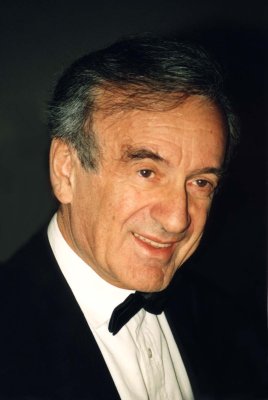
Elie Wiesel

Writer and human rights advocate; Nobel Peace Prize laureate, 1986

Recorded said elsewhere, not written here
Sensitivity. Be sensitive in every way possible about everything in life. Be sensitive. Insensitivity brings indifference and nothing is worse than indifference. Indifference makes that person dead before the person dies.

Academy of Achievement interview, 29 June 1996 source ↗

Others on this question

View all 95 →
Brian Chesky Co-founder and chief executive of Airbnb
Getting rich slow isn't actually slower. It's slower in year one, but it might be faster in year seven.
Recorded Chesky's remarks to Fortune in 2017, quoted by Business Insider, Business Insider (Markets Insider), August 2020 source ↗
Ratan Tata Chairman of Tata Sons, 1991–2012
I would hope that most of you will in fact strive for leadership in a principled manner with values, because that would be the foundation that this country needs to have if it is to take its place in the world. I would hope that each of you would lead by example and that each of you would live by the principles that you espouse.
Recorded Indian School of Business, Hyderabad — graduation address, Rediff Business, 11 June 2010 source ↗
David Vélez Co-founder and chief executive of Nubank
Primero, lanzarse, incluso sin tener todas las respuestas. Segundo, tener resiliencia y disciplina, porque los mercados son volátiles. Tercero, buscar grandes problemas del consumidor. Muchas oportunidades nacen de la frustración.
Recorded Alejandra Rico Muñoz, interview, La República, 25 March 2026 source ↗
Richard Leakey Palaeoanthropologist and conservationist; head of the Kenya Wildlife Service
It’s very hard to give people advice, because you don’t know their personality. Personality is a big part of that. Everybody is faced with passing opportunities. Many people watch the opportunity come and watch it go. I say, if an opportunity comes and you have got the self-confidence, grab it. Ride it for a bit. If it’s not the right opportunity, do something else, but be positive about opportunities.
Recorded Academy of Achievement recorded interview, American Academy of Achievement, 21 June 2007 source ↗

More from Elie Wiesel

View profile →
Question What are you unwilling to optimise? Values & belief
It went from publisher to publisher to publisher. All of them refused it. They gave the same reasons, until a small publisher picked it up. From 1960 to 1963, three years, it didn’t sell 1500 copies. Nobody wanted to read it. It doesn’t matter. I am not here to sell, I’m here to write.
Recorded Academy of Achievement recorded interview, American Academy of Achievement, 29 June 1996 source ↗
Question What is the hardest thing that has happened to you, and what did you carry out of it? Failure & regret
After the war — I was 15 when I entered the camp, I was 16 when I left it, and all of a sudden you become an orphan and you have no one. I had a little sister and I knew, with my mother the first night, that they were swept away by fire. My older sisters I discovered by accident after the war in Paris, where I was in an orphanage. But to be an orphan — you can become an orphan at 50, you are still an orphan. Very often I think of my father and my mother. At any important moment in my life, they are there, thinking, “What an injustice.”
Recorded Academy of Achievement recorded interview, American Academy of Achievement, 29 June 1996 source ↗
Question Which book changed the way you think, and what did it change? Taste & recommendation
I remember the awakening that occurred in me when I read, for the first time, Franz Kafka. ... That morning I was happy. I wanted to run out and embrace them, all these garbage collectors, because they taught me that there was another world than the world of Kafka, which is absurd and desperate, and despairing.
Recorded Academy of Achievement interview, 29 June 1996 source ↗
Question Which writers or artists most influenced your work? Taste & recommendation
Well, naturally, my grandfather. He was a Hasid, meaning a member of the Hasidic community, and I loved him, I adored him. So thanks to him, I became a Hasid too. And my mother — who actually continued his tradition — she’s the one who brought me to Hasidic Masters. And all the stories I tell now — I’ve written so many books with Hasidic tales — these are not mine, these are theirs, my mother’s and my grandfather’s. My father taught me how to reason, how to reach my mind. My soul belonged to my grandfather and my mother. They enriched me, of course. They influenced me profoundly, to this day. When I write, I have the feeling, literally, physically, that one of them is behind my back, looking over my shoulder and reading what I’m writing. I’m terribly afraid of their judgment.
Recorded Academy of Achievement interview, Sun Valley, Idaho, 29 June 1996 source ↗

More on time & hindsight

Also answered this

Óscar Arias Sánchez, Margaret Thatcher, Andrew Young, Wendy Kopp, Desmond Tutu, Rosa Parks

Search the directory for somebody in particular.

Explore further

Report this answer