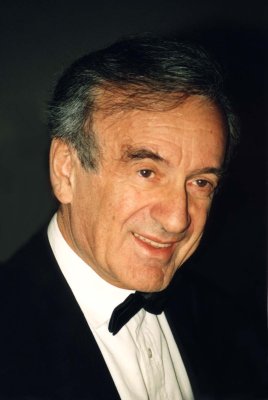
Elie Wiesel

Writer and human rights advocate; Nobel Peace Prize laureate, 1986

Recorded said elsewhere, not written here
It went from publisher to publisher to publisher. All of them refused it. They gave the same reasons, until a small publisher picked it up. From 1960 to 1963, three years, it didn’t sell 1500 copies. Nobody wanted to read it. It doesn’t matter. I am not here to sell, I’m here to write.

Academy of Achievement recorded interview, American Academy of Achievement, 29 June 1996 source ↗

Others on this question

View all 37 →
Linus Torvalds Creator of the Linux kernel and of Git
The way I work is — I want to not have external stimulation. You can kind of see, on the walls are this light green. I'm told that at mental institutions they use that on the walls. It's like a calming color, it's not something that really stimulates you. What you can't see is the computer here, you only see the screen, but the main thing I worry about in my computer is — it doesn't have to be big and powerful, although I like that — it really has to be completely silent. I know people who work for Google and they have their own small data center at home, and I don't do that. My office is the most boring office you'll ever see. And I sit there alone in the quiet. If the cat comes up, it sits in my lap. And I want to hear the cat purring, not the sound of the fans in the computer.
Recorded Chris Anderson, TED2016, Vancouver, TED (transcript of the TED2016 interview), February 2016 source ↗
Warren Buffett Chairman and chief executive of Berkshire Hathaway, 1970–2025
Charlie and I decided long ago that in an investment lifetime it's just too hard to make hundreds of smart decisions. That judgment became ever more compelling as Berkshire's capital mushroomed and the universe of investments that could significantly affect our results shrank dramatically. Therefore, we adopted a strategy that required our being smart - and not too smart at that - only a very few times. Indeed, we'll now settle for one good idea a year. (Charlie says it's my turn.)
Recorded His letter to Berkshire Hathaway shareholders in the 1993 annual report, Berkshire Hathaway Inc., February 1994 source ↗
Mario Molina Atmospheric chemist; Nobel laureate in Chemistry, 1995
It’s easy to try to exaggerate the problems just to get more attention. So for me, it was very clear that the best way to deal with that was to do the best science that I was capable of doing.
Recorded Academy of Achievement interview, Sun Valley, Idaho, 29 June 1996 source ↗
Ursula K. Le Guin Novelist, poet and essayist
I’ve had a long career as a writer, and a good one, in good company. Here at the end of it, I don’t want to watch American literature get sold down the river. We who live by writing and publishing want and should demand our fair share of the proceeds; but the name of our beautiful reward isn’t profit. Its name is freedom.
Recorded National Book Awards ceremony, New York, 19 November 2014, ursulakleguin.com (the author's own site), 19 November 2014 source ↗

More from Elie Wiesel

View profile →
Question Which writers or artists most influenced your work? Taste & recommendation
Well, naturally, my grandfather. He was a Hasid, meaning a member of the Hasidic community, and I loved him, I adored him. So thanks to him, I became a Hasid too. And my mother — who actually continued his tradition — she’s the one who brought me to Hasidic Masters. And all the stories I tell now — I’ve written so many books with Hasidic tales — these are not mine, these are theirs, my mother’s and my grandfather’s. My father taught me how to reason, how to reach my mind. My soul belonged to my grandfather and my mother. They enriched me, of course. They influenced me profoundly, to this day. When I write, I have the feeling, literally, physically, that one of them is behind my back, looking over my shoulder and reading what I’m writing. I’m terribly afraid of their judgment.
Recorded Academy of Achievement interview, Sun Valley, Idaho, 29 June 1996 source ↗
Question What is the hardest thing that has happened to you, and what did you carry out of it? Failure & regret
After the war — I was 15 when I entered the camp, I was 16 when I left it, and all of a sudden you become an orphan and you have no one. I had a little sister and I knew, with my mother the first night, that they were swept away by fire. My older sisters I discovered by accident after the war in Paris, where I was in an orphanage. But to be an orphan — you can become an orphan at 50, you are still an orphan. Very often I think of my father and my mother. At any important moment in my life, they are there, thinking, “What an injustice.”
Recorded Academy of Achievement recorded interview, American Academy of Achievement, 29 June 1996 source ↗
Question Which book changed the way you think, and what did it change? Taste & recommendation
I remember the awakening that occurred in me when I read, for the first time, Franz Kafka. ... That morning I was happy. I wanted to run out and embrace them, all these garbage collectors, because they taught me that there was another world than the world of Kafka, which is absurd and desperate, and despairing.
Recorded Academy of Achievement interview, 29 June 1996 source ↗

More on values & belief

Also answered this

Barack Obama, Edmund Hillary, Alessia Cara, Annie Proulx, Chuck Jones, Christiane Nüsslein-Volhard

Search the directory for somebody in particular.

Explore further

Report this answer